
I kept looking at the shoebox.
It was still closed.
That detail mattered.
Because there was a difference between having something in front of me and knowing what it meant.
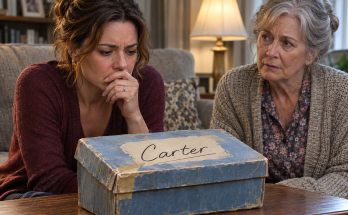
I could see the old blue cardboard.
I could see the repaired corner.
I could see the writing across the lid.
But I couldn't see the reason Patricia had brought it.
And I couldn't see whatever connection she believed existed between the box and Elora's stay.
I had spent the last few minutes trying to fill in those gaps myself.
That wasn't helping.
Every possibility led to another question.
Every question reminded me of something I hadn't known.
And every unanswered thought made the four weeks with Elora feel more distant from the uncomplicated memory I'd expected to keep.
I had believed the arrangement was finished.
Now I was beginning to understand that it might not be finished for me.
Not emotionally.
Not until I understood what Patricia was trying to tell me.
I didn't know whether the explanation would be painful.
I didn't know whether it would change how I saw Elora.
I didn't even know whether Patricia's interpretation was correct.
But the uncertainty had become impossible to ignore.
I thought again about the day Elora had come to stay.
She was recovering from a broken leg.
That was why she needed assistance.
Her three children had declined to care for her.
That was why she had no help from them.
And I was willing to take her in.
That was my decision.
I had made it because I cared about her.
I didn't regret that.
Even now, with Patricia beside me and the shoebox on the table, I couldn't bring myself to regret helping an injured woman.
I wouldn't pretend my kindness had been a mistake just because I was afraid of learning something uncomfortable.
But I was starting to question whether kindness and trust had become tangled together in my mind.
I had offered care.
I had also assumed complete honesty.
Those were different things.
I had never demanded that Elora tell me every private thought she had.
I had never expected to know everything about her life.
And I had never treated her stay as an opportunity to reopen the history of my marriage.
I wanted her to recover.
That was all.
But Patricia's warning suggested there had been something else involved.
I needed to know what that something was before deciding how I felt.
I had to resist the urge to make the situation simpler than it really was.
Elora could have needed help and still had another reason for coming.
Those two possibilities weren't automatically contradictory.
An injury could be genuine.
A relationship could be affectionate.
And a person could still keep something private.
I didn't know whether that was what had happened here.
But I had to acknowledge the possibility.
It was the only way I could listen without turning the conversation into an argument before it had properly begun.
I thought about Patricia's timing again.
Elora had been gone only a few hours.
That was all.
And already my neighbor had come to me.
I wanted to know why.
Had something made her choose that moment?
Was there a reason she hadn't spoken earlier?
Was she certain Elora would not be there?
I didn't know.
And it would have been unfair to make an accusation out of those questions.
I looked toward the hallway.
I couldn't see the spare bedroom from where I stood.
But I knew exactly where it was.
For four weeks, I had thought about that space as Elora's place to recover.
Now I couldn't help connecting it with Patricia's warning.
She had glanced that way before coming inside.
Perhaps that was important.
Perhaps it wasn't.
I didn't know.
I was tired of not knowing.
But I was even more tired of making guesses.
I returned my attention to the living room.
The coffee table had always been an ordinary part of my home.
Now the shoebox occupied its center.
I found myself studying the tape.
It had yellowed with age.
Someone had repaired the damaged corner rather than discarding the box.
I wondered whether that meant the box had been worth keeping.
Then I caught myself.
Of course someone had kept it.
It was sitting in front of me.
But why they kept it was still unknown.
I couldn't take the existence of the box as proof of a particular motive.
The same was true of the name.
My maiden name was written on the lid.
That was a fact.
Anything beyond that required an explanation.
I thought about how easily a person could turn a few facts into a complete story.
The mind wants things to make sense.
It searches for patterns.
It connects details.
And sometimes it fills the empty spaces with whatever explanation seems most frightening.
I didn't want to do that.
Not with Elora.
Not with Patricia.
Not with the life I'd worked to rebuild after my divorce.
I had already lived through enough pain caused by assumptions and expectations.
I wanted to be careful.
But being careful didn't mean pretending everything was fine.
I knew that too.
Patricia had brought me a serious concern.
She deserved the chance to explain it.
And I deserved to understand what she meant.
I looked at her.
For years, she had been a familiar part of my neighborhood.
A woman who worked among her roses in the morning and read on her porch in the evening.
A woman I had never known to spread rumors.
That history gave her words weight.
But it didn't make every conclusion automatically true.
I needed to listen to the facts behind her concern.
I needed to know what the shoebox had to do with Elora.
And I needed to understand why my old name was written on it.
Those were the questions that mattered.
Everything else could wait.
I thought about the word family.
It had meant different things to me at different times.
During my marriage, Elora had been my mother-in-law.
After the divorce, she had become my former mother-in-law.
But the word former had never fully described the affection between us.
We had remained close.
That closeness had helped me believe something good could survive a difficult ending.
I didn't want to lose that belief.
And I didn't want to discover that I had been wrong about Elora.
But the truth would not become less true because I was reluctant to hear it.
I had to accept that.
Whatever Patricia knew, I would have to hear it as it was.
Not soften it before she spoke.
Not exaggerate it afterward.
And not use it to rewrite every ordinary moment from the previous month.
Elora had needed help.
I had helped her.
Those facts would remain.
If there was something more to the story, it would have to stand alongside them.
I couldn't know what that meant yet.
I looked at the shoebox again.
My name remained visible.
It was strange to think that the writing on an old lid could make me feel so disconnected from my own understanding of the past.
The name was familiar.
The situation wasn't.
I remembered how confidently I had opened my home to Elora.
I had trusted our relationship.
I had trusted my reasons for helping.
And I had trusted that I understood why she was there.
Now I could see that those three kinds of trust were not identical.
The first concerned our history.
The second concerned my own intentions.
The third concerned hers.
And I had never actually asked enough to know the third.
That admission hurt.
But it also made the next step clear.
I didn't need to decide whether Elora had betrayed me.
I didn't have the information to make that judgment.
I didn't need to decide whether Patricia was mistaken.
I didn't know enough for that either.
I needed to understand the connection between the woman who had stayed in my house and the object now resting on my table.
I looked toward the hallway once more.
The spare bedroom was empty.
For four weeks, it had held someone I cared about.
Now it held only the memory of her stay.
And that memory was no longer as simple as it had been.
I turned back to Patricia.
I wanted to hear everything she could actually tell me.
I wanted to know what she knew, how she knew it, and why she believed Elora had planned her visit.
Most of all, I wanted an explanation for the shoebox.
I didn't want another possibility.
I wanted something I could understand.
Until then, I refused to condemn Elora.
But I also refused to ignore the questions.
The box remained on the coffee table between us.
Its lid still bore my maiden name.
And whatever Patricia had come to explain, I knew I could no longer be satisfied with the belief that Elora had stayed in my home for one simple reason.
Click here to continue reading: PART 9: I Wanted to Believe Elora Had Been Honest With Me, but the Old Shoebox Forced Me to Face Everything I Still Didn’t Know
I Took In My Former Mother-in-Law When Her Own Children Wouldn’t Help, Never Imagining She Had Another Reason for Coming
Part 8 of 10

One Comment on “PART 8 – I Finally Understood That Caring for Elora Had Never Been the Mistake, but I Could No Longer Ignore the Questions Patricia Had Brought”