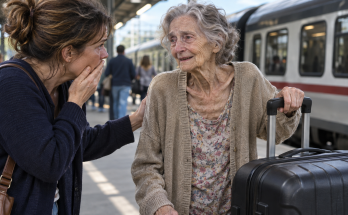
I used to think the frightening part of growing older was watching your body change.
Now I understood that there was something else.
Sometimes the people who love you most don't know what you're going through.
And sometimes they cannot help because they don't know what has happened.
That was the position I found myself in with my mother.
She was eighty years old.
She had gone away to visit Margaret.
She had returned seven days later looking alarmingly thin.
And I still didn't know what had happened during the visit.
I wanted an ending I could understand.
A simple explanation.
A clear answer.
Something that would make all the pieces fit together.
But I didn't have one.
Not yet.
And I was finally beginning to accept that I couldn't invent one simply because the uncertainty frightened me.
I thought about the man on the telephone.
His words had been so ordinary.
Margaret hadn't lived there for eight years.
He had probably answered without realizing how much the information would mean to me.
I had called expecting reassurance.
Instead, I received a fact that didn't fit my understanding of the visit.
At first, I wanted to treat that contradiction as the answer to everything.
But it wasn't.
It told me the number was associated with an address Margaret had apparently left years earlier.
It didn't tell me where she lived now.
It didn't tell me whether Mom had visited her elsewhere.
It didn't tell me what happened during the seven days.
And it didn't tell me why my mother had returned looking so thin.
Those questions remained open.
I had to be honest about that.
I couldn't claim to know more than I did.
I couldn't blame Margaret.
I couldn't accuse my mother of lying.
I couldn't decide that the suitcase contained something important without seeing inside it.
And I couldn't pretend that an outdated telephone number proved something terrible.
I wanted the truth.
But wanting it wasn't the same as having it.
That distinction had become painfully important.
I thought about my mother before she left.
The familiar woman who enjoyed baking.
The one who always looked forward to Sunday dinner.
The cheerful woman whose full cheeks and comfortable figure had been part of how I recognized her.
I had taken those details for granted.
Not because I didn't love her.
Because I assumed they would remain familiar.
I never expected one week to change the way I looked at her.
But it had.
At the train station, I had felt something I didn't have a name for.
It wasn't simply shock.
It wasn't simply worry.
It was the sudden realization that I couldn't protect her from everything.
I had known that intellectually.
Everyone knows it.
But knowing something and seeing it happen are very different experiences.
I had looked at Mom and wanted to make the problem disappear.
I wanted her cheeks to look full again.
I wanted her clothes to fit.
I wanted her to smile without effort.
And I wanted her to tell me that everything was fine in a way I could believe.
Instead, she gave me a brief explanation about stomach trouble.
I wished that had been enough.
It wasn't.
I had never seen such a frightening change in her appearance over such a short period.
Seven days.
I returned to that number again and again.
It was impossible for me to understand how a single week could leave her looking so different.
I wasn't a doctor.
I knew that.
I couldn't diagnose her by appearance.
But I knew she needed more attention than I could provide through worry alone.
I had wanted to take her to the hospital.
She refused.
That refusal remained one of the most difficult parts of the entire experience.
Because I loved her.
And because she was still entitled to make decisions about her own life.
Those two truths didn't always sit comfortably together.
I couldn't pretend she was a child simply because I was frightened.
She was my mother.
She had raised me.
She had lived eighty years.
She had earned the right to be treated with respect.
But I couldn't use respect as an excuse to ignore her condition.
That was the balance I had been trying to find since she returned.
I didn't know whether I had managed it well.
I only knew I was trying.
I thought about the blue travel bag again.
The little bag she had taken for the week.
It was such a harmless object.
I would never have expected it to become something I remembered so clearly.
But I did.
It belonged to the last ordinary picture I had of her before the visit.
Then came the enormous black suitcase.
The one she said Margaret had lent her.
The one she held firmly when I asked about the missing bag.
The one she carried straight into her bedroom.
The one she placed behind a locked door.
I could not tell whether any of those details meant more than they appeared to.
Perhaps the entire luggage story was exactly as she explained it.
Perhaps her blue bag had broken.
Perhaps Margaret had kindly offered a replacement.
I had no proof otherwise.
That was important.
I didn't want my fear to turn an ordinary kindness into something sinister.
But I couldn't ignore the way the suitcase had become connected with the question of where Mom had really spent the week.
It was the only visible object she brought home that seemed unfamiliar.
And I had attached my worry to it.
I understood that now.
The suitcase itself might be entirely innocent.
But the questions surrounding the visit remained.
I thought about Margaret.
The woman whose name had been part of my mother's life for decades.
They had been childhood friends.
Then twenty years passed without seeing each other.
And finally Mom had wanted to spend a week together.
I had been happy about it.
I still remembered how uncomplicated that happiness felt.
I hadn't demanded to know every detail.
I hadn't questioned why she wanted to go.
I simply thought it would be good for her.
I wanted her to enjoy time with someone who remembered her younger years.
Someone who knew her before she became my mother.
Someone who had shared a different part of her life.
There was something beautiful about that possibility.
And I didn't want the uncertainty afterward to erase it.
Even now, I couldn't say the decision to visit Margaret had been wrong.
I didn't know enough.
Perhaps the visit had been everything Mom hoped for until she became ill.
Perhaps Margaret had moved to an address I didn't know.
Perhaps there was a simple explanation for the telephone call.
I needed to leave room for those possibilities.
Because the alternative was inventing a story.
And that would not help my mother.
I remembered the man saying Margaret had moved away eight years earlier.
It was the one piece of information that challenged what I had assumed about the location.
But it did not establish where Mom had actually stayed.
That was the truth.
I didn't know where Margaret currently lived.
I didn't know whether the women had arranged the reunion at a different address.
And I didn't know whether there had been a misunderstanding about the telephone number.
I had checked the digits.
They matched the information I possessed.
That confirmed I had called the intended number.
It did not confirm that the number was current.
I had to recognize the difference.
Sometimes one fact can overturn an assumption without explaining everything else.
That was what had happened.
The phone call had forced me to question what I believed.
But it hadn't supplied the missing account.
I wanted to know more.
Of course I did.
I wanted to speak with Margaret herself.
I wanted to learn how Mom had spent the week.
I wanted to understand when she became ill.
I wanted to know why her blue bag had been replaced.
And I wanted to understand why she seemed so reluctant to talk.
Those questions were reasonable.
But until someone answered them, they remained questions.
I could not honestly turn them into a finished story.
That was difficult to accept.
I have always preferred problems that can be solved.
If something breaks, you repair it.
If something is misplaced, you look for it.
If information is outdated, you try to find the current details.
But the situation with Mom was not so simple.
There was a person involved.
A person who might be ill.
A person who had the right to privacy.
A person I loved more than any explanation I might eventually receive.
I had to remember that.
I couldn't become so focused on finding out what happened that I forgot how she felt.
I couldn't make the black suitcase more important than her health.
And I couldn't let my fear turn our relationship into a series of accusations.
She deserved better.
I thought about Sunday dinner.
The familiar routine.
The food.
The ordinary pleasure Mom found in bringing people together.
I wondered why such simple memories had become so precious to me after the trip.
Perhaps because they represented a time when I didn't worry so much.
A time when I saw her as the dependable person she had always been.
A time when I didn't imagine that her health could change in seven days.
I realized how much I had depended on that image of her.
She was the cheerful mother.
The one who baked.
The one who never missed our weekly meal.
I had unconsciously expected her to remain that person forever.
And I hadn't prepared myself for the possibility that one day she might need me in ways she didn't want to admit.
That was the truth I could finally face.
Not a secret about Margaret.
Not an explanation of the suitcase.
But a truth about my own expectations.
I had mistaken familiarity for certainty.
I believed that because I knew my mother so well, I would recognize every problem that mattered.
I believed that because she was cheerful, she would tell me if something serious happened.
And I believed that because the trip sounded safe, I didn't need to think much about what might go wrong.
Now I understood that none of those beliefs guaranteed anything.
People can suffer without explaining it.
People can become ill without warning.
And even the closest family members can have experiences that others don't fully understand.
I didn't like learning that.
But I couldn't deny it.
The person who returned from the train station was still my mother.
Even though she looked different.
Even though she was quieter about the trip than I wanted.
Even though I couldn't explain the luggage or reach Margaret at the number I had.
She hadn't stopped being the woman I loved.
She hadn't stopped deserving my respect.
And she hadn't stopped being someone whose well-being mattered more than my curiosity.
That thought gave me something solid to hold on to.
I didn't have all the answers.
But I knew what mattered.
Her health came first.
Her dignity mattered.
And any attempt to understand the visit had to begin with care rather than accusation.
I wished I could say that I discovered exactly what happened during those seven days.
I wished I could explain the black suitcase.
I wished I could tell you where Margaret had moved.
I wished I knew why Mom's condition had changed so dramatically.
But I couldn't.
The information I had did not establish those answers.
And I would rather admit that than claim certainty about something I didn't know.
What I could say was that the visit had changed me.
I no longer treated my mother's familiar routines as proof that everything was fine.
I no longer assumed a short trip couldn't have serious consequences.
And I no longer believed that trusting someone meant I should stop asking careful questions when their health seemed at risk.
Those changes were uncomfortable.
But they mattered.
I thought again about the station.
The moment I recognized Mom.
The shock of seeing her clothes hanging loose.
The enormous black suitcase.
Her attempt to reassure me.
And the feeling that something was wrong even before I understood what it might be.
That memory was still painful.
It probably would be for a long time.
But I didn't want it to become the only way I remembered her.
I wanted to remember the mother who enjoyed baking.
The woman who valued Sunday dinner.
The eighty-year-old who still wanted to reconnect with a childhood friend.
Those things were real too.
I needed to hold on to them.
The unanswered questions could not erase an entire lifetime.
And my fear should not be allowed to do that either.
I thought about the sound of the bedroom lock.
It had unsettled me when I first heard it.
Now I tried to understand it differently.
A closed door was not automatically evidence of a secret.
A person could want privacy for many reasons.
I did not know Mom's reason.
And I could not discover it by assuming the worst.
The suitcase remained hers to explain.
The visit remained something I needed to understand.
But neither gave me permission to forget that she was a person with her own boundaries.
I still wanted answers.
I still wanted to know whether Margaret had truly seen her.
I still wanted to understand what had happened to the blue bag.
I still wanted to know why the old telephone number led to someone who said Margaret had moved years before.
But I was no longer willing to let those questions become accusations without evidence.
I had to be patient with what I didn't know.
And serious about what I did.
Mom had returned looking frighteningly unwell.
That was enough reason for concern.
No mystery was required to make it important.
I wanted her to recover.
I wanted her to feel safe.
I wanted her to understand that she didn't need to minimize her condition to protect me from worry.
And I wanted to be someone she could speak to without fear of being judged.
Those wishes were simple.
They didn't provide a dramatic ending.
But they were the most important things I could honestly say.
I looked back at the week that had changed the way I saw my mother's life.
Seven days.
A visit to an old friend.
A missing blue travel bag.
A large black suitcase.
A locked bedroom door.
And a telephone call that revealed Margaret had moved from that address eight years earlier.
I could still remember every detail.
But I could not explain them all.
I didn't know the final truth of the visit.
I didn't know what the suitcase contained.
I didn't know whether my mother had been withholding something or simply offering the limited explanation she believed was enough.
And I couldn't pretend those answers had been established.
What remained certain was my love for her.
And my fear when I saw how much she had changed.
I had expected to meet a cheerful woman returning from a reunion.
Instead, I met my mother looking so thin that I barely recognized her.
The difference shook me.
It made me question assumptions I had carried for years.
And it taught me that being close to someone doesn't mean knowing everything they have lived through.
My mother had returned home.
I was grateful for that.
But the seven days were not fully explained.
And I had to accept the hardest part.
Sometimes love gives you the courage to ask difficult questions.
It does not always give you the answers.
The End
Read more original stories on Feel Every Story.
I Thought My Mother Was Taking a Harmless Trip to See an Old Friend, Until I Saw What Seven Days Had Done to Her
Part 10 of 10