I didn't sleep much after Rosa left.
Every time I closed my eyes, I saw the hotel lobby.
The black piano.
The fireplace.
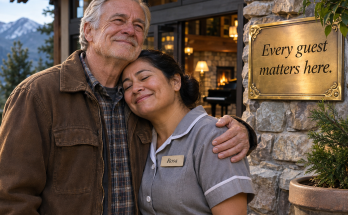
The plant covering Beatrice's plaque.
And Preston Shaw standing there, telling me that a fee I had personally eliminated was company policy.
I kept returning to that moment.
Not because he had insulted me.
Because he had lied about something I could verify.
That distinction mattered.
A rude manager could be corrected.
A careless employee could be retrained.
But a manager knowingly misrepresenting company policy was a different problem.
And Preston had done it while looking directly at me.
I shifted in the driver's seat.
My back hurt.
My legs were stiff.
The blanket Rosa had brought was the only thing making the cold bearable.
I looked at the clock.
Still early.
I thought about room 312.
Its balcony overlooked the valley.
Beatrice and I had stayed there every anniversary.
We had spent quiet evenings looking down at the lights below the mountain.
She used to sit near the balcony doors with a cup of tea.
Sometimes we talked.
Sometimes we said nothing.
I had wanted one night in that room.
One night to remember her without feeling overwhelmed.
Instead, I had spent the night in my truck.
I wasn't angry about missing the room anymore.
I was angry that someone else could have experienced the same treatment without having any way to challenge it.
I opened my email again.
Preston's message was still there.
The confirmation was dated four months earlier.
He had received the instruction.
He had acknowledged it.
And according to his reply, he had carried it out.
I read the words carefully.
Then I looked at the estimate.
The two documents contradicted each other.
There was no complicated interpretation.
The fee had been prohibited.
Yet it appeared on my bill.
I took another photograph.
This time, I placed the estimate beside the email displayed on my phone.
I wanted the information preserved.
Not because I expected anyone to destroy the original immediately.
Because experience had taught me that arguments became much easier when facts were documented.
I had built my business with Beatrice by learning that lesson the hard way.
In our first roadside inn, we kept handwritten records.
Reservations.
Payments.
Repairs.
Guest complaints.
Every important detail went into a book.
Beatrice was particular about it.
"Memory changes," she used to say. "Paper doesn't."
I smiled at the thought.
She would have approved of my photographs.
She would not have approved of the situation that made them necessary.
As the night slowly gave way to morning, I thought about what Rosa had told me.
Preston had a list.
Mallory judged guests by their appearance.
Some reservations were refused.
Others became much more expensive.
Staff members who questioned those decisions were warned about their jobs.
Those were serious allegations.
I couldn't treat them as proven simply because I believed Rosa.
I needed to examine the records.
I needed to determine whether the charges were legitimate.
I needed to know how frequently reservations were changed after guests arrived.
And I needed to establish whether Preston had been acting alone.
That last question bothered me.
It was tempting to put all the blame on one man.
Preston had been in charge.
He had supported Mallory.
He had ordered me removed.
But I had been absent.
I had trusted reports.
I had assumed that because the financial statements were arriving and the rooms were being rented, the business was operating properly.
That was my responsibility.
I couldn't pretend otherwise.
I had been avoiding Cedar Summit for three years.
The reason was understandable.
Beatrice had died.
Returning to the lodge meant returning to memories I wasn't ready to face.
But grief didn't excuse every decision I made afterward.
I was still the owner.
People still worked for me.
Guests still trusted our name.
And for at least part of that time, I had allowed others to decide what our company stood for.
That thought stayed with me.
The sky began to lighten beyond the mountains.
The storm was no longer as violent.
Water still ran across the parking lot.
My pickup looked even older in the gray morning light.
I studied the rust near the driver's door.
It had never embarrassed me before.
It didn't embarrass me now.
The truck ran well.
I liked it.
I had no reason to replace it simply to impress strangers.
But I wondered what Preston would have done if I had arrived in an expensive vehicle.
Would he have greeted me differently?
Would Mallory have honored the one-hundred-eighty-dollar reservation?
Would the extra charges have disappeared?
I knew what Rosa suspected.
And after my own experience, I suspected the same thing.
Still, suspicion wasn't evidence.
I reminded myself of that several times.
There was another matter that bothered me.
Eli.
The security officer had hesitated when Preston ordered him to remove me.
He had looked toward the storm.
He had recognized that sending an older man outside could be dangerous.
Yet he had followed the instruction.
I wasn't sure what to make of him.
He had not been cruel.
He had not insulted me.
But he hadn't stopped Preston either.
I understood why.
Employees depend on their wages.
Security officers are expected to follow management instructions.
Disobeying an order can have consequences.
I didn't know Eli's circumstances.
So I decided not to judge him until I knew more.
Then I thought about Mallory.
She had been openly dismissive.
She had looked at my truck and decided what I could afford.
Her conduct was unacceptable.
But I wanted to know who had taught her that certain guests deserved different treatment.
Had Preston created the policy?
Had Mallory helped him?
Or had the behavior become so normal inside the lodge that neither of them considered it wrong?
Those questions were important.
I didn't want to react out of wounded pride.
I wanted to understand what needed to change.
I looked again at Beatrice's plaque through the entrance windows.
The plant still stood in front of it.
I remembered moving the leaves aside the previous evening.
The words were probably hidden again.
That bothered me more than it should have.
The plaque was brass.
Not particularly large.
Not worth much money.
But Beatrice had chosen every letter.
It represented the promise we wanted the lodge to make.
Now it was almost invisible.
I wondered whether that was accidental.
Perhaps someone had simply moved the plant.
Perhaps the arrangement meant nothing.
But after Rosa's account, the image stayed in my mind.
A promise covered by leaves.
A manager who judged guests by wealth.
A housekeeper afraid of losing her job.
I didn't need to invent a meaning.
The contrast was obvious enough.
I picked up Rosa's thermos.
There was still some tea left.
I poured a little into the cup and held it between my hands.
It had cooled.
But I drank it anyway.
I remembered her saying she had worked at Cedar Summit for almost nine years.
Nine years of cleaning rooms.
Nine years of carrying supplies.
Nine years of preparing spaces that guests would enjoy for a night or two before leaving.
She had been there long enough to know the difference between the lodge's past and its present.
And she had noticed the change.
I thought about asking her to put everything in writing.
Then I stopped myself.
She had already risked enough.
I didn't even know whether she would be willing to speak again.
The first priority was making sure no one retaliated against her.
I couldn't promise that without taking control of the situation.
And I couldn't take control without revealing who I was.
That decision was approaching.
I had stayed anonymous because I wanted to see how an ordinary guest was treated.
I had seen it.
I had remained anonymous because I wanted to know whether my experience was unusual.
Rosa had given me reason to believe it wasn't.
There was no value in prolonging the situation merely to satisfy my curiosity.
I had to decide when the evidence was sufficient to begin acting.
By morning, I had settled on one thing.
I would not make an accusation in anger.
I would separate what I knew from what I suspected.
I knew that my reservation had been quoted at one hundred eighty dollars.
I knew I had received an estimate for fourteen hundred.
I knew the estimate included a fee I had eliminated.
I knew Preston had falsely described that fee as corporate policy.
I knew he had refused to honor the reservation and had ordered security to escort me outside during dangerous weather.
And I knew Rosa had told me about troubling practices involving guest selection and employee intimidation.
Everything beyond those facts needed examination.
I looked at the documents on my phone.
They were enough to justify a formal review.
Not enough to establish every conclusion.
But enough to stop pretending nothing was wrong.
I opened my contacts.
The headquarters number was there.
I had considered calling it several times during the night.
Each time, I had stopped.
Now I looked at it differently.
I wasn't calling because I wanted a better room.
I wasn't calling because Preston had embarrassed me.
I was considering the call because the people working inside Cedar Summit Lodge needed someone to examine what was happening.
And because the guests who had been turned away deserved to have their complaints taken seriously.
I held the phone for a moment.
Then I put it down.
Before speaking to anyone, I wanted to arrange the facts clearly.
That was how Beatrice and I had handled difficult decisions.
Understand the problem.
Check the records.
Act on what the evidence shows.
I began writing a list in the notes on my phone.
The reservation for room 312.
The advertised rate.
The additional charges.
Preston's confirmation about the preservation fee.
Mallory's statements.
The manager's refusal.
The security officer.
Rosa's account.
I looked over the list when I finished.
There was no need to add anything dramatic.
The facts were troubling enough.
Outside, the rain continued to weaken.
I could see the lodge more clearly now.
I had spent a miserable night watching that building.
But the discomfort no longer mattered.
I had something useful to do.
I was ready to stop being the silent man in the pickup and begin examining the decisions being made in my name.
Click here to continue reading: PART 7: I Had Spent Three Years Avoiding the Lodge Because of My Wife’s Death, but I Could No Longer Avoid My Responsibility
I Arrived at the Hotel I Owned During a Terrible Storm, but the Woman Behind the Desk Treated Me Like a Stranger
Part 6 of 10