I used to believe that a mother could never become a stranger in her own son's home.
At seventy-one, I learned how wrong I was.
My name is Margaret Briggs.
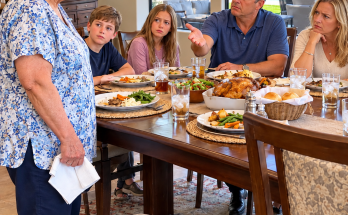
I was sitting at my son's dinner table in Scottsdale, Arizona, when he asked me a question I had been dreading for months.
I had spent the afternoon cooking his family's dinner.
Roast chicken with lemon and rosemary.
Small red potatoes, browned around the edges.
It was the way my late husband loved it.
My son, Daniel, was carving the chicken when he glanced at his wife.
Renee gave him a small nod.
Then he turned toward me.
"Mom, have you decided when you're going to find somewhere else to live?"
I looked at the microwave clock behind him.
6:18.
Thursday evening.
October.
My granddaughter stopped eating.
My grandson lowered his eyes.
And I understood something that hurt worse than Daniel's question.
Everyone else had known this conversation was coming.
I was the only one who hadn't been included.
But to understand why I sat there without answering, you need to know what I had already given up.
And what Daniel didn't know about me.
I had been married to Harold Briggs for forty-four years.
We met in Flagstaff in 1979.
I was twenty-five, working as a bookkeeper for a lumber company.
Harold was twenty-six.
He taught shop classes at a high school and usually had sawdust somewhere on his clothes.
The first time he came into the lumber yard, he argued with me about the price of some boards.
He wasn't angry.
He just enjoyed giving me trouble.
He stayed much longer than anybody needed to stay for lumber.
Before leaving, he asked whether I would have dinner with him.
I refused.
The following week, he returned to buy more boards.
I knew he didn't need them.
He knew I knew.
When he asked me out again, I agreed.
That was Harold.
He never made an important thing complicated.
We married and eventually moved to Tucson in 1984.
He found work teaching woodshop at Catalina High School.
I handled bookkeeping for a plumbing company.
We weren't wealthy.
We watched prices at the grocery store and thought carefully before replacing anything that still worked.
But we saved enough to buy a small house on East Linden Street.
Fifty-eight thousand dollars.
Two bedrooms.
A carport.
A front porch with a ceiling fan that never turned quite straight.
I loved that house before we finished carrying in our boxes.
The first thing I did was paint the kitchen yellow.
Harold came home, stood in the doorway, and stared.
"Maggie, it looks like somebody painted the whole room with lemonade."
I held up the roller.
"Then you can start painting the cabinets white."
He laughed.
And he did.
Later, he built a breakfast nook beside the kitchen window.
He used oak that had come out of an old church in Bisbee.
The wood wasn't perfect.
Neither was the table.
That made it ours.
One evening, while I was washing dishes, I found Harold underneath the table with a carving tool.
I asked what he was doing.
"Something nobody needs to see."
Naturally, I got down on my knees and looked.
He had carved our initials.
H.B. + M.B. 1984.
I ran my fingers over the marks.
He looked embarrassed.
I kissed him anyway.
Outside, I planted six rose bushes along the front walkway.
Mister Lincoln.
Double Delight.
Peace.
The Arizona heat made them difficult to keep alive.
Harold told me I had chosen the wrong climate for roses.
I told him I had chosen the wrong husband for gardening advice.
Every morning before the sun grew fierce, I carried water to those bushes.
They survived.
So did we.
Through job changes.
Through bills.
Through arguments that seemed important until we forgot what started them.
There was one thing Harold never skipped.
His morning tea.
Earl Grey.
Honey.
Just enough milk to change the color.
He drank it from a blue ceramic mug I bought him in Tubac in 1986.
Every weekday, he carried that mug onto our porch and sat in the wooden rocker he had made himself.
One cup before leaving for work.
On Saturdays and Sundays, he always had another.
I asked him about it once.
"Why do you need two cups when you're off work?"
He smiled at me.
"Because I don't have to run anywhere, Maggie."
I sat on the porch railing.
"That doesn't explain the second one."
He looked toward our roses.
"The first gets me started. The next lets me enjoy being home."
I remember how casually he said it.
As though everybody understood.
A few days later, I heard him working in the garage.
When he finished, he brought out a piece of mesquite with words burned into the wood.
EVERY HOUSE NEEDS A PORCH FOR THE SECOND CUP.
He hung it above his rocking chair.
I thought it was a little sentimental.
I loved it anyway.
And for the next thirty-seven years, that sign remained on our porch.
Our son, Daniel, grew up beneath it.
He was born in 1987.
Our only child.
We had hoped for another, but life didn't give us one.
Daniel was quiet when he was little.
Always asking questions.
Always watching his father build things.
On Saturday mornings, he sat on the porch steps with a juice box while Harold drank tea.
When Daniel was six, Harold started making him read the wooden sign.
He struggled with some of the words.
Harold never rushed him.
After Daniel finished, he asked what it meant.
Harold pointed toward the house.
"It means a good home makes you glad to come back."
Daniel thought about that.
Then he drank his juice.
For years, it became their Saturday habit.
Harold drank tea.
Daniel read the sign.
I watched them from the kitchen.
I didn't realize those mornings would become some of the most valuable memories I owned.
Daniel grew older.
He graduated.
He attended Arizona State University and studied business.
That was where he met Renee.
She was studying nursing.
Renee was pretty, intelligent, and more organized than anybody I knew.
She carried a planner with different colored tabs.
Harold liked to tease her about it.
"Does that thing tell you when to breathe?"
She would smile.
"Only on busy days."
They married in 2012.
Daniel went into commercial real estate.
Renee eventually became a nurse manager.
They bought a large house in north Scottsdale.
Three-car garage.
Swimming pool.
A gate with a guard at the entrance to the neighborhood.
I was happy for them.
Harold was too.
But he never felt comfortable there.
During one visit, he walked through their beautiful house and asked Daniel where he sat in the mornings.
Daniel laughed.
"Dad, mornings are when I get things done."
Harold nodded.
He didn't argue.
He only looked around as though something important was missing.
Years passed.
Daniel and Renee gave us two wonderful grandchildren.
Chloe, with long dark hair and a laugh that sounded like Harold's.
Caleb, with freckles and a fascination for anything that crawled through the garden.
We visited for birthdays and holidays.
We loved those children.
And I thought our family was doing well.
Then Harold died.
It happened in March, two years before that dinner.
A Saturday morning.
He was seventy.
I had gone into the kitchen to get the honey he had forgotten.
When I came back outside, he was sitting in his rocker.
His blue mug rested near his hand.
At first, I thought he had fallen asleep.
I called his name.
No answer.
I touched his shoulder.
Nothing.
By the time I understood what had happened, I was already shouting for help.
It was a stroke.
Sudden.
There was no conversation.
No last promise.
No chance to tell him anything new.
He was simply gone.
The mug was still warm when I found him.
That detail stayed with me.
More than I wanted it to.
He had been sitting with his second cup.
Daniel drove down from Scottsdale that afternoon.
He handled everything.
The funeral home.
The paperwork.
The arrangements.
He made lists and spreadsheets because that was the way he dealt with trouble.
I let him.
I could barely remember to eat.
After the funeral, we sat together in my yellow kitchen.
At the table his father had made.
Daniel looked around the room.
"Mom, I don't think you should stay here alone."
I told him I could manage.
He mentioned the roof.
The old air conditioner.
The possibility of falling when nobody was around.
I knew he was worried.
That was what made it difficult to refuse.
Then he offered me a place with his family.
They had a casita beside the pool.
A bedroom.
A bathroom.
A separate entrance.
He said the children would be thrilled.
He said Renee had already agreed.
And he promised I could stay until I felt ready for something different.
I wanted to believe him.
I needed to believe somebody still wanted me close.
So I agreed.
I sold the house Harold and I had shared for thirty-eight years.
I left the yellow kitchen.
The six rose bushes.
The porch fan that shook whenever it ran.
The oak breakfast nook.
And the marks under the table.
H.B. + M.B. 1984.
I couldn't take Harold's rocking chair.
Renee said the casita was too small.
I understood.
Or told myself I did.
I packed my life into fourteen boxes.
The last thing I removed was the mesquite sign.
I wrapped it in an old bath towel.
Harold's blue mug went into newspaper.
I placed them both in the back of my Buick and drove to Scottsdale.
Renee welcomed me politely.
She had put clean sheets on the bed.
Daniel had bought a television for the dresser.
Chloe made a welcome sign with glitter.
Caleb wanted to know whether I could help him find lizards by the pool.
I smiled more that first week than I had since Harold died.
I thought I had made the right decision.
When Renee saw the wooden sign, she examined the wall of the casita.
Then she looked toward the garage.
"We should keep this somewhere it won't get damaged."
I followed her.
She put it on a metal shelf.
Beside holiday decorations and bottled water.
I almost asked her to bring it back.
Instead, I said thank you.
Looking back, I wish I had spoken.
Not because of the sign alone.
Because I was already learning how easily a person could make herself smaller to avoid troubling anyone.
That first Saturday, Daniel took everyone to dinner.
Renee asked me about Harold.
Chloe held my hand under the table.
Caleb drew a lizard on the paper table covering.
For one evening, I felt surrounded by the people I loved.
Later, in the restaurant bathroom, I cried.
They were grateful tears.
I believed I had found somewhere to belong.
I didn't know that belonging and being useful could become two very different things.
Click here to continue reading: PART 2: My Daughter-in-Law Slowly Turned My Retirement Into Unpaid Work, and I Overheard the Conversation My Son Never Intended Me to Hear
I Gave Up the Home My Husband Built for Us Because My Son Promised I Would Always Have a Place With His Family
Part 1 of 8