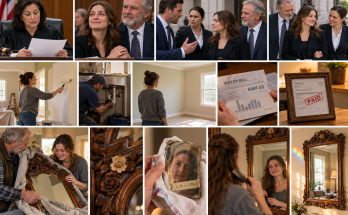
Judge Alvarez looked down at the papers in front of her.
I was still holding Dad's hand.
Across the courtroom, Brian sat beside Mr. Pruitt with his eyes fixed on the table.
Nobody spoke.
I had spent eight months wondering whether the judge would ever understand what Brian had put me through.
Now she had heard about the damage, the disputed mirror, and the conversations Brian had tried to keep from me.
But I didn't know what she would decide.
I watched her turn another page.
Then she began speaking.
She denied Brian's request to reduce my share of the remaining assets.
I didn't react immediately.
For a moment, I was afraid I'd misunderstood.
Claire leaned toward me.
“She denied his motion, Nicole.”
I looked at her.
“Really?”
Claire nodded.
I let out a breath I hadn't realized I'd been holding.
Judge Alvarez continued.
She explained how the documented property damage would be accounted for in resolving the remaining financial issues.
The drywall repairs.
The plumbing work.
The damaged bathroom subfloor.
The water heater inspection.
The wasted water.
Those expenses would be charged against Brian's portion of the settlement.
I stared at the judge.
For months, Brian had argued that I was too emotional about the house.
Now the costs of what he'd left behind were being placed where they belonged.
The judge confirmed that the house remained mine.
There would be no forced sale.
No division of its value between us.
I looked toward Claire.
She gave my hand a quick squeeze.
Then the judge continued through the remaining disputes.
The furniture.
The second car.
The savings.
The retirement accounts.
One by one, she settled the matters that had kept us returning to court for months.
I expected to feel something enormous.
Some sudden burst of happiness.
Instead, I felt tired.
I had imagined this day so many times that the real moment seemed strangely ordinary.
Judge Alvarez reviewed the final paperwork.
She signed the documents.
Then she ended the hearing.
There was no dramatic speech.
Nobody applauded.
My father didn't jump up or celebrate.
He simply sat beside me until it was time to leave.
I looked at him.
His suit collar was still crooked.
And for some reason, that made me smile.
We gathered our things.
Claire organized her papers while Dad waited for me to stand.
I looked across the courtroom once.
Brian was speaking quietly to Pruitt.
His face was tense.
He didn't look toward me.
I thought I would feel satisfied seeing him like that.
I didn't.
I just wanted to go home.
We reached the courthouse hallway before Brian caught up with us.
“Nicole, can you stop?”
I stopped walking.
I wish I could say I ignored him.
But nine years of marriage had taught me to turn when he said my name.
Claire stepped between us.
She told Brian to communicate through his attorney.
He moved around her.
His face was flushed.
The navy suit he'd worn so confidently that morning now looked rumpled.
“You've made it sound like I wrecked the entire place,” he said.
I looked at him.
Eight months earlier, I would have started arguing.
I would have explained everything again.
I would have cried.
Brian would have waited until I was upset enough to raise my voice.
Then he would have called me unreasonable.
I'd lived through that conversation too many times.
I wasn't going to have it again.
I kept my voice quiet.
“There were three holes in the walls.”
Brian shook his head.
“You can't say I made those.”
I looked directly at him.
“All those faucets were left running.”
He started to interrupt.
I continued.
“And Grandma's mirror was broken.”
His expression changed.
I didn't need him to admit anything.
I had seen the house.
I had heard Dad's account of those calls.
The judge had made her decision.
Brian stared at me.
Then his voice dropped.
“Nicole, it was only a mirror.”
I felt something settle inside me.
For months, I'd wondered whether he understood what that mirror meant.
Now I knew he did.
He had simply decided it didn't matter.
Dad stepped closer.
His shoulder touched mine.
He didn't threaten Brian.
He didn't raise his voice.
He just looked at him.
“That was the one thing she couldn't go out and buy again.”
Brian opened his mouth.
Then he looked away.
He didn't answer.
I turned toward the exit.
Dad walked on one side of me.
Claire walked on the other.
I could hear Pruitt speaking sharply behind us.
I didn't turn around.
Outside, the pavement was wet.
It had rained while we were inside.
Now the sun had come through the clouds.
Claire hugged me on the courthouse steps.
She said we'd both done well.
Then she looked at Dad.
“Next time you have important evidence, please tell me before we're standing in front of the judge.”
Dad lowered his head a little.
“Yes, ma'am.”
Claire laughed.
I laughed too.
It was the first time I'd laughed in days.
A few weeks later, the contractors returned to the house.
The holes were repaired first.
The damaged drywall was cut away.
New sections were fitted into place.
The seams were covered and sanded until I couldn't see where the openings had been.
I decided to paint the walls myself.
I bought a warm cream color called Morning Light.
I spent an entire weekend carrying paint trays from room to room.
I played classic rock on the radio.
The same kind of music Brian and I had argued about years earlier.
This time, nobody asked me to change the station.
I painted the living room.
Then the hallway.
Then I went into the guest bedroom.
For a while, I stood looking at the pale green walls.
I remembered the hopes we'd attached to that room.
The babies we'd lost.
The nights I'd spent sitting on the floor after our second miscarriage.
I still missed what might have been.
But I didn't want that room to hold only those memories.
So I painted it cream too.
When the paint dried, I stood in the doorway.
It looked like an ordinary room.
Empty.
Clean.
I didn't have to decide what it would become.
Not yet.
The plumber checked the house again.
The damaged section of the upstairs bathroom floor was replaced.
The drains and pipes were inspected.
The water heater turned out to be all right.
I was grateful for that.
At the end of the month, the water bill arrived.
I opened the envelope at the kitchen table.
Then I stared at the amount.
It was terrible.
Not quite as terrible as I'd feared, but bad enough.
For a moment, I felt that old panic.
Then I remembered the court order.
I sent the bill to Claire.
She passed it to Pruitt.
The amount was paid from Brian's share of the settlement.
Nobody argued.
When I received confirmation, I sat at the table holding the receipt.
Then I did something a little ridiculous.
I put it in a frame.
I knew it was petty.
I kept it anyway.
The house was becoming mine again.
But Grandma's mirror was still missing from the living room wall.
Dad had taken the box containing its pieces to a furniture restorer named Abe.
Abe lived two towns away.
His workshop was inside an old barn.
Dad told me the man had sawdust in his eyebrows and tools hanging from nearly every wall.
Abe examined the frame.
He believed he could repair most of it.
The split corner could be rebuilt.
He could match the walnut.
He could even replace the damaged petal on the carved rose.
I wanted to believe him.
Then I asked about the glass.
Abe became quiet.
The original mirror had been made with an old reflective backing.
Its surface had become slightly uneven over time.
That was why our reflections had always looked wavy.
Abe explained that he couldn't reproduce it exactly.
He could install modern mirror glass.
But it would look different.
I sat with the phone against my ear.
“It won't have those little waves?”
“No, honey. The new glass will be smooth.”
I thought of my grandmother standing behind me.
Her face in the old reflection.
Mine beneath it.
I wanted that image back.
But the pieces on the floor had been shattered too badly.
Finally, I told Abe to use the new glass.
He kept the mirror for almost two months.
Dad called him every week.
Sometimes twice.
I told Dad to leave the poor man alone.
He said he was just checking.
I knew better.
That mirror had belonged to his mother.
He wanted to see it whole again as much as I did.
One Sunday afternoon in December, I heard Dad's truck outside.
The familiar rattle came through the front window.
Then the engine stopped.
I looked out.
Dad was pulling something large from the back.
It was wrapped in thick moving blankets.
I opened the door before he reached the porch.
“Dad, what have you brought?”
He smiled.
“Come and see.”
He carried the bundle into the living room.
He rested it carefully against the couch.
Then he stepped back.
I knelt and pulled away the blankets.
The walnut frame was whole.
I touched the corner where it had been split.
I couldn't feel the repair.
The carved roses were beautiful.
One petal was a little lighter than the others.
I knew immediately which one Abe had replaced.
He'd done such careful work that I had to examine it closely to find the difference.
Then I looked at the glass.
It was perfectly clear.
No ripples.
No cloudy patches.
I could see myself without distortion.
I was thirty-seven.
My hair was tied in a messy bun.
I wore an old sweatshirt with paint on one sleeve.
And I was crying.
Dad watched me quietly.
Then he reached into his jacket.
“Abe saved something for you.”
He handed me a folded handkerchief.
Inside was a piece of the original glass.
About the size of my palm.
The sharp edges had been smoothed.
I lifted it carefully toward the window.
My reflection bent slightly in the old surface.
One eye looked stretched and watery.
I almost laughed.
That was the mirror I remembered.
I turned the piece over.
Abe had placed a small strip of tape on the back.
Written on it were Grandma's initials and the year.
L.M. — 1952.
I held the glass for a long time.
Then I folded the handkerchief around it.
Dad and I hung the restored mirror in its old place.
Over the same nail.
He lifted the frame.
I stood behind him and checked the position.
“A little higher.”
He moved it.
“Now toward your left.”
He shifted again.
“Not that much.”
Dad gave me a look.
“You want to hang it yourself?”
I laughed.
“No. You're doing fine.”
We adjusted it together.
When we finally stepped away, the mirror looked right.
Almost.
Dad tilted his head.
“Your grandmother would say it's crooked.”
I checked the frame.
It was slightly off.
I smiled.
“She'd be right.”
We moved it a fraction.
Then Dad went into the kitchen to make coffee.
I stayed in the living room.
I looked at the woman reflected in the clear glass.
For years, that mirror had shown me a slightly blurred version of myself.
Now there was nowhere for my reflection to hide.
I thought about Grandma.
I remembered being fifteen.
I remembered how difficult it had been to get through the mornings after Mom died.
I could almost feel Grandma's hand resting against my hair.
I went upstairs.
I found my hairbrush.
Then I returned to the living room.
I pulled the elastic from my bun.
My hair fell around my shoulders.
I began brushing.
Slowly.
Carefully.
I counted each stroke aloud.
By twenty, I was crying.
By fifty, I was smiling through the tears.
When I reached one hundred, I stopped.
I stayed there looking into the mirror.
Dad was standing in the kitchen doorway.
He held two cups of coffee.
I hadn't heard him return.
He looked at me.
“Your grandmother would be happy seeing you here.”
I wiped my face.
“Because I finally brushed my hair properly?”
Dad smiled.
“She always said you got impatient before thirty strokes.”
I laughed.
He handed me a cup.
We sat together on the couch.
Afternoon sunlight came through the blinds.
For a moment, the new glass caught the light and threw a little rainbow across the wall.
It landed near the place where Brian had damaged the drywall.
I looked at it until it faded.
For eight months, I'd believed the divorce would be over only when the court gave me what was mine.
The house.
The proper share of the money.
The belongings Brian kept disputing.
Those things mattered.
I wasn't going to pretend otherwise.
Having the judge recognize the damage mattered too.
Brian had been required to pay for what he'd destroyed.
That was fair.
But none of those decisions could bring back the original glass.
Or erase what I'd felt when I found it broken.
What helped me move forward was different.
It was Dad kneeling on the floor with his work gloves.
It was Abe repairing the walnut frame.
It was the small, lighter petal on the wooden rose.
It was standing in front of the mirror and finishing one hundred brushstrokes.
I put the saved piece of glass in my jewelry box.
It stayed beside Grandma's reading glasses and my mother's wedding ring.
Some mornings, I took it out.
I held it toward the light.
I looked at my distorted reflection for a moment.
Then I put it away and used the restored mirror.
Brian eventually moved into his condominium by the lake.
Later, I heard he'd sold it and taken another job outside the state.
I never learned whether those stories were true.
I didn't ask.
Dad started visiting every Sunday.
He would find something around the house that supposedly needed attention.
A loose handle.
A squeaky hinge.
Sometimes there was nothing to repair.
He came anyway.
We drank coffee in the kitchen.
He told me stories about Grandma Lena that I'd never heard.
How she drove a tractor when she was twelve.
How she once slapped a priest who spoke rudely to her sister.
How she helped her mother make payments on another little mirror for my aunt.
That smaller round mirror still hung in my aunt's hallway in Ohio.
One Sunday, I finally asked Dad about the suit.
He looked down at his coffee.
I told him I'd been wondering about it since the courthouse.
He was quiet for a moment.
Then he explained.
Years earlier, my mother had told him that if he ever needed to defend his daughter before the world, he should make sure he looked serious about it.
I couldn't speak.
Dad finished his coffee.
When he got up to leave, he kissed the top of my head.
Then he stopped beside the mirror.
He adjusted it slightly.
I laughed.
“It was straight.”
Dad smiled.
“Maybe. But a home shouldn't look too perfect.”
He left, and I stood looking at the frame.
There was a small difference between the old walnut and Abe's new work.
I could see it if I looked carefully.
I liked that.
I didn't want to pretend the mirror had never been broken.
The damage was part of its history now.
So was the repair.
I thought about the woman I'd been when I first walked back into the house.
She'd stood in the hallway listening to water run.
She'd been frightened.
She'd wanted to call Brian and demand an explanation.
But she closed the faucets.
She photographed the damage.
She called her lawyer.
And she let herself accept help.
I hadn't given that woman enough credit.
I used to believe being strong meant not crying.
Or fixing every problem alone.
I don't believe that anymore.
I still cried over Grandma's mirror.
I still needed Dad beside me.
But I had learned that I could be hurt without letting Brian control what happened next.
I no longer wanted to spend my days thinking about him.
I had walls to paint.
A house to care for.
A father whose stories I wanted to hear.
And a mirror that still belonged to my family.
One afternoon, I stood in front of it and adjusted the little frame by a fraction.
Then I laughed at myself.
Dad would probably move it again on Sunday.
I left it where it was.
I knew what the judge's decision had given me.
Financial fairness.
A house I could keep.
A clear end to the arguments.
But the rest had taken longer.
I had to learn that Brian's cruelty didn't decide what became of me.
He had broken something precious.
That would always be true.
The old glass could never be made whole again.
Neither could the marriage.
But I wasn't living inside either one anymore.
I looked at my reflection.
Clear this time.
I could see every line of my face.
I could see the lighter petal above my head.
And I could see the home I had chosen to stay in.
I picked up my hairbrush.
I began counting.
When I reached one hundred, I put it down.
Then I went into the kitchen to make coffee.
The End
Read more original stories on Feel Every Story.
I Returned to the House My Ex-Husband Had Finally Vacated, but the Sound Behind My Front Door Told Me Something Was Wrong
Part 5 of 5