I used to believe a father could fix anything if he cared enough.
Then my wife died.
And my son began crying in ways I could not understand.
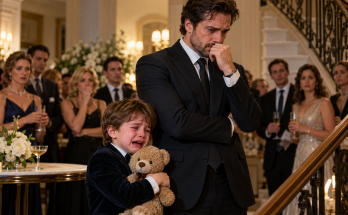
That evening, I stood near the staircase in our house, listening to him cry while people tried to pretend they could still have a normal conversation.
I remember the sound of the glasses.
The low voices.
The small breaks in conversation whenever his crying became louder.
I remember all of it.
What I remember most is that I did nothing useful.
My name is Daniel.
My wife's name was Elena.
I still had trouble saying that she was gone.
Even thinking the words felt wrong.
She had been part of every ordinary thing in our lives.
And then she wasn't.
Our son had not understood how to live with that.
Neither had I.
People sometimes talk about grief as though it is a feeling that comes and goes.
For my boy, it had become something he carried everywhere.
He cried when he needed something.
He cried when nobody was bothering him.
Sometimes he cried without seeming to know why.
I would watch him and wonder what was happening inside his head.
I wanted to ask.
I wanted him to tell me.
But since Elena's death, he had spoken so little that even a simple conversation seemed beyond us.
I missed hearing his voice.
Not just the crying.
His actual voice.
The little things he used to say without thinking.
I had never imagined how much I would miss those ordinary sounds.
That evening, people had come to our house because they cared about us.
At least, that was what I believed.
They wanted to offer comfort.
They wanted to show that we weren't alone.
I understood why they came.
I even appreciated it.
But appreciation was difficult to show when my son was crying and I couldn't help him.
Our house had always seemed large to me.
That night, it seemed too large.
The main hall had high ceilings and enough room for everyone to stand comfortably.
There was an elegant staircase beside me.
There were glasses in people's hands.
There were conversations that started quietly and ended without much being said.
Everything looked the way a gathering in our home was supposed to look.
Except for my boy.
His crying reached every corner of the hall.
Nobody could ignore it.
I knew because I watched people try.
Someone would begin speaking.
Then my son would cry harder.
The person would stop, glance toward him, and lower their voice.
A moment later, the conversation would begin again.
And then the crying would interrupt it.
Over and over.
I stood beside that staircase and listened.
I had become very good at standing still.
I told myself I was giving my son time.
I told myself I shouldn't push him.
I told myself grief couldn't be hurried.
All of that sounded reasonable.
It also allowed me to avoid admitting how helpless I felt.
The people around us seemed to believe that the right words might make a difference.
I wanted to believe that too.
Every attempt at comfort had the same result.
My son kept crying.
Some people tried speaking gently.
Others offered the kind of reassurance adults give children when they don't know what else to say.
Nothing reached him.
Nothing changed.
I watched their faces afterward.
There was concern.
Then uncertainty.
Then that embarrassed expression people get when they realize their kindness hasn't helped.
I knew that expression well.
I had seen it on my own face.
Losing Elena had changed the smallest parts of our lives.
There were things I used to do without thinking because she was there.
Now I noticed her absence in everything.
And my son noticed it more.
I could tell.
Not because he explained it.
He didn't.
I could tell because his crying sounded different from the way it once had.
This wasn't the frustration of a child who wanted something and couldn't have it.
It wasn't anger over a small disappointment.
It was something I couldn't take away.
I knew what he wanted.
He wanted his mother.
And there was no answer I could give him that would bring her back.
I kept looking toward him.
Then toward the people in the hall.
Then back toward him.
I had no reason to expect one of our guests to solve anything.
They were people who cared.
Not people who could undo death.
I understood that.
But understanding didn't make the sound of my son's crying easier to bear.
At some point, I started thinking less about what he needed and more about what I needed.
I wanted quiet.
That is a difficult thing to admit.
I wanted to hear my son laugh again.
I wanted to hear him speak.
I wanted some proof that the child I remembered was still there.
But I also wanted the crying to end because listening to it reminded me that I was failing him.
I was ashamed of that feeling.
I am still ashamed of it.
My son wasn't doing anything wrong.
He was grieving his mother.
He was a child.
And I was standing in a beautiful hall, surrounded by people, wishing somebody would make the situation easier for me.
I looked at the staircase.
It was just a staircase.
Nothing about it had changed.
But standing there without Elena made the whole house feel unfamiliar.
I kept thinking that a father was supposed to know what to do.
I had believed that before.
I had believed that when Elena was alive.
Now I couldn't even find the right thing to say to our son.
Every time I looked at him, I thought about what he had lost.
Then I thought about what I had lost.
And I hated myself a little for putting those two things together.
His loss was different.
Elena had been his mother.
He had depended on her in ways I couldn't replace.
I could be his father.
I could love him.
I could stay beside him.
But I couldn't become Elena.
Nobody could.
That should have been enough for me to understand what was happening.
Instead, I began searching the faces in the hall.
I wondered whether someone else might reach him.
Someone with more patience.
Someone with a better way of speaking.
Someone who didn't become frightened by the sound of his grief.
The thought embarrassed me.
Still, it stayed.
My son cried.
Our guests watched.
I stood by the staircase and felt my desperation growing.
I didn't know it then, but I was close to saying something I had no right to promise.
Click here to continue reading: PART 2: Everyone Came to Comfort My Grieving Son, but Every Failed Attempt Made Me More Desperate to Find an Answer
I Thought My Son Needed Someone to Stop His Tears, but I Had Forgotten How Much He Had Already Lost
Part 1 of 5