
The closing date for the sale of my old house was approaching when a handwritten envelope arrived in my mailbox. The return address belonged to the buyers, a couple named Hannah and Peter who had written to my agent after their offer was accepted. I recognized their names immediately, but I hadn't expected to hear from them directly.
I opened the envelope at the kitchen table.
They thanked me for agreeing to sell the house to them and explained that they had spent the previous weekend walking through the rooms with their children. Their daughter had already chosen which bedroom she wanted, while their son had asked whether the garden was large enough for a small vegetable patch. They wrote that they hoped to preserve the mature trees and the stone path, and that they planned to use the dining room for family meals rather than turn it into an office.
At the end of the letter, Hannah mentioned that they had noticed the height marks on the pantry door during the inspection. She asked whether I would be willing to leave them intact.
I read that sentence several times.
I had photographed the marks before moving, but I had not considered whether the new owners would want to preserve them. The idea that another family might use the same door to measure their children's growth touched me more deeply than I expected.
I wrote back that I would be happy for them to keep the marks. I explained that they belonged to my son, Daniel, and that I had preserved them for decades because they reminded me of his childhood. I didn't include the details of our recent conflict. Those belonged to our family, not to the people preparing to begin their own life in the house.
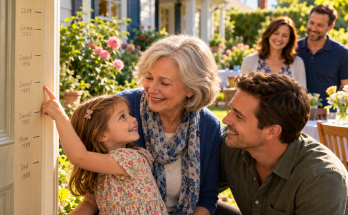
A few days later, Hannah replied with a photograph of the pantry door. She had placed a small strip of clear protective film over the markings to prevent them from fading. Beside the photograph, she wrote that her daughter wanted to know whether the tallest mark belonged to someone who was now very old.
I laughed aloud when I read it.
For the first time, I felt grateful that the house would belong to a family who understood that its value came from more than the number printed on an appraisal.
The letter also made me think about the years I had spent preserving the house because I believed it represented everything Robert and I had built. I had treated leaving as a form of betrayal, as though selling the property would erase the life we had lived there.
But the buyers were not erasing anything. They were adding their own story to the place where ours had unfolded.
That realization brought a quiet sense of closure.
On the day of closing, I arrived at Evelyn's office with the final documents in a folder. The buyers were represented by their own attorney, and the transaction proceeded in the ordinary, careful way such matters should. We reviewed the final figures, confirmed the transfer details, and signed the documents required to complete the sale.
When the final signature was in place, Evelyn shook my hand.
"Congratulations, Carol. The property has been transferred."
I thanked her and sat for a moment, letting the significance settle over me. The house where I had lived for thirty-six years was no longer mine. The proceeds would be transferred according to the closing arrangements, and the buyers would receive the keys.
I had expected to feel a sharp sense of loss. Instead, I felt tired, relieved, and strangely peaceful.
Outside, the air was cold enough to make me pull my coat tightly around myself. I walked to my car and sat behind the steering wheel without starting the engine. I thought about the day Robert and I had first entered the house, carrying boxes and arguing about where to place the sofa. We had been young enough to believe that thirty-six years was an almost unimaginable amount of time.
Now I understood how quickly a life could move from one chapter to another.
I drove past the old neighborhood on my way home. I didn't stop at the house. I didn't need to see the buyers taking possession to know that the transition was complete. I had said goodbye to the rooms, the garden, and the pantry door. The rest belonged to the future.
When I arrived at the bungalow, I found Daniel waiting on the front step. He held a paper bag and looked as though he had been standing there for some time.
"I hope you don't mind," he said. "I brought lunch."
I invited him inside.
He placed the bag on the kitchen counter and watched me hang up my coat.
"How did closing go?"
"Everything is complete."
He nodded slowly.
"How do you feel?"
The question was simple, but I appreciated that he had asked it.
"Relieved," I said. "A little sad, too. But mostly relieved."
He looked down at the floor.
"I know I made it harder than it needed to be."
"Yes, you did."
He accepted the answer without trying to defend himself.
We ate lunch at the kitchen table, and he told me that he had been thinking about the old house. He remembered the backyard games, the summer evenings when Robert grilled dinner, and the winters when the family gathered around the fireplace. He said he had been afraid that selling the property would somehow make those memories less real.
"I think I wanted to hold on to it because I didn't know what else to do with everything Dad left behind," he said.
I listened carefully.
"Your father left you many things, Daniel. The house was only one of them."
"I know that now."
"What do you think he left you that matters most?"
Daniel considered the question.
"Probably the way he treated people. He could be stubborn, but he never made anyone feel like they owed him for helping them."
I smiled faintly. "He wasn't always perfect at that."
"No. But he tried."
We sat quietly for a moment.
Daniel then told me that he and Melissa had decided to make a more permanent change to their finances. They were considering selling some of the expensive furniture they had bought during the renovation and replacing their car with a less costly model. They had also agreed to stop using credit cards for routine purchases until their balances were under control.
"Those sound like sensible decisions," I said.
"They're not glamorous."
"Financial stability rarely is."
He laughed.
After lunch, Daniel helped me move a small cabinet from the study into the hallway. Before leaving, he asked whether I had kept the old photographs from the pantry door.
"I did."
"Could I see them?"
I retrieved the envelope from the desk drawer and spread the photographs on the table. Daniel examined each one, smiling at the familiar marks.
"I was so proud when I reached six feet," he said.
"Your father made you stand straight before he marked it."
"He always said I was trying to cheat."
"You were."
We laughed together, and for a moment I felt as though we had recovered a small piece of the family life we once shared.
But when Daniel gathered the photographs, he paused.
"Mom, I want you to know that I don't expect anything from you after today. Not the money from the sale, not the new house, not your estate. I want us to have a relationship because we're family, not because I might inherit something."
I looked at him for a long moment.
"I hope that's true."
"It is."
"Then keep showing me."
He nodded and placed the photographs carefully back in the envelope.
That evening, I received a message from Hannah, the buyer. She sent a photograph of her daughter standing beside the pantry door, reaching up toward the highest mark. The child was much shorter than Daniel had been at the same age, and her expression was one of fierce concentration.
Hannah wrote that they had decided to keep the markings and add their daughter's height beside them each year.
I saved the photograph to my phone.
It was a small thing, but it helped me understand that the house had not been lost. It had become part of another family's life, just as it had once been part of mine.
The following morning, I transferred the closing statement and related documents into my permanent records. I reviewed the financial arrangements with my adviser and confirmed that the funds were allocated according to the plan we had developed. The purchase of my bungalow was complete, my savings remained intact, and I had enough money set aside to cover ordinary expenses and unexpected needs.
For the first time since Robert died, I felt that my financial future was organized around my own priorities rather than around the possibility of rescuing someone else.
I was not wealthy beyond concern, and I did not pretend that money could eliminate every future difficulty. But I had choices, and I intended to preserve them.
That afternoon, I walked through the garden and began planning where to plant the roses in the spring. I measured the distance between the fence and the path, considered the amount of sunlight each section received, and made a list of supplies.
The work was ordinary, but it made me feel grounded.
I was no longer the woman standing in a pantry, listening to her son describe her as a burden. I was a woman who had heard something painful, examined her circumstances, and made a decision that protected her independence.
The hurt remained, but it no longer controlled the shape of my days.
Click here to continue reading: PART 12: A Family Gathering Tested Our New Understanding When Someone Asked Who Would Inherit My New Home
The Evening I Heard My Son Discuss My Future as Though I Were Already Gone
Part 11 of 34

One Comment on “PART 11 – The Letter From the Buyers Made Me Question Whether I Had Been Ready to Leave My Past Behind”