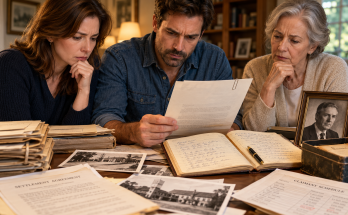
The formal accounting demand produced a response two weeks later. Arthur’s lawyer supplied additional partnership records, including invoices for the legitimate liabilities paid from the business account, but no original loan agreement, no bank deposit record for the supposed advance, and no second written approval for the final allocation. Richard provided his remaining correspondence and confirmed that he had relied on the revised reconciliation summary when approving the later transfer. Voss supplied a signed statement acknowledging that his final spreadsheet had presented the settlement as complete even though he had never seen the original proof of the advance.
None of the statements established that one person had personally taken the entire amount. They did, however, confirm that the settlement had been recorded without the evidence required by the original bank instruction. The partnership had received the funds, and some of the money had paid genuine business expenses, but the underlying advance remained unverified. The missing supporting schedule had never been located, and the required second approval was absent from every surviving file.
Helen explained the implications to Margaret in a meeting at her office. They had enough evidence to pursue a formal civil accounting and seek recovery of any amount that could be shown to have been transferred without authority or used for an unsupported purpose. They also had grounds to refer the questionable records to the relevant authorities for independent review. But they could not responsibly claim that the entire amount had been stolen by Arthur, Richard, Voss, or anyone else.
Margaret felt both disappointment and relief. She had wanted the investigation to end with one person admitting exactly what had happened. Instead, the evidence established a series of failures: an account kept open under an unresolved liability, a transfer made without the required approval in the surviving records, a summary revised to show a settlement that had not been substantiated, and payments passed through companies with incomplete documentation. Some people had accepted explanations they should have tested. Others had made decisions without preserving the records needed to justify them. Whether anyone had deliberately engineered the entire chain remained a question for further inquiry.
“Does this mean Peter never found out where the money went?” Margaret asked.
“We cannot know everything he discovered before he died,” Helen replied. “His letters show that he questioned the settlement and wanted the original records. The fact that he never certified the final account suggests he did not accept the explanation he was given. We have no evidence that he knew the full route of the later transfers.”
Margaret looked down at the copy of Peter’s draft letter. A balance can be made to disappear from a page without being repaid. He had understood the central problem years before she did. The records had been arranged to look complete, but the evidence behind them had never caught up. Peter had not left her a confession or a list of guilty people. He had left her a warning not to mistake an official-looking summary for the truth.
Helen recommended that the formal accounting proceed and that the questionable transactions be referred for independent review. Margaret authorized both steps. She understood that the process might take months, and she accepted that the final outcome might not include a full recovery of the money. What mattered now was that the transaction could no longer be treated as settled merely because an old spreadsheet said it was.
After the meeting, Margaret drove home and stopped outside the Bell Street convenience store. She had no intention of confronting anyone. She simply wanted to see the place where Vanessa had purchased the birthday ticket and where Peter had once been photographed beside an unidentified man. The shop looked ordinary: a faded sign, a narrow entrance, and a lottery display beside the register.
Inside, the manager recognized her from the earlier inquiry. He repeated that the store had no record of anyone marking the ticket and no surviving camera footage from the relevant period. He could not identify the older man Vanessa remembered. Margaret thanked him and left without pressing for an answer he could not give.
On the pavement, she looked at the photograph of Peter outside the same store. The date placed the picture near the period when he was trying to obtain the original bank instruction. The initials L.V. might refer to Leonard Voss, and Voss had recognized himself in the image. But the photograph did not prove why Peter had met him there, and it did not connect the meeting to the lottery ticket that Vanessa bought years later.
Margaret had almost decided the blue mark was simply a coincidence when her phone rang. Vanessa was calling, and her voice sounded unsettled.
“I remembered something about the ticket,” Vanessa said. “I don’t know if it matters, but I should tell you.”
Margaret stood beneath the store’s faded awning and listened.
Vanessa explained that after Margaret won, she had returned to the store and asked the clerk whether he remembered selling the ticket. She had not mentioned the blue mark at the time, but the clerk had told her that an older customer sometimes came in asking for the same scratch-ticket game. The man had once asked whether the store could keep a ticket aside for him, but the clerk said he had explained that customers could not reserve individual tickets from the display.
“Did he give you a name?” Margaret asked.
“No. The clerk didn’t know it. He said the man sometimes paid for small purchases with cash and usually bought the same game. I didn’t think it meant anything. I only remembered it because you asked me about the mark.”
Margaret asked whether Vanessa could describe the man. Vanessa said she could not, beyond the dark jacket and the impression that he was older. She had never spoken to him. She had not seen him at the store when she bought the ticket, and she had no reason to believe he had touched the particular ticket she purchased.
The information did not solve the mystery, but it added one small detail to the timeline. Someone had repeatedly asked about the same game, and the ticket had carried a mark resembling Peter’s handwriting. There was still no evidence that the customer had known Peter or had anything to do with the old account. Margaret thanked Vanessa for telling her and reminded her not to turn a vague memory into a claim.
“I know,” Vanessa replied. “I just didn’t want to keep anything back because I was afraid it would sound strange.”
Margaret appreciated that. It was the first time Vanessa had volunteered a detail that might make the situation more complicated without waiting to be asked. Whatever the truth about the ticket, their conversations were beginning to change. Vanessa was learning to share uncertainty instead of hiding it, and Margaret was learning that she could listen without surrendering control of her own decisions.
That evening, Margaret brought the photograph, the ticket image, and Peter’s notes to her kitchen table. She arranged them side by side, then separated them again. The blue mark on the ticket remained unexplained. The old financial account had been traced through several businesses, and the missing authorization had become the focus of a formal inquiry. The family house had not been sold, and the lottery money remained secure. There was no evidence that the ticket was connected to the disputed transfer, and Margaret would not invent a connection simply to make the story feel complete.
She called Martin and thanked him for preserving Peter’s records. Martin admitted that he had once believed the old account was resolved because Peter had stopped discussing it with him. He now understood that Peter’s silence had not meant acceptance. It might have meant exhaustion, uncertainty, or a decision to continue pursuing the matter privately. Martin could not know which. He promised to keep the remaining records safe and to respond if the formal review required further documents.
Margaret also spoke with Samuel. His final report would state that the transaction could not be fully substantiated, that the required authorization had not been found, and that the accounting trail contained unexplained transfers and unsupported entries. It would not assign personal guilt where the evidence did not support it. If new records emerged, the report could be supplemented. For now, it would establish the most accurate account they could construct from the surviving documents.
When Margaret put down the phone, she felt the first genuine sense of completion she had experienced since finding Peter’s letter. Not because every question had been answered, but because she no longer had to pretend that uncertainty was resolution. The investigation had reached a clear conclusion about what the records did and did not prove. The next decisions belonged to the formal process, not to her imagination.
The following morning, she called the travel agency and confirmed her coastal trip. She would leave in three days and stay away for a little over a week. She had delayed the booking twice while waiting for the next set of records, but there would always be another document to request and another person whose memory might be incomplete. She could continue the inquiry after she returned. She did not need to remain at home to prove that she cared about Peter’s unfinished work.
Daniel came by that afternoon to help her check the car and carry a small suitcase downstairs. He asked whether she wanted him to stay in the house while she was away. Margaret thanked him but said she had already arranged for a neighbor to collect the mail and water the plants.
“I want you to have a good trip,” Daniel said. “And I want you to know that I’m not expecting anything from you because of the lottery.”
“I’m glad to hear that.”
“I mean it. Vanessa and I are working through our debts. It’s difficult, but we need to solve them ourselves.”
Margaret looked at her son. For months, she had worried that the investigation would permanently damage their relationship. It had exposed his fear, Vanessa’s assumptions, and the family’s habit of leaving hard questions unanswered. But it had also forced them to speak honestly. She could love Daniel without rescuing him, and he could love her without treating her home or money as resources waiting to be allocated.
“I want you both to build something stable,” she said. “But I need you to remember that my life is mine. You don’t have to agree with every choice I make. You do have to respect that I make it.”
Daniel nodded. “I understand.”
Before leaving, he handed her a small envelope containing a copy of the family photograph of Peter outside the store. He had made a duplicate so she could take it on the trip without risking the original. On the back, the initials L.V. were still visible. Margaret slipped it into her bag beside her notebook, not as proof of anything, but as a reminder of the questions her father had left behind.
That evening, Vanessa stopped by to say goodbye. She did not bring up the lottery money or ask whether Margaret might help them financially. Instead, she told Margaret that she had begun to understand the difference between wanting to help someone and trying to control what they chose. Margaret thanked her for saying so. Their trust would take time to rebuild, but the conversation was no longer a negotiation over Margaret’s future.
After Vanessa left, Margaret walked through the house. She paused in Peter’s workshop, touched the edge of his old desk, and looked at the blue pencil in its drawer. The hooked mark on the lottery ticket might have been made by someone who knew Peter’s handwriting, or it might have been an accidental stroke. She had no reliable way to decide. She placed the ticket photograph back in its sleeve and closed the drawer.
The house assessment remained in her file, but it no longer frightened her. Vanessa had admitted why she had wanted the property sold, and Daniel had put his promise in writing. The house would remain hers unless she chose otherwise. The lottery money would fund her travel, repairs she had postponed, and the quiet security of knowing that she could make decisions without asking anyone’s permission.
On the morning of departure, Margaret locked the front door and stood on the porch for a moment. She thought of Peter’s final warning, the missing settlement page, the bank instruction, and the trail of payments that might never be completely reconstructed. She thought of Daniel’s apology and Vanessa’s willingness to speak more openly. She thought, too, of the blue mark that still had no explanation.
She could not finish every task Peter had left behind. She could ensure that his questions were now documented, that the unexplained transaction was being formally examined, and that no one could quietly label it settled again without evidence. That was enough for now.
Margaret placed her suitcase in the car and drove toward the coast. The morning light spread across the road, and for the first time in months she did not feel compelled to look back at every turn. She would return to the records when she returned to the house. Until then, she intended to see the ocean, walk along the shore, and let the wind carry some of the weight she had been holding.
Peter’s unfinished work would remain important. It would not be the only thing that mattered.
And when Margaret finally reached the coast, she understood the truth she had been fighting to accept: she could honor the past without surrendering her future to it.
The End
Read more original stories on Feel Every Story.
At Seventy-Three, Margaret Hale Discovered That the People Closest to Her Had Been Making Decisions Behind Her Back
Part 35 of 35