The first birthday Russell missed was Maisie's fourth.
She wanted a chocolate cake with pink icing.
She also wanted her father.
One of those requests was easy.
The other was impossible.
I invited a handful of children from preschool and decorated the living room with paper flowers.
Maisie wore a yellow dress.
She kept running to the front window whenever a car slowed down outside.
“Is that Daddy?”
“No, sweetheart.”
“Maybe the next one.”
I didn't know how to respond.
I had spent months trying to explain his absence without damaging her.
Daddy needed time.
Daddy was away.
Daddy had some things to sort out.
Every explanation sounded less convincing than the previous one.
I didn't want to tell her he had abandoned us.
But I couldn't keep promising he would return.
When we brought out the cake, Maisie closed her eyes.
She made her wish.
Then she looked at me.
“Can I tell you what it was?”
“Of course.”
“I wished Daddy would come home.”
I kissed her cheek.
Then I went into the kitchen and cried beside the sink.
I was learning how to hide tears quickly.
Cold water.
A towel.
A deep breath.
Back into the living room.
There were children waiting for cake.
Life didn't stop because my husband had disappeared.
The mortgage still needed paying.
Maisie needed new shoes.
Our car needed repairs.
The refrigerator began making a strange rattling noise.
I returned to full-time work.
I arranged childcare.
I learned how to manage household expenses on my income.
Some evenings, I fell asleep on the sofa with unopened mail beside me.
Other evenings, I couldn't sleep at all.
I thought about Russell constantly.
Sometimes I imagined him frightened and alone.
Sometimes I imagined him enjoying a peaceful life somewhere while I struggled to get through the week.
I didn't know which possibility made me angrier.
Eventually, I stopped checking my telephone every time it vibrated.
That was progress.
Small progress.
But it mattered.
Russell's mother remained involved in Maisie's life.
She visited on Sundays.
She brought books and homemade biscuits.
She never defended what her son had done.
One afternoon, while Maisie played in the garden, she sat beside me on the porch.
“I don't understand him anymore,” she said.
“Neither do I.”
“He wasn't raised to behave like this.”
I looked at her.
“I know.”
She began crying.
For the first time, I realized that Russell had left more than his wife and daughter behind.
His mother was grieving too.
Except none of us had a funeral.
There was no final goodbye.
No certainty.
Just an empty space that everybody kept walking around.
After nearly a year, I met with a lawyer.
I wanted to understand my options.
I needed to protect Maisie and organize our finances.
The lawyer asked whether I wanted a divorce.
I looked at my wedding ring.
“I don't know.”
“That is a decision only you can make.”
I nodded.
I wished somebody could make it for me.
I was tired of making decisions.
School lunches.
Insurance.
Birthday parties.
Bills.
Whether to keep a photograph on the mantelpiece.
Whether to explain to strangers that my husband was absent or simply say I was a single mother.
Whether to take off a gold ring that suddenly felt heavier than it should.
Eventually, I removed it.
I placed it in a small ceramic dish beside my bed.
I didn't throw it away.
I wasn't ready for that.
Maisie started school the following autumn.
She was excited about everything.
Her backpack.
Her pencils.
The little name tag attached to her classroom desk.
She brought home drawings and songs she wanted to perform.
She also brought home questions.
“Why do other children have daddies who collect them?”
“Every family is different.”
“Is our family broken?”
That one hurt.
“No, darling.”
“Then where's Daddy?”
I sat beside her on the sofa.
I took her hands.
“Sometimes grown-ups make choices that hurt other people. But none of those choices are your fault.”
She studied my face.
“Did Daddy make a bad choice?”
“Yes.”
“Can he make a good one next time?”
I swallowed.
“I hope so.”
She nodded.
Then she asked whether we could watch cartoons.
Children sometimes moved past terrible questions faster than adults could recover from them.
Nearly two years after Russell left, Maisie brought home a bright pink sheet of paper.
Her school was organizing a family performance.
Parents could participate with their children.
There would be songs, dancing, and little comedy routines.
Maisie pointed at a photograph printed on the announcement.
“I want to do this one.”
It showed adults dancing in colorful costumes.
Some were wearing tutus.
I laughed.
“You want Mommy to dance?”
She shook her head.
“I want Daddy.”
I stopped laughing.
She looked down at the paper.
“He's funny when he dances.”
Russell used to dance around our kitchen while making pancakes.
He would exaggerate every movement until Maisie collapsed into laughter.
I hadn't realized she remembered.
“We could ask Grandma,” I suggested.
Maisie shook her head again.
“Daddy would wear the pink skirt.”
I put the paper down.
“Sweetheart, we don't know where Daddy is.”
“Can I invite him?”
I nearly said no.
Then I saw her expression.
She wasn't asking me to guarantee that he would attend.
She was asking whether she could try.
“Yes,” I said.
“We can send him an invitation.”
We sat at the kitchen table with crayons.
Maisie drew herself on a stage.
She drew Russell beside her wearing a large pink tutu.
Above them, she drew several yellow stars.
She asked me to help write the date.
Then she carefully folded the picture.
“Can you send it to Daddy?”
I still had Russell's old email address.
I had sent occasional messages during the first year.
Most had received no response.
I photographed Maisie's drawing and attached it to an email.
I kept the message simple.
“Maisie wanted you to have this. Her school performance is next Friday. She would like you to attend.”
I didn't tell her that he probably wouldn't reply.
I didn't promise that he would.
I simply sent it.
For several days, nothing happened.
Maisie practiced her dance in the living room.
I helped her prepare a costume.
We arranged for another parent to accompany her onstage if necessary.
She seemed disappointed, but she agreed.
On the evening before the performance, I checked my email.
There was no reply.
I closed the laptop.
I told myself I had expected that.
Still, I slept badly.
The next afternoon, the school auditorium was full of parents.
Folding chairs scraped against the floor.
Children hurried between classrooms and the backstage area.
Teachers carried clipboards.
Somebody was testing a microphone.
Maisie wore a pink costume with silver stars.
Her hair was tied back.
She looked beautiful.
I helped straighten one of her sleeves.
“Are you nervous?”
“A little.”
“You'll be wonderful.”
She glanced toward the auditorium doors.
I knew what she was looking for.
I pretended not to notice.
Five minutes before her performance, I was standing beside a teacher when somebody called Maisie's name.
I recognized the voice before I saw the person.
“Hey, little monkey.”
My entire body went cold.
Maisie turned.
For a second, she didn't move.
Then she screamed.
“Daddy!”
Russell stood near the entrance.
He looked older.
Thinner.
His hair was shorter, and his face carried a tiredness I didn't recognize.
But it was him.
My daughter ran straight into his arms.
He lifted her.
She wrapped her legs around his waist.
He closed his eyes.
I stood several feet away.
I had imagined this moment hundreds of times.
In some versions, I slapped him.
In others, I cried.
Sometimes I simply turned around and walked away.
In reality, I couldn't move.
Russell finally opened his eyes.
He looked at me.
“Sarah.”
Two years.
And that was the first thing he said.
My name.
I wanted to ask a hundred questions.
Where had he been?
Why hadn't he called?
How could he stand there holding our daughter as though he had only missed a weekend?
But Maisie was smiling so widely that I couldn't bring myself to ruin the moment.
“Daddy, did you get my picture?”
“Yes, sweetheart.”
“Are you going to dance?”
He nodded.
“If your mommy says it's all right.”
They both looked at me.
I wanted to refuse.
I had every reason to refuse.
But this was Maisie's performance.
She had been waiting two years for her father.
I wasn't going to make her pay for his decisions.
“For tonight,” I said quietly.
Russell nodded.
“Thank you.”
A teacher hurried over.
“We've got a spare costume backstage.”
Maisie grabbed Russell's hand.
“Come on!”
He followed her.
I remained beside the auditorium door.
My hands were shaking.
I sat down before anybody noticed.
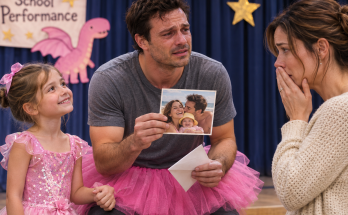
When Maisie's performance began, Russell walked onto the stage wearing an enormous pink tutu over his trousers.
The audience laughed.
Maisie laughed harder than anyone.
He performed every silly movement she had practiced.
He spun.
He stumbled deliberately.
He pretended to be a serious ballet dancer.
For three minutes, our daughter had her father back.
I watched her face.
I remembered the birthdays.
The questions.
The afternoons she had spent watching the front window.
I remembered repairing a stuffed rabbit because Russell wasn't there.
And I cried.
Not because he looked ridiculous.
Not because I had forgiven him.
Because Maisie was happy in a way I hadn't seen for a very long time.
When the music ended, the audience applauded.
Russell bowed.
Maisie took his hand.
I expected them to walk offstage.
Instead, he approached the microphone.
He reached into his pocket.
He removed a small envelope.
He looked at me.
Then he looked down at our daughter.
I knew immediately that he hadn't returned simply to dance.
Click here to continue reading: PART 3: Standing Before a Room Full of Strangers, My Husband Finally Tried to Explain the Two Years He Had Taken From Us
The Morning My Husband Asked for Some Time Alone, I Had No Idea How Long He Intended to Stay Away
Part 2 of 10