Gail called the following morning.
I answered because I was tired of watching her name appear on my phone.
“Hello.”
“Finally.”
I closed my eyes.
“What do you need?”
“Tori said you're considering being tested.”
“I said I was gathering information.”
“That's wonderful.”
“Gail.”
She stopped.
“I haven't agreed to anything.”
Her silence lasted several seconds.
“But you're going to get tested.”
“I haven't decided.”
“Annie, we can't keep waiting.”
I sat down.
“I understand that Tori's situation is serious.”
“Then why are you making everything so difficult?”
I looked at the paper containing my questions.
Because this was my body.
Because surgery was serious.
Because I deserved accurate information.
None of those explanations seemed to matter to her.
“I'm not making anything difficult,” I said.
“I'm making an informed decision.”
She sighed.
“You always were stubborn.”
I stared at the wall.
Always.
She hadn't known me since I was five.
She hadn't been there to learn what sort of person I became.
Yet she spoke as though she had spent thirty years raising me.
“You don't know me well enough to say that.”
“I'm your mother.”
“Olivia is my mother.”
The words came out naturally.
Gail went quiet.
Then she spoke again.
“Those people have clearly influenced you.”
I felt anger rise so quickly that I almost raised my voice.
Instead, I waited.
“Don't speak about them like that.”
“I only mean they've probably encouraged you to resent us.”
“They encouraged me to make my own decisions.”
“Well, we need a decision.”
“You'll receive one when I'm ready.”
She tried to interrupt.
I ended the call.
My hands remained steady.
That surprised me.
A few years earlier, I would have replayed every word and wondered whether I had been too harsh.
Now I simply returned to the questions I had written.
I contacted a transplant program to ask how potential living donors could obtain information independently.
I explained that I hadn't consented to donation.
I was gathering facts.
The person I spoke with didn't sound surprised.
She explained that potential donors needed their own assessment and that participation had to be voluntary.
Medical suitability couldn't be assumed from family relationships alone.
There would be evaluations.
There would be discussions about risks.
And I was entitled to decline.
I asked the question I had underlined.
“Can I withdraw if I begin an evaluation?”
She explained that I could.
I wrote down what she told me.
When I finished the call, I sat quietly.
It felt strange that a person who had never met me seemed more concerned about my consent than Gail did.
Later, Vince called.
His voice was subdued.
“Your mother is upset.”
“I know.”
“She thinks you're trying to hurt us.”
“I'm not.”
He sighed.
“Maybe you could reassure her.”
I almost laughed.
For most of that conversation, he sounded like someone asking me to make his afternoon easier.
“Vince, I'm not responsible for keeping Gail comfortable.”
“She just wants Tori to be okay.”
“So do I.”
“Then you understand.”
“Yes. I understand that Tori needs treatment.”
He waited.
“And I understand that I have the right to decide whether I become a donor.”
He didn't answer immediately.
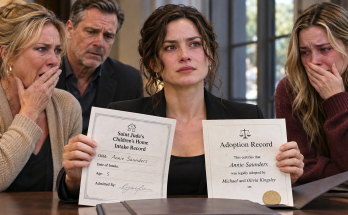
I looked at the intake record lying on my desk.
“Can I ask you something?”
“Sure.”
“Why didn't you come back for me?”
The silence changed.
I could hear him breathing.
“Annie.”
“It's a simple question.”
“It wasn't simple at the time.”
“Was it difficult to find Saint Jude’s?”
“No.”
“Did you forget where it was?”
“No.”
“Then why didn't you come back?”
He made a small sound.
Almost a sigh.
“Your mother thought it was better that way.”
I felt my throat tighten.
I had expected another excuse.
I hadn't expected him to hand the responsibility entirely to Gail.
“And what did you think?”
“I don't know.”
“You don't know?”
“We had a lot happening.”
I pressed my hand against the desk.
“I was five years old.”
“I know.”
“You were an adult.”
“I know.”
“Then you could have done something.”
He didn't argue.
That somehow made it worse.
For years, I had wondered whether Vince had secretly wanted me home.
Whether he had been prevented from looking for me.
Whether somewhere inside him there was a father who had missed his daughter.
Now he was telling me that he had allowed Gail to make the decision.
And afterward, he had allowed the years to pass.
“I'm sorry,” he finally said.
I stared at the adoption record.
“Are you sorry you left me, or sorry I found out?”
He didn't answer.
I waited a little longer.
Then I said goodbye.
That evening, I received another message from Gail.
Vince says you brought up things that aren't relevant to Tori's health.
I read it carefully.
Then I typed my response.
My history is relevant to my relationship with you. My medical decisions are private. Please respect that.
She answered almost immediately.
A good sister wouldn't need to be reminded what is at stake.
I deleted the notification from my screen.
I didn't delete the message itself.
I wanted a record of what had been said.
Later, Tori contacted me.
“Mom's really angry,” she said.
“I know.”
“She told me you were refusing to help.”
“I haven't told her anything about my final decision.”
Tori sighed.
“I wish she'd stop.”
“Have you told her that?”
“Yes.”
I waited.
“She says I'm not thinking clearly because I'm sick.”
I recognized the pattern.
Whenever someone disagreed with Gail, Gail found a reason why that person's judgment couldn't be trusted.
“I'm sorry,” I said.
Tori sounded close to tears.
“I didn't ask her to speak for me.”
“Then she shouldn't.”
We talked briefly.
I reminded her that I was gathering information independently.
She didn't ask me to disclose anything from my conversation with the transplant program.
I noticed that.
Before hanging up, she said something that stayed with me.
“I don't want you to disappear again because of us.”
I sat with those words after the call ended.
Disappear.
That was what Gail had called it on television.
But I hadn't disappeared.
I had been abandoned.
Then I had been adopted.
I had lived an entire life.
There were birthdays.
School days.
Ordinary dinners.
Conversations at Michael and Olivia's kitchen table.
Thirty years of experiences that belonged to me.
I wasn't some missing piece of the Saunders family waiting to be recovered when I became useful.
I was Annie Kingsley.
The following morning, I visited Michael and Olivia again.
Michael was sorting papers at the kitchen table.
Olivia was preparing lunch.
I sat down with them.
“I spoke to Vince.”
Michael looked up.
“How did that go?”
“He said Gail thought leaving me was better.”
Olivia stopped what she was doing.
I told them the rest.
When I finished, Michael removed his glasses.
“Annie, you were entitled to protection from both of them.”
I nodded.
“I kept hoping he would say something different.”
Olivia sat beside me.
“I know.”
She didn't tell me I should stop hoping.
She understood that losing an imagined version of someone could hurt almost as much as losing a real relationship.
I opened my bag and removed the sheet of medical questions.
“I think I'm getting closer to a decision.”
Michael studied my face.
“Your decision?”
“Yes.”
“Then take whatever time you need.”
I folded the paper again.
I hadn't told them what that decision would be.
They didn't ask.
That afternoon, I realized I no longer needed Gail or Vince to approve of me.
Their approval wouldn't change what had happened at Saint Jude’s.
It wouldn't make my childhood more valuable.
And it wouldn't make a decision about donating a kidney any easier.
I had spent too many years trying to understand why I had been considered unnecessary.
I wasn't going to spend the rest of my life trying to prove that I wasn't.
Click here to continue reading: PART 8: I Asked Gail and Vince to Meet Me One Last Time Before Giving My Answer, but This Time My Sister Refused to Remain Silent
My Mother Had Spent an Entire Week Telling People She Lost Her Daughter, but the Documents in My Hands Told a Different Story
Part 7 of 10