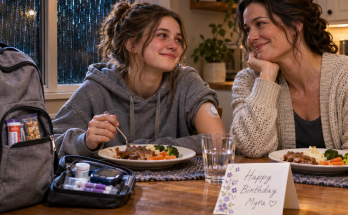
Supper at Kirk's house was pleasant.
His wife had prepared chicken and rice.
There was a small bowl of green beans on the table.
She apologized because she hadn't made dessert.
I told her that supper was enough.
We ate together.
Kirk told me about something funny that had happened at work.
His wife laughed.
I laughed, too.
There had been a time when hearing her laugh reminded me of standing beside the SUV in my lavender dress.
That evening, it didn't.
I was grateful for that.
After supper, I offered to help with the dishes.
She insisted that I remain seated.
“You're our guest.”
I smiled.
“All right.”
Kirk brought me another glass of water.
Then he sat across from me.
We talked while his wife finished in the kitchen.
There were no uncomfortable questions.
Nobody mentioned my savings.
Nobody asked whether I intended to change my mind about the SUV.
I didn't need to defend anything.
When it was time to leave, Kirk brought me my cardigan.
His wife hugged me at the door.
“Come again soon, Ozella.”
“I will.”
Kirk drove me home.
He waited while I unlocked my front door.
Then he waved and returned to his vehicle.
I stood inside the doorway listening to the engine disappear down the street.
It wasn't the smooth, quiet sound of the silver SUV.
His vehicle was older.
Sometimes it rattled.
But Kirk had paid for it.
He maintained it.
He had learned to manage the responsibilities that came with it.
And I no longer felt responsible for making his life easier every time something became inconvenient.
The weeks that followed were ordinary.
I went to church.
I bought groceries.
I attended bingo with my daughter-in-law's mother.
Occasionally, Kirk and his wife came for supper.
Sometimes I went to their house.
There were days when I drove myself and days when I accepted a ride.
Nobody kept score.
Nobody presented a bill.
I began noticing how much time I had available when I wasn't constantly worrying about somebody else's finances.
I spent more time with friends.
I read books that had been sitting unopened on my bookshelf.
I planted flowers in containers beside my porch.
They were small things.
But they belonged to me.
One afternoon, I found myself standing in the garden section of a store, deciding between yellow flowers and purple ones.
I bought both.
I laughed when I carried them to the SUV.
For years, I had talked myself out of little purchases because I never knew when Kirk might need something.
Now I had room in my budget for flowers.
I also had room for unexpected expenses.
I had room to make choices without first imagining my son's reaction.
That freedom was worth more than I had understood.
A few months after the incident, Kirk called me one morning.
He asked whether he could stop by.
When he arrived, he was carrying a white envelope.
I noticed it immediately.
Something about white paper in his hand still made me uncomfortable.
He sat at the kitchen table.
“I've been meaning to give you this.”
He placed the envelope in front of me.
I opened it.
Inside was a handwritten note.
There was also a check.
I looked at the amount.
It wasn't twenty dollars.
It was considerably more.
“Kirk, what's this?”
He shifted in his chair.
“Some of the money you helped me with before.”
I looked at him.
“You don't owe me for everything I've ever done for you.”
“I know.”
He pointed toward the note.
“But there were things I said I'd pay back.”
I unfolded the paper.
He had written down several expenses he remembered promising to repay.
Some of them I had nearly forgotten.
Others I remembered clearly.
He told me he wasn't able to return everything immediately.
He had been saving what he could.
He wanted to start making things right.
I looked at the check again.
“You can afford this?”
“Yes.”
“Without falling behind on your own bills?”
“Yes, Mama.”
I studied his face.
He didn't appear to be trying to impress me.
He didn't look toward the window.
He didn't mention the SUV.
Finally, I put the check down.
“All right.”
He looked surprised.
“Really?”
“If you promised to repay something and you're able to do it, I'll accept it.”
He smiled.
I smiled back.
I didn't feel guilty.
That surprised me.
There was a time when I would have refused the money immediately.
I would have told him to keep it.
I would have insisted that his needs mattered more than mine.
But he was trying to honor his own promises.
Refusing him simply because he was my son would have taken something away from him.
I thanked him.
He nodded.
Then he asked whether I had any coffee.
I went to the kitchen counter and poured two cups.
We sat together for nearly an hour.
Eventually, he brought up the SUV himself.
“You know, Mama, I used to think about getting that thing back all the time.”
I believed him.
He smiled a little.
“I figured if I apologized enough, you'd eventually change your mind.”
I appreciated his honesty.
“And now?”
He looked toward the driveway.
“Now I'm glad you've got it.”
I wasn't expecting that answer.
He continued.
“You should have something nice.”
I felt my eyes begin to fill.
It wasn't because of the vehicle.
It was because he had finally considered what I deserved without asking what it meant for him.
I reached across the table and touched his hand.
“Thank you, sweetheart.”
He squeezed my fingers.
For a few moments, we didn't speak.
Then he told me he needed to leave for work.
I walked him to the door.
After he drove away, I returned to the kitchen.
The check and handwritten note were still on the table.
I read the note again.
Then I put it away.
Later that week, I deposited the check.
I didn't use the money to buy Kirk something.
I didn't quietly return it through another payment.
I added it to my savings.
That was where it belonged.
The next Sunday, I wore my lavender dress to church.
As I stood before the mirror, I noticed that the sleeves were beginning to show their age.
I considered buying another dress.
Then I smiled.
I could buy another one whenever I wanted.
There was no need to explain the expense to anybody.
I put on my shoes and collected my Bible.
Outside, the silver SUV was waiting.
I walked toward it with the keys in my hand.
Then I stopped beside the passenger door.
I remembered that first Sunday.
Kirk standing there.
The little white card.
His wife's laughter.
I remembered how embarrassed I had felt reaching into my purse.
For a long time, I had been ashamed that I had paid him.
I had wondered why I hadn't simply refused.
Why I hadn't turned around and gone back inside.
Why I had continued paying after discovering that another mother was receiving free rides.
Standing there that morning, I finally understood my own behavior a little better.
I had wanted to avoid an argument.
I had wanted to attend church.
Most of all, I had wanted to believe that my relationship with my son was still what I thought it was.
Admitting otherwise had been painful.
Paying twenty dollars had seemed easier than facing that pain.
Until it wasn't.
I walked around to the driver's side.
I unlocked the door and climbed inside.
The seat was comfortable.
The mirrors were already adjusted.
I placed my Bible beside me.
Then I drove to church.
Kirk and his wife arrived shortly afterward.
They sat with me.
During the service, my daughter-in-law reached across Kirk and touched my arm.
She smiled.
I returned the smile.
It wasn't the same smile I had given them when they charged me for transportation.
That smile had been an attempt to hide my hurt.
This one was genuine.
Afterward, we stood together in the parking lot.
My daughter-in-law asked whether I would join them for lunch.
I accepted.
We went to a nearby restaurant.
When the server brought the bill, Kirk reached for it.
“I've got this.”
I didn't argue.
I thanked him.
He smiled.
There was nothing unusual about the meal.
And that was precisely what made it special.
My son had invited his mother to lunch.
He had paid because he wanted to.
He hadn't treated kindness as something that needed to be balanced against my bank account.
When we finished, we said goodbye in the parking lot.
I returned home and changed into comfortable clothes.
Then I opened the drawer containing the smaller envelope.
I took out the white card.
The corners were slightly bent.
The ink had begun to fade.
I looked at the smiling face.
It no longer made me angry.
It didn't make me feel embarrassed.
It was just a piece of paper.
A reminder of something that had happened.
But I didn't need that reminder anymore.
The lesson had become part of how I lived.
I unfolded my daughter-in-law's apology letter.
I read it slowly.
Then I placed it beside Kirk's handwritten repayment note.
Those were the things I wanted to keep.
Not because they erased what had happened.
Because they represented what my family had chosen to do afterward.
I picked up the white card.
Then I tore it in half.
I tore the halves again.
Four little pieces.
The smiling face disappeared into the rubbish bin along with the rest of the card.
I stood looking at them for a moment.
Nothing dramatic happened.
The house remained quiet.
The clock continued ticking.
A car passed outside.
I hadn't expected to feel anything extraordinary.
And I didn't.
I simply felt finished with it.
I put the two letters back into the smaller envelope.
Then I returned the envelope to the drawer.
The title and purchase agreement remained safely in the filing cabinet.
I intended to keep those.
They were important documents.
The white card had served a different purpose.
Its purpose was complete.
That evening, Kirk called.
He asked what I was doing.
“Nothing much.”
“Want some company?”
“Certainly.”
He arrived about half an hour later.
His wife came with him.
They brought a small container of ice cream.
We sat on the porch together.
The evening was warm.
My flowers were beginning to bloom.
Kirk noticed them.
“Those look good, Mama.”
“I thought so, too.”
His wife asked where I had bought them.
I told her.
We talked about flowers, the weather, and people we knew.
Eventually, Kirk offered to water the plants.
I pointed him toward the hose.
He got up and watered them.
His wife carried our empty bowls into the kitchen.
When they returned, we sat together until the sky began to darken.
I looked toward the driveway.
Two vehicles were parked there.
The silver SUV.
And Kirk's older vehicle.
For a moment, I thought about how much trouble had begun because of one of them.
Then I realized the vehicles had never really been the problem.
The problem had been what we believed we were entitled to receive from one another.
Kirk had believed my help would always be available.
I had believed refusing him might cost me his affection.
We had both needed to learn something.
I couldn't guarantee that we would never disagree again.
Families disagreed.
People made mistakes.
There would probably be other occasions when Kirk needed help.
There would be occasions when I needed help, too.
But I understood now that I could decide when to give.
And I could receive kindness without treating myself as a debt somebody else needed to collect.
Before leaving, Kirk stood beside my chair.
“Love you, Mama.”
“I love you, too.”
His wife hugged me.
Then they walked down the porch steps.
I watched Kirk open the passenger door for her.
A few seconds later, their vehicle pulled away.
I remained outside.
The porch was peaceful.
My flowers moved slightly in the evening breeze.
I could see the silver SUV from where I sat.
Nine days after that first Sunday, my son had come to my house shouting because he believed somebody had stolen something from him.
He had discovered that the vehicle was mine.
What neither of us understood that morning was that I had taken back something far more important than a set of keys.
I had taken back the right to decide what happened in my own life.
I was still his mother.
I was still generous when I wanted to be.
I still enjoyed cooking for him, listening to him, and helping when I reasonably could.
But I was no longer frightened of the word no.
I was no longer trying to purchase peace.
And I wasn't measuring my worth by how useful I could make myself to another person.
I went inside and checked my front door.
Then I carried my Bible into the living room.
The cream-colored curtains looked lovely in the lamplight.
I sat in my favorite chair.
My handbag rested beside me.
Inside it were my wallet and the little black key fob.
Both belonged to me.
Both would remain under my control.
I opened my Bible and read for a while.
Before going to bed, I looked through the window one last time.
The SUV was still in the driveway.
I smiled.
Tomorrow, I might drive into town.
I might visit a friend.
I might stay home and tend my flowers.
Nobody else needed to make that decision.
At seventy-two, I had finally learned that loving my family didn't require surrendering myself.
My son could have my affection.
He could have a place at my table.
He could have my forgiveness.
But my dignity was never his to sell.
And it certainly wasn't worth twenty dollars.
The End
Read more original stories on Feel Every Story.
I Thought Buying My Son a Vehicle Would Bring Us Closer, Until One Sunday Morning Changed Everything I Believed About Family
Part 10 of 10