The first thing I did when I returned home was take Dad's cardboard box from the shelf.
I placed it on my kitchen table.
For several minutes, I simply looked at it.
There was nothing remarkable about the container.
No polished wood.
No engraving.
Nothing that suggested the life of the man inside.
I thought about the old oak tree.
I thought about Mom.
Then I placed Dad's letter beside the box.
“I haven't forgotten,” I said quietly.
Over the following weeks, my life became filled with paperwork.
Helen helped me begin the necessary court process.
I kept copies of every document.
Every letter.
Every statement.
I purchased a plain folder and wrote Dad's name across the front.
It wasn't unlike something he would have done himself.
He had always believed that important things should be kept together.
I understood that better now.
The financial records arrived gradually.
Some came directly from the bank through the proper estate procedures.
Others were supplied by Ray after Helen requested them.
There were gaps.
There were explanations that didn't match the dates.
There were withdrawals for which Ray couldn't produce receipts.
Helen arranged for the transactions to be reviewed carefully.
I didn't want legitimate expenses treated as theft.
Dad wouldn't have wanted that either.
If Ray had paid an actual bill for him, it needed to be recognized.
If he had spent his own money helping Dad, that needed to be considered.
But money taken for personal reasons was another matter.
I reminded myself of that distinction whenever I became angry.
This wasn't supposed to be revenge.
It was supposed to be an accounting.
The number Dad had written in his letter remained central to the investigation.
Sixty-two thousand dollars.
It represented years of careful saving.
Years of deciding that something could wait.
Years of making sure there was enough money for an emergency.
Ray had treated those savings differently.
As the records were examined, his descriptions of the transactions became increasingly inconsistent.
An amount he initially described as a household expense later became a personal loan.
Another withdrawal had supposedly covered repairs, but there was no corresponding invoice.
Helen continued asking for documentation.
Ray continued providing explanations.
One afternoon, he called me directly.
I nearly let the call go unanswered.
Then I picked up.
“Janet.”
His voice sounded tired.
“Yes?”
“Are you really going to keep doing this?”
“Doing what?”
“Dragging everything through lawyers.”
I looked toward Dad's folder.
“The estate needs to be settled properly.”
“I'm your brother.”
“I haven't forgotten.”
“You're treating me like a stranger.”
I thought about that for a moment.
“No, Ray. I'm asking you to account for Dad's money.”
He sighed heavily.
“Dad didn't understand how much pressure I was under.”
There it was again.
An explanation centered entirely on Ray.
I wanted to ask whether he had considered the pressure Dad was under.
Whether he had considered what it meant for an eighty-one-year-old man to become frightened of losing control of his own finances.
Instead, I asked a simpler question.
“Did you read his letter?”
Ray was silent.
“The one he wrote to you.”
“Yes.”
“All of it?”
“Yes.”
“Then you know what he was asking for.”
Another silence.
Ray said he needed time.
I told him that Helen would continue handling the financial matters.
Before he could end the call, I asked about Dad's ashes.
He became defensive.
“I haven't done anything with them.”
“Good.”
“Why?”
“I'm arranging for them to be buried beside Mom.”
Ray made a small sound of frustration.
“Jan, he's already been cremated.”
“I know.”
“What's the difference now?”
I closed my eyes.
The difference was Dad.
His decision.
His request.
The place he had chosen.
But I didn't think repeating those things would make Ray understand.
“Please bring the ashes to Helen's office.”
He said he would think about it.
I ended the call.
That evening, I contacted the cemetery.
I explained the circumstances carefully.
The woman who answered checked their records.
Dad's burial plot was still there.
Purchased in 1998.
Located beside Mom's grave.
Hearing somebody confirm that made my chest ache.
All those years, the place had been waiting.
Dad had made sure of it.
I asked whether cremated remains could be interred there.
She explained that it was possible, subject to their requirements and the necessary arrangements.
I wrote everything down.
The paperwork.
The fees.
The information they needed.
For once, the documents I was collecting weren't evidence of something unpleasant.
They were helping me do something right.
A few days later, I drove back to town.
I carried Dad's ashes with me.
The box rested securely on the passenger seat.
This time, the journey didn't feel as empty.
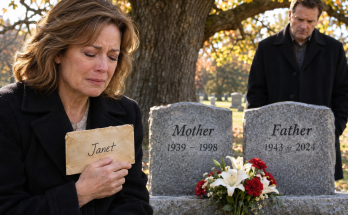
I went directly to the cemetery.
The grass was pale from the cold.
The old oak had lost most of its leaves.
I recognized Mom's headstone from a distance.
I walked toward it slowly.
Her name was still there.
So were the dates I knew by heart.
I stood beside the empty plot.
Dad had chosen it because he couldn't imagine resting anywhere else.
I remembered how often he had talked about being reunited with Mom.
Not dramatically.
Not as though he wanted his life to end.
Simply as somebody who had loved his wife and intended to remain beside her when the time came.
I brushed a few fallen leaves away from her headstone.
Then I stood quietly.
There was nobody else nearby.
“I found his letter, Mom.”
My voice sounded strange in the open air.
“He tried to make sure everything was done properly.”
I looked toward the oak.
“I'll bring him here.”
I stayed for a while.
Then I returned to Helen's office.
She had received additional information concerning the estate.
The evidence supporting Dad's concerns was becoming clearer.
Ray had been offered the opportunity to explain the disputed transactions and propose a way to address any financial responsibility established through the accounting.
Helen told me that he had begun discussing a resolution.
He wasn't admitting everything.
But he was no longer dismissing the matter as nonsense.
That was progress.
It wasn't the same as an apology.
I wasn't sure an apology would ever come.
Helen asked whether I wanted to pursue the matter through every available legal avenue.
I thought carefully before answering.
“I want Dad's wishes followed.”
She waited.
“And I want the estate made whole as far as the law allows.”
She nodded.
We discussed the possible arrangements.
Nothing would be finalized without proper documentation.
Nothing would depend on another verbal promise from Ray.
Dad had already experienced enough of those.
Before leaving, I asked whether Ray had brought the ashes.
Helen opened a cabinet.
Inside was another plain cardboard container.
I stopped moving.
“When did he bring that?”
“Yesterday afternoon.”
I looked at the box.
“He didn't say anything to me.”
“He asked that we contact you.”
Helen placed it on the desk.
I felt tears running down my face.
It was such an ordinary thing.
Another cardboard box.
But for weeks, I had been carrying the knowledge that Dad's remains were separated.
Now I could finally arrange to have them placed together.
I put my hand on the container.
Helen gave me a moment.
When I was ready, we discussed transferring the remains through the appropriate funeral professionals and completing the cemetery arrangements.
I wanted everything done respectfully.
No shortcuts.
No decisions made without proper consideration.
Dad deserved that much.
Later that afternoon, I sat in my car with his letter open across my lap.
I read the final page again.
Dad had written that money could be replaced.
Time couldn't.
He asked me not to allow the dispute to consume the rest of my life.
I understood what he meant.
He wasn't asking me to forget what Ray had done.
He wasn't asking me to surrender what was rightfully part of the estate.
He was asking me to remember that my own life still belonged to me.
I folded the letter carefully.
For the first time, I noticed that the original envelope had begun to soften along its creases.
The tape remained attached.
A few brown fibers were still caught beneath it.
I decided I would keep that envelope.
Not because it represented the money.
Because Dad had carried it with him when he didn't know who else he could trust.
He had found a way to protect his wishes.
A way to reach me.
And even after his death, his careful handwriting had accomplished what my brother's hurried arrangements couldn't prevent.
The truth had reached somebody willing to listen.
I called the cemetery before driving home.
We discussed the remaining requirements for Dad's interment.
I confirmed the plot beside Mom.
I asked about the possibility of a small, private service.
Nothing elaborate.
Just something respectful.
Something Dad would have recognized as his own.
When I ended the call, I looked at the two cardboard containers.
They would soon be entrusted to the funeral professionals.
They would no longer remain separated.
I still had an estate to settle.
There were financial matters that needed resolution.
There were conversations Ray and I hadn't finished.
But the decision about Dad's resting place was finally being made according to his wishes.
I started the car.
Then I looked toward the passenger seat.
“We're going to get you home, Dad.”
This time, I knew exactly where home was.
Click here to continue reading: PART 9: Under the Old Oak Tree, I Finally Honored the Promise My Father Had Made Long Before My Brother Took Control of Everything
I Drove Six Hours to Say Goodbye to My Father, but My Brother Had Already Made a Decision Neither of Us Could Undo
Part 8 of 10