I never received an explanation that made that Tuesday evening feel right.
Not about the money.
Not about the photograph.
Not about the difference between Rory's conversation with Sadie and the words he wrote beneath Madison's picture.
There were things I simply didn't know.
And I had to learn to live with that.
For a long time, I had believed that every painful family situation needed a confrontation before anyone could move forward.
Someone needed to answer for what happened.
Someone needed to admit they were wrong.
Someone needed to apologize.
Then, I thought, everyone could begin to feel better.
But Sadie's prom taught me something different.
Sometimes the person who disappointed you wasn't the person who helped you move forward.
Sometimes kindness came from somewhere else.
In our case, it came from Darla.
Rory's mother.
Sadie's grandmother.
Seventy-two years old.
A woman who had spent forty-one years working as a hairstylist in Howard.
A woman who had remembered every one of Sadie's birthdays.
Even during the terrible ice storm.
When I thought about what had happened, those were the details that stayed with me.
Not because I wanted to make Darla sound perfect.
I didn't believe anyone was perfect.
But she had been dependable.
And I had come to understand how valuable that was.
She hadn't needed to be reminded that Sadie belonged to her family.
She hadn't treated our divorce as the end of her relationship with her granddaughter.
She hadn't made Sadie responsible for disagreements between adults.
She had remained present.
Year after year.
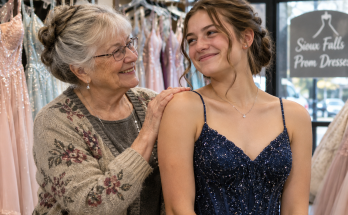
And when prom became another important moment in Sadie's life, she took her shopping in Sioux Falls.
That was the outcome I could speak about.
Not some dramatic apology from Rory.
Not a public argument beneath Tasha's photograph.
Not a confrontation that forced everyone to explain themselves.
A grandmother showing up for her granddaughter.
I realized that was a different kind of ending from the one I might once have wanted.
Years earlier, I might have called Rory the moment I saw the picture.
I might have demanded to know why Madison had a six-hundred-dollar gown while Sadie had been told there wasn't enough money.
I might have argued until we were both angry.
Then I might have told myself I had done everything possible for my daughter.
But an argument wouldn't necessarily have helped Sadie prepare for prom.
It wouldn't have changed the words she'd already heard.
And it might have made her feel that her disappointment had created another problem between her parents.
I was glad I hadn't done that.
Not because Rory's decision no longer mattered.
It did.
Not because Sadie had no reason to feel hurt.
She did.
And not because I believed a shopping trip could erase what had happened.
It couldn't.
I was glad because I had chosen to focus on helping my daughter instead of proving a point.
There was a difference.
A difficult one.
One I wished I had learned earlier.
The photograph itself never changed.
Madison was wearing the gown.
Tasha had posted the picture.
The dress had cost six hundred dollars and had been purchased in Sioux Falls.
Rory had left a proud comment.
Those facts remained exactly what they were.
But my understanding of what mattered had changed.
At first, I had treated the photograph like a question demanding an answer.
Why could Madison have that dress?
Why had Rory told Sadie there wasn't money?
Why had he publicly celebrated one girl's prom gown on the same evening he disappointed the other?
I had asked those questions in my head over and over.
But no amount of staring at the photograph told me who had paid for the gown.
No amount of rereading the comment revealed Rory's private thoughts.
And no amount of anger could tell me exactly what Sadie was feeling behind her bedroom door.
I had to accept the limits of what I knew.
That was one of the hardest parts.
As a mother, I wanted certainty.
I wanted to know what had happened, why it happened, and how to make everything better.
But life didn't always give me those answers.
Sometimes all I could do was respond to the facts in front of me.
My daughter was seventeen.
She was preparing for prom.
Her father had said he couldn't afford to help with a dress.
The same evening, a photograph appeared of his stepdaughter wearing an expensive gown.
And Sadie went upstairs quietly.
Those were the facts that made me call Darla.
I hadn't needed anything more.
I remembered the moment Darla asked whether Sadie was crying.
I could still hear the concern in her question.
She hadn't asked how to defend Rory.
She hadn't questioned whether I was exaggerating.
She hadn't turned the conversation toward herself.
She had asked about her granddaughter.
And I had been unable to give her a certain answer.
I hadn't seen Sadie cry.
I hadn't heard her crying.
I had only heard the bedroom door close.
For a while, that made me feel like I had failed to notice something important.
But I learned to think about it differently.
Sadie didn't owe me visible tears.
She didn't have to cry in front of me to prove that something mattered.
She didn't have to explain every feeling before I was allowed to care.
She was growing up.
She needed privacy.
And she needed a mother who could be available without demanding to be included in every thought.
That was a balance I was still learning.
I remembered how easily I had accepted her quiet answer at supper.
She had told Rory that she understood.
I had wanted to believe that meant she was handling the disappointment well.
Now I knew I needed to be more careful.
Understanding someone's explanation didn't mean you weren't hurt by it.
Accepting a decision didn't mean you agreed with it.
And staying quiet didn't mean you had nothing to say.
I had learned those things during my own marriage.
Yet I had almost forgotten to apply them to my daughter.
That was the part I regretted most.
Not that I hadn't confronted Rory.
I didn't regret choosing not to fight.
I regretted how long it took me to recognize that Sadie could be deeply disappointed without making a sound.
I hoped I would remember that lesson whenever she faced something difficult in the future.
I couldn't know what every future disappointment would look like.
I couldn't protect her from all of them.
But I could make sure she didn't feel that she had to hide her feelings just to keep the peace at home.
I could listen.
I could ask gently.
And I could accept her answer without deciding for her how she was supposed to feel.
That was something I could control.
Unlike Rory's choices.
Unlike Tasha's photographs.
Unlike the way other families spent their money.
I thought about Madison one last time.
She had been smiling in a beautiful gown.
She was also seventeen.
I didn't want the photograph to become a reason for anyone to resent her.
She deserved to enjoy her prom.
So did Sadie.
Those two wishes were not in conflict.
There was enough room in the world for both girls to have happy memories.
The problem had never been that Madison received something beautiful.
The problem was the painful contrast between that public celebration and what Sadie had been told earlier.
I knew the distinction mattered.
It kept me from blaming a teenager for the choices of adults.
It also kept me from turning the shopping trip into a contest.
I didn't need Sadie to wear a more expensive dress than Madison.
I didn't need her to prove she was prettier.
I didn't need anyone to compare photographs.
I wanted her to feel comfortable and valued.
I wanted prom to belong to her.
And I wanted Darla's kindness to stand on its own.
Not as an accusation.
Not as revenge.
As love.
I thought about Sioux Falls again.
The name had appeared in two different parts of the experience.
First, in the photograph of Madison's expensive gown.
Then, when Darla took Sadie shopping.
I found something meaningful in that.
The same city.
Two different experiences.
One had been attached to a painful moment.
The other to a grandmother's willingness to help.
I didn't need to invent details about which shops they visited or which dresses they considered.
I didn't need to pretend I knew every conversation they had.
What mattered was already clear.
Darla had personally taken Sadie shopping.
She had made time for her granddaughter.
And she had done something practical when Sadie needed support.
That was enough.
I used to think that family love was best measured by big gestures.
The expensive present.
The public celebration.
The photograph shared for everyone to see.
But the older I became, the less convinced I was.
A picture could show a beautiful dress.
It couldn't tell the whole story of a family.
It couldn't show every sacrifice someone had made.
It couldn't prove who cared the most.
And it couldn't tell you how someone behaved when nobody else was watching.
That was what I kept thinking about when I remembered Darla.
Her kindness hadn't begun with prom.
It was part of a much longer pattern.
Seventeen years of remembering Sadie.
Seventeen years of remaining her grandmother through changes in the family.
Forty-one years of working.
Seventy-two years of living.
And one evening when she listened to me explain something difficult.
Then asked about the girl who might be crying.
That was the question I would remember.
Not because it was clever.
Not because it solved everything.
Because it placed Sadie exactly where she belonged.
At the center.
I thought about the night I made chili.
How ordinary it had seemed before Rory called.
How quickly the mood had changed.
How little Sadie had said.
I could still picture the bowl.
The spoon.
The phone.
The kitchen table.
For a while, those objects had reminded me only of disappointment.
Now they reminded me of a decision.
The decision not to call Rory.
The decision not to argue.
The decision to reach out to someone who loved Sadie.
That decision hadn't answered every question.
But it had led to something good.
Darla took her granddaughter shopping for prom.
I wished the circumstances had been different.
I wished Sadie hadn't first had to hear that her father couldn't afford to help.
I wished the photograph hadn't appeared at such a painful moment.
I wished Rory had considered how his public comment might look to his daughter.
Those wishes didn't disappear.
I could acknowledge them without letting them control everything that followed.
I could be disappointed in how he handled the situation and still refuse to make Sadie carry my disappointment.
I could appreciate Darla without expecting her to repair every mistake her son made.
And I could love my daughter without promising her a world where nobody would ever let her down.
That was the balance I wanted to keep.
There was a cost to what had happened.
Sadie had received an answer from her father that she hadn't wanted.
She had experienced a moment that should have been about excitement as a disappointment instead.
And I had been reminded, painfully, that there were parts of her relationship with Rory I couldn't fix.
Darla's kindness didn't erase those things.
It simply meant they weren't the only things left standing.
There was also care.
There was also family.
There was also someone willing to help.
I couldn't say exactly what Sadie would remember years later.
Maybe the phone call.
Maybe the photograph.
Maybe the shopping trip with her grandmother.
Maybe all three.
Her memories would belong to her.
I had no right to decide which ones should matter most.
But I knew what I would remember.
I would remember a seventeen-year-old girl at a kitchen table, being far more understanding than she should have needed to be.
I would remember a photograph posted at 9:40 that made me question the choices of a man I had once married.
I would remember choosing not to fight him.
And I would remember calling his mother.
Darla Lindstrom.
The woman who had always remembered Sadie's birthdays.
The woman who listened to what happened and cared enough to ask whether her granddaughter was crying.
The woman who took Sadie shopping in Sioux Falls.
I hadn't expected that quiet phone call to become the part of the story that mattered most to me.
But it did.
Because I had spent so many years wishing I could make Rory a different kind of father.
That evening reminded me to pay attention to the people who were already showing my daughter love.
Darla was one of them.
And I was grateful.
Not because everything had been made right.
Not because the questions about the photograph had been answered.
But because Sadie hadn't been forgotten.
She had someone who cared enough to show up.
And sometimes, when a child has been disappointed, that is the thing that matters most.
The End
Read more original stories on Feel Every Story.
My Daughter Accepted Her Father’s Excuse About Prom, but One Photograph That Night Made His Words Hard to Believe
Part 10 of 10