I put the knife down.
Alden was sitting at the kitchen table.
His hands were folded in front of him.
He looked toward the window once.
Then back at me.
"I've been thinking about what you said."
I waited.
He cleared his throat.
"About the account."
I pulled out the chair across from him.
I sat down.
For days, I'd wondered whether we'd ever have this conversation without shouting.
Now that it was happening, I didn't want to rush it.
"What have you been thinking?"
He looked at his hands.
"Maybe I handled it badly."
I felt a small ache in my chest.
Not because the words were cruel.
Because I'd wanted to hear something like them for so long.
"Yes," I said. "You did."
He nodded.
"I thought I was making things easier."
"For whom?"
He looked up.
I hadn't meant to sound sharp.
But the question was fair.
He thought about it.
"Mostly for me, I guess."
I didn't answer.
He rubbed one thumb against the other.
"I get tired, Joanne. You know that."
"I do."
"I spend long days driving. I worry about bills. Sometimes I just want to come home and not think about money."
I listened.
Those things were true.
His work was tiring.
The bills were real.
And we'd both spent years worrying about whether everything would get paid.
But that hadn't been the problem.
"I understand wanting less to worry about," I told him.
He nodded.
"Exactly."
"But shutting me out didn't make the worry disappear."
He looked at me.
"It just meant I had to worry without being able to do anything about it."
He lowered his eyes.
I continued.
"When you took away my access, I didn't know what I was supposed to do if I needed money while you were gone."
He shifted in his chair.
"You could have called me."
"And asked permission?"
"I wouldn't have said no."
"That's not the point."
He looked frustrated.
I knew he wanted me to accept that explanation.
For years, I probably would have.
I would have told myself that Alden meant well.
That he was tired.
That he wasn't trying to hurt me.
But intentions didn't change what had happened.
I'd been left without access to the money we'd used for our household.
And he'd acted as though I ought to be grateful.
"I need to be able to take care of myself," I said.
"You've always been able to."
"Then why did you decide I shouldn't have access to our account?"
He didn't answer immediately.
The clock ticked.
I could hear a faint bleat from outside.
Alden looked toward the pasture.
"I don't know."
It was a quiet answer.
I believed him.
Not because he had no reason.
Because I suspected he'd never truly questioned his right to make that decision.
He'd earned the paycheck.
He'd decided that made him the person in charge.
Everything else had followed.
I took off my glasses.
I set them on the table.
"Do you remember what you said when you told me?"
He rubbed his forehead.
"Not every word."
"You laughed."
He looked uncomfortable.
"I was joking."
"You told me that since you brought home the money, you ought to be the one deciding how it was handled."
He looked down.
"And when I asked what I was supposed to do, you made another joke."
"I didn't mean to hurt you."
"I know you may not have meant to."
I stopped.
Then I said the part I'd been carrying for two weeks.
"But you did."
He sat very still.
I hadn't raised my voice.
I hadn't accused him of anything beyond what he'd done.
That seemed to make the words harder for him to dismiss.
After a while, he spoke.
"I'm sorry, Joanne."
I looked at him.
He hadn't added an excuse.
He hadn't blamed his work.
He hadn't told me I was being sensitive.
Just those words.
I let them settle.
"Thank you."
He nodded.
Then he looked toward the drawer where the old deed was kept.
"I still don't like the way you went about that pasture."
I almost laughed.
Of course he didn't.
I could understand that he'd been startled to come home and find the field changed.
A new fence.
A wooden sign.
Thirty-seven goats.
And a signed lease he'd known nothing about.
"I understand why it surprised you."
"Surprised me?"
He shook his head.
"I thought I'd come home to the wrong farm."
I smiled a little.
He noticed.
For the first time since he'd returned, he smiled back.
It didn't last long.
He became serious again.
"But you really did have the right to sign that lease."
"Yes."
He nodded slowly.
"I looked at the deed again."
I waited.
"I'd forgotten how clearly your father arranged everything."
I thought about Daddy.
His careful handwriting.
The old folder.
The way he'd insisted I keep important documents somewhere safe.
"That was important to him."
"I know."
"He wanted me to be secure."
Alden looked at me.
"Have I made you feel insecure?"
The question was so direct that I almost avoided answering.
Almost.
"Yes."
He took a breath.
I could see that the answer hurt him.
I didn't enjoy that.
But I wasn't going to take it back.
He needed to understand.
For years, I'd measured my words according to how they might affect his mood.
I'd learned when to stay quiet.
When to apologize.
When to make another cup of coffee and let an argument disappear.
But disappearing arguments hadn't solved anything.
They'd only left me carrying things I never said.
Alden leaned forward.
"What do you want me to do?"
I thought about it.
I had spent days considering that very question.
At first, I'd wanted him to feel the same helplessness I'd felt when he removed me from our account.
I'd wanted him to understand what it was like to discover that someone else had made an important decision without consulting him.
The pasture had accomplished that.
But I didn't want to spend the rest of our marriage finding new ways to hurt each other.
I wanted something different.
"I want us to make financial decisions together."
He nodded.
"And I want access to the household money."
"All right."
"And I intend to keep my own account."
His eyes moved toward me.
I could tell that part was harder.
"Why?"
"Because the rent is income from my land."
"We're married."
"I know."
"Shouldn't we share things?"
I looked at him.
"That's exactly what I've been asking you."
He fell silent.
Then he nodded.
"Fair enough."
I wasn't certain he liked it.
But he'd heard me.
That mattered.
He asked whether I'd be willing to discuss the household expenses again.
I said yes.
We talked about what needed paying.
About the money he earned.
About the things I handled at home.
For the first time in a long while, he didn't speak as though his work was the only contribution that counted.
I noticed that.
I also noticed how unfamiliar it felt.
At one point, he said he'd thought I didn't want to deal with the finances.
I looked at him.
"I wanted to be included."
He nodded.
"I see that now."
We didn't solve everything that evening.
There were still details to arrange.
Banking access.
Regular expenses.
The income from the pasture.
And the ordinary decisions that had somehow become arguments between us.
But we began talking about them.
That was more than we'd done before.
A few days later, we went through the household papers together.
Alden brought the information from the account he'd been controlling.
I brought the lease and the records for my new account.
We sat at the kitchen table.
The same table where he'd demanded to see the deed.
The same table where he'd asked who gave me permission to rent my father's pasture.
This time, neither of us shouted.
We took our time.
We checked figures.
We discussed what belonged where.
When Alden didn't understand something, he asked.
When I disagreed, I said so.
Sometimes he looked annoyed.
Sometimes I did, too.
But neither of us walked away simply because the other had an opinion.
One afternoon, Miriam came by to ask about the pasture gate.
Alden was on the porch.
I was inside.
I heard her call my name.
Before, Alden might have answered for me.
This time, he opened the door.
"Joanne, Miriam's here about the lease."
He stepped aside.
I went out.
Miriam smiled.
We spoke about the gate and the fencing.
Alden listened.
He offered a suggestion about keeping one section easier to reach for maintenance.
Miriam considered it.
I agreed that it made sense.
And that was that.
No shouting.
No argument about whose land it was.
Just three people discussing something that needed doing.
After Miriam left, Alden stood beside me.
He looked toward the goats.
"They've certainly taken care of that tall grass."
"They have."
He nodded.
"I suppose there's some benefit to having them around."
I smiled.
"More than one."
He glanced at me.
"Don't get carried away."
But there was no anger in his voice.
That evening, I made supper.
Not because Alden expected it.
Because I wanted to.
He came into the kitchen while I was finishing.
He asked whether I needed help.
I handed him the plates.
He set the table.
It was a small thing.
I knew that.
But after everything we'd said, small things had begun to matter.
We ate together.
Alden told me about his next driving schedule.
I told him when Miriam's family expected to check the fence.
He asked a question about the lease.
I answered it.
We talked about the weather.
The truck.
The old oak tree.
Ordinary things.
After supper, he carried his plate to the sink.
I watched him rinse it.
Then he turned toward me.
"You know, Joanne, I really was surprised when I saw that sign."
"I could tell."
He shook his head.
"Thirty-seven goats."
I laughed.
I couldn't help it.
He smiled.
Then his expression grew thoughtful.
"Your daddy would've been pleased you kept those papers."
I looked toward the drawer.
The old deed was inside.
Forty-five years earlier, Daddy had made certain that pasture belonged to me.
For much of my marriage, I'd treated that fact as something unimportant.
Something I didn't need to mention.
Something that might cause trouble if I insisted on it.
But Daddy hadn't given me the land so I could spend my life afraid to use it.
He'd given it to me because he wanted me to have something secure.
I understood that better now.
Later that night, I stepped onto the porch.
The air was cool.
The gravel driveway was quiet.
The old oak stood where it always had.
Beyond it, the new fence marked the pasture.
I could just make out the sign hanging on the gate.
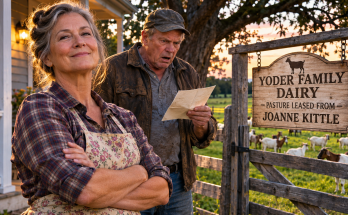
YODER FAMILY DAIRY – PASTURE LEASED FROM JOANNE KITTLE
Alden came outside.
He stood beside me.
For a while, neither of us spoke.
Then a goat called from somewhere in the dark.
Alden sighed.
"Still can't believe you put goats out there."
I smiled.
"I know."
He rested his hands on the porch railing.
I looked at him.
He was still my husband.
We still had years of habits to work through.
One apology hadn't fixed all of them.
One conversation hadn't erased how small I'd felt.
And one signed lease couldn't guarantee he'd never make another decision without consulting me.
I knew that.
I wasn't going to pretend otherwise.
But the account had been discussed.
My own income was being recognized.
The deed was no longer something Alden could ignore.
And I'd learned that speaking plainly didn't have to mean the end of our marriage.
It could mean we finally understood what needed to change.
Alden turned toward me.
"Are we all right?"
I thought about that.
I could have told him yes.
I could have smiled and let the question pass.
That was what the old Joanne would have done.
Instead, I gave him the answer I believed.
"We're working on it."
He nodded.
"All right."
Then he went back inside.
I stayed on the porch a few minutes longer.
The goats moved quietly beyond the fence.
My name hung on the gate.
And for the first time in years, I didn't feel the need to explain why it belonged there.
Click here to continue reading: PART 9: Just When I Thought My Husband Finally Understood, One Ordinary Morning Forced Us to Face What His Apology Had Not Yet Fixed
After Fourteen Hours on the Road, My Husband Came Home Expecting Dinner, but I Had Something Else Waiting for Him
Part 8 of 10