The first time I returned to Grandma Eleanor's cottage, I cried before I reached the front door.
Fred had driven me there on a clear Saturday morning.
Gregory had arranged the visit through the trustee overseeing the property.
We were permitted to inspect the house and garden while the legal matters continued.
I had imagined the visit many times.
I thought I would walk through every room.
Look at the furniture.
Remember the afternoons I spent there as a child.
But when Fred parked, I stayed in the passenger seat.
The roses were visible from the driveway.
They had grown wild.
Some branches bent toward the walkway.
Others had spread beyond the garden beds.
The bushes had not been carefully maintained.
But they were alive.
I stared at them.
Fred turned off the engine.
"Take your time."
I nodded.
Then I started crying.
It wasn't the kind of crying that comes suddenly and stops.
It was quiet.
Tired.
The kind that happens when you have been holding yourself together for too long.
Fred waited.
Eventually, I opened the door.
The gravel shifted beneath my shoes.
I walked toward the garden.
I remembered Grandma handing me a small pair of gardening gloves.
I remembered how carefully she showed me where to cut dead stems.
I remembered worrying that I would damage the plants.
She always told me they were stronger than they looked.
I stood beside one of the rosebushes.
A few flowers were still blooming.
I touched a branch gently.
Then I looked at the cottage.
For years, my mother had controlled the information surrounding this place.
She had controlled the paperwork.
The correspondence.
The decisions I was supposedly allowed to make.
But standing there, I felt something she had never managed to take from me.
My memories.
They belonged to me.
No signature could transfer them.
No company could invoice them away.
Fred came to stand beside me.
"Want to go inside?"
I nodded.
The house smelled faintly of dust and old wood.
Some rooms were nearly empty.
Other pieces of furniture remained.
The kitchen table was still there.
I recognized it immediately.
I put my hand on the edge.
I had eaten breakfast there.
I had listened to Grandma tell stories there.
I had once sat at that table with a school assignment spread across it while she worked nearby.
I remembered being impatient.
I remembered thinking I had all the time in the world to ask her questions.
Now I would have given almost anything for another afternoon.
Fred stood quietly behind me.
I pulled out one of the chairs.
It made the familiar scraping sound against the floor.
I sat down.
For several minutes, I simply looked around.
Then I took Grandma's letter from my purse.
I had brought it deliberately.
I unfolded the pages.
I read them again at her kitchen table.
The place where she had once told me stories about our family.
The place where I had never imagined she was preparing to protect me from them.
I understood more now.
Not everything.
But enough.
She had seen how easily I apologized.
How often I backed down.
How I tried to make myself smaller whenever someone else became upset.
She had wanted me to have choices.
And she had created the trust because she feared I would never claim those choices for myself.
I folded the letter carefully.
Then I looked at Fred.
"I wish she'd known I finally found out."
He sat beside me.
"Maybe she always believed you would."
I wanted to believe that.
I still do.
The legal proceedings continued for months.
There were more meetings.
More documents.
More difficult conversations.
The final accounting revealed that Whitcomb Family Holdings had received payments unsupported by adequate records.
The amounts were substantial.
Not every transaction was disputed.
Some maintenance expenses had been legitimate.
But others had been billed more than once, poorly documented, or paid for work that investigators could not verify had occurred.
The estate proceedings resulted in an agreement requiring repayment of improperly received funds.
My mother's company lost its role in managing trust-related services.
Independent administration was put in place.
The disputed authorizations bearing my name were rejected.
The court accepted the evidence that I had not knowingly appointed my mother to act for me.
The trust remained in effect according to Grandma's instructions.
I was formally recognized as its primary beneficiary.
I remember the day Laura called to confirm that last part.
I was at home.
Fred was in the kitchen.
I listened while Laura explained the ruling and the remaining administrative steps.
Then I asked her to repeat one sentence.
She did.
The trust would be administered for my benefit under the terms Grandma had established.
I closed my eyes.
It was not the money that made me cry.
It was the recognition.
For years, documents had claimed I had agreed to things I had never seen.
Now the legal record reflected what I had actually said.
My name belonged to me again.
The financial settlement did not leave my mother untouched.
Her company had to surrender records and repay funds.
She was no longer permitted to direct trust business.
Her attorney negotiated a repayment arrangement for the amounts covered by the agreement.
I was told the financial consequences would be significant.
I did not celebrate that.
I had never wanted to ruin her.
But I would not pretend the losses were unfair simply because they hurt her.
She had made choices involving property that was not hers to control.
Those choices had consequences.
The matter involving the baby shower was separate.
That investigation took longer than I expected.
Investigators reviewed the digital messages.
The bakery records.
The laboratory findings.
The missing medication.
And statements from the people who had been present.
Terrence cooperated.
So did Fred.
Kelly provided copies of the screenshots we had sent her that afternoon.
The investigators also examined the history I had described.
The switched cookie labels.
The injector that disappeared during my teenage camping trip.
The catering restriction Michaela removed before my wedding.
Those older incidents were difficult to establish conclusively after so many years.
I understood that.
I had no way to prove who had switched the cookie labels.
I could not establish who put my missing injector in the bathroom trash when I was a teenager.
I could not prove that every event had been deliberate.
But I no longer needed to pretend they had all been harmless.
The baby shower had its own evidence.
Evidence that could be examined without relying on my childhood memories.
The laboratory confirmed the walnut content.
The messages identified the blue plate and referred to hiding my injectors.
The bakery order contradicted Michaela's claim that the tart had been prepared without tree nuts.
And the witnesses described what happened that afternoon.
Eventually, criminal charges were filed against Michaela in connection with the attempted exposure and interference involving my emergency medication.
The prosecutors did not claim they could prove she intended to kill me.
They focused on the conduct supported by the evidence.
I was relieved by that distinction.
I did not want anyone making the case more dramatic than the facts allowed.
The truth was terrible enough.
Michaela's attorney initially described the situation as a family misunderstanding.
That explanation became harder to maintain as the records were reviewed.
Later, through counsel, Michaela accepted responsibility for knowingly presenting food containing walnuts after assuring me it was safe.
She also admitted arranging for my emergency injectors to be removed from my purse.
I remember reading the formal statement.
I was sitting at the same kitchen table where I had first opened the laboratory report.
Fred was beside me.
I read the admission twice.
Then I put the paper down.
For months, I had wanted to know whether she would finally acknowledge what she had done.
Now she had.
And it did not make me feel better.
I felt exhausted.
There was no explanation that could make those actions safe.
No excuse that could change the risk.
I asked the prosecutor whether Michaela had explained why she did it.
He told me she had described feeling desperate about the estate dispute and afraid I would interfere with the family's financial arrangements.
I listened.
Then I asked whether she had understood my allergy could be life-threatening.
He said her statement acknowledged that she knew my condition was serious.
I closed my eyes.
That was the answer I had been afraid of.
She knew.
She had always known.
The court ultimately imposed a sentence that included supervised probation, restrictions on contacting me, and other conditions.
The exact outcome did not satisfy everyone.
Some relatives thought it was too harsh.
Others thought it was too lenient.
I stopped listening to those arguments.
The court had made its decision.
The evidence had been examined.
Michaela had accepted responsibility for the conduct at the shower.
And I no longer had to persuade my family that the danger had been real.
My mother was not charged in that same proceeding.
Her role in the messages and the estate dispute had been investigated, but the authorities did not establish criminal responsibility for the food incident to the standard required for charges.
I was disappointed.
I will not pretend otherwise.
I still remembered the message asking whether I had received the blue plate.
I still remembered her hanging up when I asked who Ashby was.
But disappointment did not give me the right to invent certainty where the evidence had not established it.
I had spent too many years being told what had supposedly happened.
I wanted my own account to be different.
I wanted to say only what I knew.
My mother had concealed information about the trust.
She had participated in disputed estate arrangements.
She had acknowledged knowing I was supposed to receive notice.
And she had defended Michaela after the baby shower instead of asking whether I was safe.
Those facts were enough to change our relationship.
I did not need to add anything.
Terrence and Michaela separated after the proceedings began.
He told me the marriage had become impossible to continue as it had been.
I did not ask for details.
I knew he was trying to decide what was best for himself and their child.
By then, Michaela had given birth.
A healthy baby girl.
When Terrence told me, I cried.
I was relieved the baby was safe.
And sad that I could not share the moment the way I once imagined.
There had been a time when I expected to be the aunt who arrived with gifts.
The one who babysat.
The one who made birthdays special.
I had pictured holding Michaela's baby while she laughed at how nervous I was.
Those plans had disappeared.
Not because I stopped caring.
Because the circumstances had changed.
Terrence sent me a photograph.
I looked at it for a long time.
The baby had tiny fingers curled against her cheek.
I told him she was beautiful.
Then I put the phone down.
I cried for the relationship I could no longer safely have with her mother.
That loss was real.
It did not become less real because Michaela had done something terrible.
People sometimes expect you to stop loving someone the moment you learn what they are capable of.
I wish it worked that way.
It would have been easier.
But I still remembered the girl who slept on my floor.
I still remembered her laughing during our late-night conversations.
I still remembered the sister I believed I had.
I could miss those things without allowing her back into my life.
That distinction took time to learn.
My mother eventually sent a letter.
A real letter.
Not a text demanding an apology.
Not a message passed through another relative.
An envelope addressed directly to me.
I recognized her handwriting.
I almost left it unopened.
Then I sat at the kitchen table and read it.
She wrote that she had convinced herself she was protecting the family.
She admitted that she resented Grandma for leaving the trust primarily to me.
She said she had believed Michaela needed the money more.
She said she had thought I would be able to manage without it.
I read that sentence several times.
Manage without it.
That was what she had always expected of me.
When Michaela needed help, I was supposed to understand.
When Mom needed something, I was supposed to cooperate.
When I needed protection, I was supposed to manage.
I had made a career of being responsible.
Somewhere along the way, my family had decided that meant I did not require the same consideration as everyone else.
The letter continued.
My mother said she regretted allowing the estate dispute to damage our relationship.
She apologized for concealing information.
She did not fully address the baby shower.
She wrote that she hoped I could eventually forgive Michaela.
I folded the letter.
Then I unfolded it.
I wanted to find something else.
A sentence asking how I had felt when my injectors were missing.
An acknowledgment that my sister could have caused a medical emergency.
A question about whether I had been frightened.
There was nothing.
I sat there until Fred came home.
He saw the letter.
"From your mother?"
I nodded.
He asked whether I wanted to talk about it.
I told him I needed a little time.
He kissed my forehead and left me alone with it.
I never wrote back.
Not because I wanted to punish her.
Because I had spent years giving explanations to someone who rarely listened.
This time, silence was the clearest answer I could give.
Several months after the estate matter was resolved, I made a decision about Grandma's cottage.
I did not sell it.
At least, not then.
The trust had other assets, and independent financial advisers helped me understand the costs of maintaining the property.
I wanted to make a careful decision.
Not an emotional one.
Not one driven by guilt.
I visited the cottage several times.
Eventually, I hired someone to help restore the garden.
The first day we worked on the roses, I brought Grandma's old gardening gloves.
They were still in a drawer near the back door.
The leather had stiffened.
The fingertips were worn.
I held them for a long time.
Then I set them on the kitchen table.
I used my own gloves.
Some things deserved to be kept.
Not because they were valuable.
Because they reminded me who I had been before everything became complicated.
Fred helped me carry bags of garden waste.
We cleared dead branches.
We trimmed what could be saved.
We left the healthiest rosebushes in place.
By the end of the afternoon, the walkway was visible again.
I stood near the porch and looked at the garden.
It was not perfect.
There was still work to do.
But I could see its shape.
I thought about how much that resembled my life.
For years, I had allowed other people's demands to grow around me.
A little guilt here.
A small apology there.
One more misunderstanding I was expected to overlook.
Eventually, I had stopped seeing how much space those demands occupied.
Now I was clearing them away.
Not all at once.
Not without pain.
But carefully.
Fred came to stand beside me.
"Looks better."
I nodded.
"It does."
He put an arm around my shoulders.
We stayed there until the afternoon began to cool.
I still worked as a clinical pharmacist.
The inheritance did not make me abandon the life I had built.
I liked my work.
I liked being useful.
I liked knowing that careful attention to details could keep someone safe.
If anything, what happened made that responsibility feel more personal.
I became even more aware of how important it was for people with serious allergies to have reliable access to their prescribed emergency medication.
I had known the clinical facts for years.
But now I also understood how frightening it was to reach for protection and discover it was gone.
I kept my replacement injectors where I could check them.
I checked their expiration dates.
I made sure Fred knew where they were.
I stopped apologizing when I asked questions about food.
If someone could not confirm ingredients, I did not eat it.
No embarrassment.
No guilt.
No arguments.
My safety was not an insult to anyone.
I wish I had understood that sooner.
The trust eventually came under stable independent administration.
The properties were accounted for.
The repayment arrangement continued under the agreement.
The documents that had falsely represented my consent no longer controlled anything.
For the first time, I received statements directly.
They came to my actual address.
The one my mother had known all along.
Sometimes I still found that detail difficult to accept.
Such an ordinary thing.
An envelope arriving where it was supposed to arrive.
And yet it represented something I had been denied for years.
The right to know what concerned me.
The right to make my own decisions.
The right to say no.
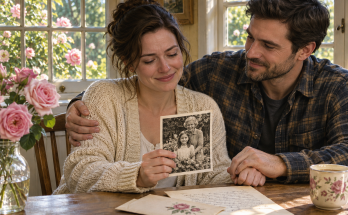
One evening, almost a year after the baby shower, I sat at Grandma's kitchen table with Fred.
We had spent the day working in the garden.
The roses were beginning to bloom again.
I had brought a small box of old photographs from the house.
We looked through them together.
There were pictures of Grandma when she was younger.
Pictures of the cottage.
Pictures of family gatherings.
And one photograph of me as a child.
I was standing beside the rosebush near the porch.
Grandma was behind me.
Her hand rested on my shoulder.
I looked terribly serious.
Fred laughed softly.
"You looked like you were in charge of the entire garden."
I smiled.
"I probably thought I was."
I studied the photograph.
I remembered that afternoon.
Not every detail.
Just the feeling of standing beside Grandma.
The warmth.
The smell of the garden.
The certainty that I was safe with her.
For years, I had thought her greatest gift was making me feel loved.
I still believed that.
But now I understood she had done something else.
She had tried to protect the person I would become.
The trust had been her way of giving me choices.
The letter had been her way of telling me to use them.
I placed the photograph beside the envelope.
Fred reached across the table and took my hand.
"Do you regret any of it?"
I knew what he meant.
The investigation.
The legal proceedings.
The distance from my mother.
The loss of my relationship with Michaela.
I thought carefully before answering.
"I regret that it happened."
He nodded.
"But I don't regret finding out."
I looked toward the kitchen window.
The roses were visible outside.
I thought about the blue ceramic plate.
It had been preserved as evidence.
I never asked for it back.
I did not want it.
That plate belonged to the afternoon when I finally learned that being related to someone did not make them safe.
The cottage belonged to something different.
A woman who had seen my fear.
Who had noticed how easily I gave up my own needs.
Who had wanted me to grow into someone capable of protecting herself.
I wished Grandma could have seen the garden.
I wished I could tell her about Fred.
About Gregory.
About Laura.
About the people who had helped me when I finally stopped pretending everything was fine.
Most of all, I wished I could tell her I understood her letter.
I looked down at the photograph.
Then I spoke quietly.
"Thank you, Grandma."
Fred squeezed my hand.
Outside, the roses moved gently in the breeze.
I sat there for a while.
No phone ringing.
No one demanding an apology.
No family argument waiting for me to fix it.
Just my husband beside me.
Grandma's letter on the table.
And a life I finally understood belonged to me.
I had once believed keeping my family together meant forgiving everything.
Now I knew better.
Love could be real.
Memories could be precious.
And someone could still lose the right to be part of my life because of what they chose to do.
I did not need to hate my mother.
I did not need to stop caring about Michaela.
I did not need to pretend the past had been entirely bad.
I simply needed to stop allowing the good memories to excuse the dangerous ones.
That was the lesson I carried out of Grandma's cottage that evening.
I had survived the baby shower because Fred saw something wrong and warned me.
I had uncovered the estate deception because I finally asked questions my family did not want to answer.
And I had kept my freedom because, for once, I refused to surrender it to make someone else comfortable.
The money gave me security.
The truth gave me a choice.
But Grandma had given me something even more important.
She had believed I deserved both.
It took me thirty-four years to believe it too.
The End
Read more original stories on Feel Every Story.
The Lawyer Who Had Been Looking for Me Since August Knew Something About My Family That I Had Never Been Told
Part 10 of 10