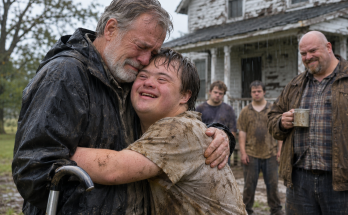
I didn't move.
Pruitt looked at me as though he expected me to obey him.
I wasn't going anywhere without Tucker.
My son was still holding my arm.
I could feel the cold dampness of his shirt against my sleeve.
"Come on, Tucker. We're leaving."
Tucker looked toward the ditch.
"But I didn't finish, Dad."
"You don't have to finish it."
"Mr. Pruitt said I have to."
I looked directly at Pruitt.
"He's coming with me."
The man lowered his coffee mug.
"You take him off this property, and we're going to have a problem."
"We already have one."
My brother stepped closer.
I was grateful for that.
I didn't know what Pruitt might do, and I was in no condition to defend myself physically.
Thirty years of coaching wrestling didn't mean much when I needed a cane to stay upright.
But I had something better than physical strength.
I had the truth.
"Did my wife show you any court documents giving her authority over my son?"
Pruitt frowned.
"She signed everything I needed."
"That's not what I asked."
He looked irritated.
"I've got her signature."
"She's not his legal guardian."
For the first time since he'd walked outside, he stopped smiling.
I explained that the court had appointed me as Tucker's guardian after his eighteenth birthday.
I told him Brenda had no authority to place Tucker in his care.
Pruitt looked toward the farmhouse.
Then he looked back at me.
"That's between you and your wife."
"No. You're keeping my son here."
I reached into my pocket for my phone.
My fingers weren't cooperating.
I nearly dropped it.
My brother took it from me.
"Who do you want me to call?"
"The sheriff."
Pruitt straightened.
"There isn't any reason to involve the police."
I looked at the two young men who were still standing beside the ditch.
They hadn't resumed digging.
They were watching us.
"I think there is."
My brother made the call.
He explained where we were, what we had discovered, and that I was the legal guardian of a young man being held at the property.
He also mentioned the conditions outside.
The rain.
The shovels.
The men without coats.
Pruitt began walking toward the farmhouse.
"You're making a big mistake."
I didn't answer.
Tucker looked frightened.
"Am I in trouble, Dad?"
"No, buddy."
"Because I stopped digging?"
"No."
I put my hand against his cheek.
"You haven't done anything wrong."
He nodded, but he didn't look convinced.
That was the first time I understood how deeply this place had affected him.
My son had always liked doing a good job.
There was nothing unusual about that.
But now he seemed afraid of disappointing somebody who controlled whether he ate.
I couldn't imagine how many times he'd heard those instructions.
I couldn't imagine how often he'd gone to bed wondering whether he'd been good enough.
My brother helped Tucker into the car.
He turned on the heater.
I stayed near the vehicle, leaning heavily against my cane.
I wasn't going to leave the other men without telling somebody what I'd witnessed.
One of them looked at me.
He was still holding his shovel.
"Are we allowed to stop?"
That question nearly finished me.
"Put it down, son. Get yourself out of the rain."
He glanced toward the farmhouse before lowering the shovel.
The other young man followed him.
Neither seemed comfortable making that decision.
I wondered how long they'd been taught that permission was something they needed for everything.
When the sheriff's deputies arrived, Pruitt came outside again.
He had changed his expression.
The arrogance was gone.
Suddenly, he was a man dealing with an unfortunate misunderstanding.
He described Sunny Acres as a residential arrangement for adults who needed structure and supervision.
He said the men enjoyed working outdoors.
He claimed Brenda had voluntarily enrolled Tucker.
One deputy listened to him.
The other spoke to me.
I explained everything from the beginning.
My stroke.
The rehabilitation center.
The telephone calls.
The empty bedroom.
The ditch.
The deputy asked whether I could produce evidence of my guardianship.
I told him where the documents were kept at home.
My brother offered to retrieve them.
But the deputy said they could begin looking into the matter immediately.
He wanted to speak with Tucker.
I asked him to be patient.
Not because Tucker couldn't answer questions.
Because I didn't want another stranger making him feel as though he'd done something wrong.
The deputy crouched beside the open car door.
His voice was gentle.
"What's your name?"
"Tucker."
"Do you want to stay here, Tucker?"
My son shook his head.
"I want to go home with Dad."
"Has anybody told you that you aren't allowed to leave?"
Tucker looked toward Pruitt.
Then he looked down.
"He says I have to work here."
The deputy asked about meals.
Tucker explained the digging.
He explained that finishing his work meant he could have supper.
He said it with the seriousness of somebody describing an ordinary rule.
The deputy's expression changed.
He stood up and went to speak with his colleague.
Another call was made.
Additional officers arrived.
So did emergency medical personnel.
I watched them approach the farmhouse.
Pruitt insisted that he hadn't mistreated anybody.
He kept referring to paperwork.
But paperwork couldn't explain why those men had been working without coats.
It couldn't explain why Tucker looked so thin.
And it couldn't make Brenda my son's guardian.
Eventually, someone asked me whether I wanted to accompany the officers inside.
I said yes.
My brother helped me toward the porch.
Every step hurt.
I climbed anyway.
Inside, there was a smell of damp clothing and stale food.
The building felt cold.
Much colder than a home occupied by people who needed proper care should have felt.
There were blankets spread across the floor.
Thin ones.
Some were folded against the walls.
Others looked as though somebody had recently been sleeping on them.
I searched the room for beds.
There weren't any.
Not proper ones.
An officer began asking Pruitt how many residents lived there.
His answers became less definite.
The officers eventually accounted for nine adults.
Nine people with disabilities.
Nine people who should have been receiving appropriate support.
And nine people sleeping on floors.
I looked at the blankets again.
"Where did Tucker sleep?"
Pruitt didn't answer.
I asked my son later.
He pointed toward one of the places on the floor.
"Over there."
I had stood in his bedroom earlier that day, looking at his bare mattress.
Now I understood where he'd been sleeping instead.
I couldn't speak for a moment.
My son had possessed a perfectly good bed at home.
A room of his own.
His music.
His clothes.
And the familiar comfort of Duke being nearby.
Somebody had removed him from all of that and brought him here.
For money.
I was angrier than I had ever been in my life.
But underneath that anger was grief.
I had trusted Brenda to protect him.
Instead, she had helped put him in a place from which he didn't believe he could leave.
The emergency personnel examined Tucker.
They were concerned about his weight loss, dehydration, and prolonged exposure to the cold.
They recommended that he be evaluated at a hospital.
I agreed.
Tucker looked at me when they explained what was happening.
"Are you coming?"
"Every step of the way."
Before we left, an investigator asked whether I had heard Pruitt make any statements about disability payments.
I repeated his words as accurately as I could remember them.
I explained what he'd said about sharing Tucker's money with Brenda.
Then I told him about the other two residents whose paperwork Pruitt said she handled.
The investigator wrote everything down.
He asked me not to confront Brenda about the financial details until they had an opportunity to examine the records.
I agreed to cooperate.
I had no intention of protecting her from the consequences of whatever she had done.
Outside, Tucker was wrapped in a blanket.
His wet shirt was still visible near his neck.
He reached for my hand.
"Dad, can I have dinner?"
The question was quiet.
Almost apologetic.
I swallowed.
"Of course you can."
"Even though I didn't finish?"
I looked into his face.
"You never have to earn the right to eat, Tucker."
He stared at me.
"Really?"
"Really."
He leaned against my shoulder.
I don't think I had ever hated a question as much as I hated that one.
Not because my son had asked it.
Because somebody had made him believe he needed to.
The authorities began arranging appropriate placements and medical assessments for the other residents.
I watched people bring blankets and assistance into the farmhouse.
The young men who had been digging were no longer holding their shovels.
Nobody was ordering them back into the rain.
That mattered to me.
I couldn't undo what had already happened.
But I could be grateful that the work had stopped.
At the hospital, Tucker ate under the supervision of the medical staff.
I sat beside him.
He looked at me several times while he was eating.
Each time, I smiled.
Eventually, he stopped looking for permission.
He simply ate.
It was one of the most ordinary things a person could do.
And watching him do it made me cry.
I turned my head because I didn't want him worrying about me.
He noticed anyway.
"Dad, does your head hurt?"
"No, buddy."
"Are you sad?"
"A little."
He reached across and touched my arm.
The boy who had spent weeks sleeping on a farmhouse floor was trying to comfort me.
I took his hand.
That evening, the doctors told me they wanted to monitor him before deciding whether he was ready to leave.
I told them I understood.
My own legs were aching.
My hand was trembling more than usual.
I'd done far more walking than I should have on my first day out of rehabilitation.
But I wasn't going to complain.
I had spent weeks wanting to sit beside my son.
Now I was sitting beside him.
When my phone rang, Brenda's name appeared on the screen.
I answered.
"Where are you?"
"With Tucker."
There was a silence.
"What happened?"
"He's being examined at the hospital."
"Why did you take him out of there?"
I looked at my son.
I couldn't understand how that could be her first concern.
"Because he needed me."
She began explaining that I hadn't understood the arrangement.
She said Pruitt had been helping her.
She said I was making everything more difficult than necessary.
I listened for a moment.
Then I interrupted.
"Did you know he was sleeping on the floor?"
She didn't answer.
"Did you know he had to dig a ditch before they would feed him?"
"Walter, you need to calm down."
I ended the call.
For nineteen years, I had tried to teach Tucker that he deserved respect.
I couldn't continue sharing my life with somebody who had treated him as disposable.
That decision didn't require any more discussion.
I looked toward his hospital bed.
He was resting.
For the first time that day, his face looked peaceful.
I moved my chair a little closer.
And I stayed.
Click here to continue reading: PART 10: Bringing My Son Home Was Only the Beginning, Because We Still Had to Learn How to Feel Safe in Our Own House Again
I Had Spent Thirty Years Teaching Boys How to Get Back on Their Feet, but Nothing Prepared Me for What Happened to My Own Family
Part 9 of 10