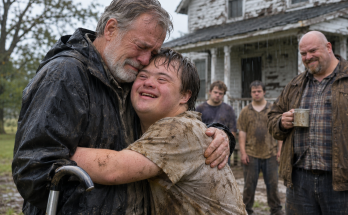
The following morning, Tucker asked about Duke.
It was the first thing he mentioned when he woke up.
"Does Duke remember me?"
I smiled.
"Of course he does."
"Is he still at our house?"
"Yes."
He seemed relieved.
I understood why.
Tucker had been taken away from everything familiar to him.
He needed to know that something was still waiting for him.
The doctors were satisfied that he was well enough to leave with me, provided he received follow-up care.
My brother agreed to help us.
I was still recovering from my stroke, and I couldn't pretend that the previous day hadn't exhausted me.
My brother understood that without making me feel ashamed.
Before we left the hospital, I received a call from an investigator.
He wanted copies of the court order establishing my guardianship.
He also wanted permission to review relevant records concerning Tucker's disability benefits.
I agreed to provide everything I could.
Then I asked about the other eight people from Sunny Acres.
He told me that they were receiving assistance while the authorities investigated their circumstances.
Some required medical attention.
Others needed help contacting family members and establishing appropriate living arrangements.
I was relieved that nobody had been left behind.
I thanked him.
Then I turned my attention to getting Tucker home.
My brother drove us back to the house.
When we arrived, I looked at the front steps.
I'd climbed them the previous day believing my son was waiting inside.
This time, he was standing beside me.
"Careful, Dad."
He watched me position my cane.
"I can help you."
He offered me his arm.
I accepted it.
There was something important about that moment.
Tucker needed support in certain areas of his life.
But that didn't mean he couldn't offer support to somebody else.
I had never wanted him to think otherwise.
We climbed the steps together.
When I opened the door, Duke came toward us.
The old dog's movements were slower than they used to be.
But when he recognized Tucker, his tail began moving so hard that his entire body seemed to follow it.
Tucker dropped to his knees.
"Duke! I missed you!"
He wrapped his arms around the dog.
Duke pressed his head against Tucker's chest.
I stood in the doorway watching them.
I didn't interrupt.
There was nothing I could have said that would have improved that moment.
Eventually, Tucker stood and looked toward his bedroom.
He walked down the hallway.
I followed him.
He stopped when he reached the doorway.
The mattress was still uncovered.
The walls were empty.
He looked inside the closet.
"Where's my stuff?"
I felt that same heaviness in my chest.
"We're going to get your things back."
"My music?"
"That, too."
He looked at the bare mattress.
"Do I sleep here tonight?"
"Yes."
"On the bed?"
I gripped the doorframe.
"On your bed, Tucker."
He smiled.
I wished that simple answer hadn't meant so much to him.
Brenda came into the hallway.
She looked at Tucker.
Then she looked at me.
"You brought him back."
I nodded.
"He's home."
She folded her arms.
It was the same posture she'd adopted when I first asked where Tucker was.
"Walter, this isn't going to work."
I didn't want to have that conversation in front of my son.
I asked Tucker to spend some time with Duke.
When he left, Brenda started talking again.
She said she'd been overwhelmed.
She said caring for Tucker had become too difficult while I was receiving treatment.
She said she had needed help.
I could have understood somebody asking for help.
I could have understood somebody admitting they couldn't manage a situation alone.
But that wasn't what she'd done.
She'd made an arrangement behind my back.
She'd prevented me from speaking to my son.
And she'd allowed me to believe he was still living at home.
"Why didn't you tell me?"
"You had enough to worry about."
"You could have told me the truth."
She sighed.
"I thought you would make it complicated."
I looked at her.
"Complicated for whom?"
She didn't answer.
I thought about Pruitt's coffee mug.
The way he'd stood there smiling while explaining their financial arrangement.
I remembered the investigator's instructions and resisted the urge to question her about everything he'd said.
Instead, I told her something I had already decided.
"I want us to separate."
She stared at me.
"You're serious?"
"Yes."
"After everything we've been through?"
I thought about the past four years.
I thought about our marriage and all the things I'd believed about her.
I wasn't pretending those years meant nothing.
They had meant a great deal to me.
That was why discovering the truth hurt so badly.
But they couldn't justify asking Tucker to live with somebody who had betrayed his trust.
"I can't have you making decisions about my son anymore."
She looked toward his bedroom.
"You're going to need somebody."
"I know."
"And you think you can do everything yourself?"
"No."
That surprised her.
I wasn't claiming I could manage every responsibility without assistance.
I had learned something during rehabilitation.
There was no shame in accepting help.
The important thing was choosing people who could be trusted.
My brother remained with us while Brenda made arrangements to stay elsewhere.
I contacted an attorney to handle our separation and establish appropriate protections for Tucker.
I didn't want another private agreement.
I wanted everything handled properly.
That evening, we put clean sheets on Tucker's mattress.
My brother helped with the corners because my hand still wasn't strong enough.
Tucker watched us.
"Can Duke stay in here?"
"If you want him to."
He smiled.
I brought him some dinner.
He looked at the plate.
"What do I have to do?"
The question stopped me.
"Nothing."
He waited.
"It's your dinner, buddy."
He sat down and began eating.
I went into the kitchen afterward and stood quietly for a while.
I knew getting him out of Sunny Acres hadn't ended the damage.
He was going to carry some of those experiences home with him.
I had to be patient.
I had to give him time.
Over the following weeks, the investigators began piecing together what had happened.
The financial records were particularly important.
They uncovered irregularities involving money intended for the care of vulnerable adults.
The records also connected Brenda to arrangements involving two other residents besides Tucker.
Pruitt hadn't been lying about that part.
I wished he had been.
Investigators asked me several times about the telephone calls I'd made from Kansas City.
They wanted to understand when Brenda had first prevented me from speaking to Tucker.
I explained that the change began after my third week of rehabilitation.
I remembered the explanations clearly.
They seemed ordinary when I first heard them.
Now they were part of a much more troubling sequence of events.
Brenda had continued reassuring me even after Tucker was no longer living in our house.
I had difficulty discussing that without becoming emotional.
The investigators were patient.
They asked me to distinguish what I remembered from what I suspected.
I appreciated that.
I didn't want anybody punished for something they hadn't done.
I wanted the truth established.
Every part of it.
The investigation eventually confirmed that Sunny Acres had been operating without the authorization and safeguards required for the care it claimed to provide.
The authorities documented the sleeping conditions.
They interviewed the residents.
They examined the financial records and the arrangements made with those supposedly responsible for them.
What happened to Tucker wasn't an isolated incident.
The other residents had experienced their own forms of neglect and exploitation.
Some had been made to perform work under conditions they had little meaningful ability to refuse.
Pruitt was arrested and faced criminal charges.
Brenda was charged for her involvement in the financial exploitation and improper placement arrangements.
I remember receiving that news.
I expected to feel satisfied.
Instead, I felt tired.
There wasn't anything pleasant about learning that the woman I'd married was facing criminal proceedings connected to my son's mistreatment.
I had wanted her promises to be genuine.
I had wanted our marriage to last.
I had wanted Tucker to have another person in his life who loved him.
Those things were gone.
Accepting that took longer than making the decision to separate.
Our divorce was eventually finalized.
The criminal cases moved forward separately.
Months later, Pruitt was convicted on charges connected to the operation of Sunny Acres and the exploitation of its residents.
He received a prison sentence.
Brenda entered a guilty plea for her part in the scheme.
The court imposed criminal penalties and ordered financial restitution.
I attended proceedings when I could.
I didn't make Tucker sit through everything.
He had already experienced enough.
When his wishes and experiences needed to be heard, arrangements were made to help him communicate in a supportive environment.
I was proud of him.
Not because he said everything perfectly.
Because he told the truth in his own words.
Sunny Acres remained closed.
The other residents received help finding safer living arrangements, reconnecting with relatives where appropriate, and securing support for their individual needs.
I thought about those two young men beside the ditch more often than I expected.
Especially the one who had asked whether he was permitted to stop working.
I hoped somebody had explained to him that he mattered beyond what he could produce.
As for Tucker's disability benefits, safeguards were established to protect the money from further misuse.
Recovering what had already been taken wasn't immediate.
But nobody else was going to receive or control his benefits simply because they claimed to be helping him.
I also reviewed the arrangements surrounding his care.
I wanted to make sure that if anything happened to me again, there would be a clear plan.
My brother agreed to help.
We involved professionals who understood Tucker's needs and respected his preferences.
This time, I didn't rely on somebody's promise alone.
And I didn't leave Tucker out of conversations about his own future.
He deserved to understand what was being arranged.
He deserved to express what he wanted.
He deserved to be heard.
Meanwhile, life at home began changing in small ways.
My own recovery continued.
I practiced walking.
I worked on my speech.
I kept doing exercises to improve the strength and coordination in my hand.
Tucker encouraged me.
"You're getting better, Dad."
Some days, hearing him say that meant more than anything a therapist could have told me.
He eventually returned to the supermarket.
We didn't rush him.
He wanted to go back, but we made sure he was medically ready and comfortable with the decision.
On his first day, he was excited.
He talked about seeing familiar people again.
He talked about bagging groceries.
And when he returned home, he was smiling.
"Everybody missed me."
"I'm sure they did."
He told me about his day.
I listened to every word.
There had been a time when hearing about groceries seemed like an ordinary part of our evening.
Now I understood what a privilege it was to sit there and listen.
We gradually replaced the things missing from his bedroom.
His country music collection began growing again.
Posters returned to the walls.
His closet was no longer empty.
The room started looking like Tucker's room.
One afternoon, I heard country music coming from the hallway.
I stopped walking.
I simply stood there with my cane and listened.
I'd missed that sound.
It was something I had barely noticed before the stroke.
Now it reminded me that my son was home.
Some habits took longer to disappear.
For a while, Tucker continued asking whether he had earned his meals.
Sometimes he apologized for taking a break.
Sometimes he worried that failing to finish a task would mean he couldn't stay with me.
Each time, I answered him.
"You live here because this is your home."
I never wanted him confusing love with payment.
Or food with reward.
Or belonging with obedience.
Gradually, the questions became less frequent.
One evening, he went into the kitchen and asked whether he could have something else to eat.
He didn't ask whether he'd been good enough.
He didn't mention finishing any work.
He was simply hungry.
I told him to help himself.
Then I went into the other room and cried.
Recovery looked different for each of us.
Mine involved a cane and physical exercises.
His involved learning that ordinary things were safe again.
Neither process could be hurried.
Nearly a year after my stroke, I could walk farther than I had expected.
I still used my cane when I needed it.
I wasn't ashamed of that anymore.
One Saturday, Tucker and I sat outside with Duke.
The old dog stretched out near our feet.
Country music played quietly from inside the house.
Tucker looked at me.
"You're staying home now, right?"
I understood what he was asking.
"I'm planning to."
He thought about that.
"What if you get sick again?"
It was a fair question.
I didn't want to give him a promise I couldn't keep.
"I might need help again someday."
He waited.
"But we've made plans. You'll have people who know how to help you, and nobody gets to send you away without listening to you."
He nodded.
"Okay."
Then he reached down and scratched Duke behind the ears.
I sat beside him.
For a long time, I had blamed myself for what happened.
I'd blamed myself for marrying Brenda.
For accepting her explanations.
For being unable to leave rehabilitation sooner.
It took me time to recognize that trusting somebody didn't make me responsible for their decision to betray that trust.
But I could take responsibility for what happened next.
I could put better safeguards in place.
I could listen carefully.
I could make sure Tucker's choices mattered.
And I could stop believing that love required me to do everything alone.
That afternoon, I went inside to prepare dinner.
Tucker offered to help.
He took the forks from the drawer and placed them on the table.
I watched him for a moment.
Months earlier, I'd struggled to hold a fork at the rehabilitation center.
At the same time, my son had been digging a ditch because somebody told him he had to work before he could eat.
Now we were preparing dinner together.
Nobody was keeping score.
Nobody was withholding food.
Nobody was telling him that he needed to prove his worth.
"Ready, Dad?"
"Almost."
He called Duke away from the table.
Then he sat down.
I lowered myself into my chair and rested my cane beside it.
Tucker picked up his fork.
He didn't look at me for permission.
He took a bite.
And then he began telling me something funny that had happened at the supermarket.
I listened.
I laughed.
I ate my dinner.
It was an ordinary evening in Springfield, Missouri.
Nothing remarkable.
Nothing anybody would have thought worth writing about.
But after everything we'd been through, I knew exactly how precious it was.
My son was sitting across from me.
He was warm.
He was fed.
He was free to be himself.
And he was home.
The End
Read more original stories on Feel Every Story.
I Had Spent Thirty Years Teaching Boys How to Get Back on Their Feet, but Nothing Prepared Me for What Happened to My Own Family
Part 10 of 10