Tori arrived ten minutes early.
I recognized her immediately when I entered the little café.
She was sitting near the window with both hands wrapped around a cup.
When she saw me, she stood.
“Thank you for coming.”
I sat across from her.
“You said you wanted to talk.”
She nodded.
For several moments, neither of us knew where to begin.
Then she took a folded tissue from her pocket.
“I haven't slept much.”
I believed her.
There were dark circles beneath her eyes.
She looked different without Gail sitting beside her.
Less guarded.
More uncertain.
“I asked them about Saint Jude’s after you left,” she said.
I waited.
“Mom said they had no other choice.”
I looked down at my cup.
“And Vince?”
“He said it was complicated.”
I almost smiled.
Not because anything was funny.
Because those answers were becoming familiar.
Tori unfolded the tissue.
“Did they really leave you there when you were five?”
“Yes.”
She closed her eyes briefly.
“I can't understand it.”
“Neither can I.”
She looked toward the window.
“Growing up, I knew there had been another little girl.”
I looked at her.
“What did they tell you?”
“That something terrible had happened and they didn't know where you were.”
I let her continue.
“Whenever I asked questions, Mom became upset.”
“Did you ask often?”
“When I was younger.”
She rubbed her thumb against the tissue.
“Eventually, I stopped.”
I could understand that.
Children learned which subjects made adults uncomfortable.
Sometimes they learned not to mention those subjects again.
Tori looked at me.
“I thought they had lost you.”
“They knew where I was.”
“I know that now.”
Her voice cracked.
I waited while she collected herself.
Then she asked a question I hadn't expected.
“Were you happy with Michael and Olivia?”
“Yes.”
The answer came easily.
She smiled a little.
“I'm glad.”
Something inside me softened.
It wasn't forgiveness.
It wasn't instant affection.
But I appreciated that she had asked about my life rather than my medical history.
We talked about Michael and Olivia for a while.
I told her how they had raised me.
How they had never tried to make me ashamed of where I came from.
How they had let me keep my first name.
Tori listened without interrupting.
Then she said something that made me put my cup down.
“Mom told me you would probably agree as soon as you knew we were related.”
I stared at her.
“She said that?”
Tori nodded.
“She thought you would be grateful to have your family back.”
I looked out the window.
Grateful.
I had been grateful when Michael and Olivia adopted me.
Grateful when I finally understood that I wasn't going to be left somewhere again.
Grateful for every ordinary morning when nobody threatened to take my home away.
I couldn't imagine feeling grateful for Gail's return.
Not under these circumstances.
“Did you believe her?” I asked.
Tori looked embarrassed.
“At first.”
She didn't try to protect herself from the answer.
“I didn't know what they'd done.”
“And now?”
“Now I don't know what to believe about them.”
I understood that feeling better than she probably realized.
She folded the tissue into a small square.
“I need a kidney, Annie.”
I nodded.
“I know.”
“But I don't want you to be forced into anything.”
I studied her face.
She continued.
“I've been scared for a long time.”
Her eyes filled.
“Sometimes I think about nothing except getting better.”
She looked ashamed.
“I know that sounds selfish.”
“It sounds human.”
She wiped her cheek.
“I don't know how much time I have before things become more difficult.”
I didn't pretend to understand the medical details of her condition.
I wasn't her doctor.
But I could see that she was frightened.
“What options have your doctors discussed?” I asked.
She explained that her medical team was managing her condition and discussing transplant possibilities.
There were uncertainties.
There were appointments.
There were tests and conversations about potential donors.
She was tired of waiting for answers.
I listened.
Then I asked the question that had bothered me since Gail first approached me.
“Have either of them offered to be evaluated?”
Tori hesitated.
“They've talked about it.”
“What does that mean?”
“I don't know exactly.”
I leaned back.
I didn't assume they were medically eligible.
People could have legitimate reasons why donation wasn't possible.
But I wondered why they had been so determined to make my participation sound inevitable before I had even spoken with an independent medical professional.
“Has anyone actually established that I'm a suitable donor?”
“No.”
“Then they're asking me to agree to something they don't even know is possible.”
Tori nodded.
“I suppose so.”
I watched people passing outside.
A woman walked by carrying a shopping bag.
A little boy held her hand.
For a few seconds, I couldn't take my eyes away from them.
Then I returned my attention to Tori.
“If I ever consider testing, I need you to understand something.”
She waited.
“It won't mean that I've agreed to donate.”
“I understand.”
“And I won't discuss my private medical information with Gail or Vince.”
“Okay.”
“I won't allow anyone to pressure me.”
She looked directly at me.
“I won't ask you to.”
I appreciated her answer.
But I also knew that words were easier than actions.
I needed time to see whether she meant them.
We sat quietly for a while.
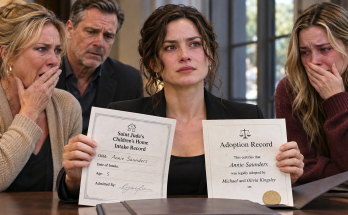
Eventually, Tori asked whether she could see the documents again.
I had brought copies.
I removed them from my bag.
She looked at the intake record first.
Then the adoption paperwork.
Her finger paused near my original surname.
“Annie Saunders.”
“Yes.”
She stared at the name.
“You really were my sister all this time.”
“Biologically, yes.”
She nodded.
I didn't correct anything else.
I didn't know what our relationship would become.
That was something neither of us could decide in a single conversation.
She returned the copies.
“I'm sorry they did this to you.”
I looked at her.
“Thank you.”
“I wish things had been different.”
“So do I.”
She asked whether we could meet again.
I told her we could, provided that our conversations weren't simply another way for Gail to reach me.
She agreed.
When we left, she didn't attempt to hug me.
She seemed to understand that we weren't there yet.
I appreciated that, too.
I watched her walk toward her car.
Then I checked my phone.
Gail had called three times during our conversation.
There was another message.
Tori told us she's meeting you. Don't upset her.
I stared at the words.
Then I looked toward Tori's car.
I had spent the last hour listening to her talk about her fears, her confusion, and her medical condition.
Gail hadn't asked how either of us was feeling.
She had simply instructed me to manage the situation in a way that suited her.
I put my phone away.
I drove home.
That evening, I began looking at the questions I would need answered before making any decision about living kidney donation.
Not because Gail had convinced me.
Because I wanted to understand the choices available to me.
Whatever I ultimately decided, I wanted it to come from knowledge rather than fear.
I wrote the questions on a sheet of paper.
At the bottom, I added one more.
Can I change my mind?
I underlined it.
Then I placed the paper beside my folder.
Click here to continue reading: PART 7: When My Mother Discovered That I Intended to Make an Independent Medical Decision, She Started Treating My Boundaries as Another Personal Betrayal
My Mother Had Spent an Entire Week Telling People She Lost Her Daughter, but the Documents in My Hands Told a Different Story
Part 6 of 10