
Several months passed before Dad's estate was finally settled.
By then, I had learned more about bank statements, court documents, and property records than I had ever wanted to know.
Helen remained patient throughout the process.
She explained things when I didn't understand them.
She reminded me when documents needed signatures.
And whenever Ray suggested handling something informally, she brought the conversation back to the written requirements.
I was grateful for that.
I had discovered that family disputes became particularly difficult when one person expected the other to feel guilty for requesting proof.
Ray had relied on that expectation for a long time.
It no longer worked.
The final accounting confirmed that he had improperly taken sixty-two thousand dollars from Dad's accounts.
The legitimate expenses he had incurred while helping Dad were considered separately.
I didn't want those expenses ignored.
He had helped our father after his hip surgery.
He had taken him to appointments.
He had been nearby when I couldn't be.
Those things were real.
So were the unauthorized withdrawals.
One truth didn't cancel the other.
After discussions between the lawyers, Ray agreed to a formal settlement that accounted for the entire sixty-two thousand dollars.
The amount was charged against what he would otherwise receive from Dad's estate, with the necessary financial adjustments documented.
He wasn't going to receive his full inheritance while also keeping the benefit of the money he had already taken.
The agreement followed Dad's instructions and went through the required estate procedures.
Everything was written down.
Everything was accounted for.
There were no promises about making things right someday.
No arrangements that depended on whether Ray felt like honoring them later.
The estate was made whole through the settlement.
I remember looking at the final documents on Helen's desk.
The figure appeared again.
$62,000.
By then, I had seen it so many times that I could recognize it without reading the surrounding words.
Helen showed me where to sign.
I picked up the pen.
My hand was steady.
That surprised me.
The first time I had seen the number, sitting across from Pete Dawson, I had barely been able to hold Dad's letter.
Now I was completing the work Dad had trusted me to do.
I signed.
Helen checked the pages.
“That's everything we need from you today.”
I set down the pen.
“Thank you.”
She smiled.
“Your father chose well.”
I looked away.
I still wasn't accustomed to hearing people speak about Dad in the past tense.
The formal settlement was important.
But it wasn't the thing that made me feel his absence most strongly.
That happened in his house.
Once the necessary arrangements had been made, Ray and I began sorting through Dad's belongings.
The house smelled familiar.
I recognized that smell before I had taken off my coat.
For a moment, I expected Dad to appear and ask whether I wanted coffee.
The silence that followed was painful.
Ray was already in the living room.
Several empty boxes stood against the wall.
He asked where I wanted to start.
“His bedroom.”
He nodded.
We went through Dad's clothing first.
There were shirts he had worn for years.
Trousers that had been carefully folded.
Sweaters that still looked almost new.
Dad had never thrown away anything that remained useful.
I separated the clothes that could be donated.
Ray helped without complaint.
Then I reached the section of the closet where Dad's jackets had hung.
There was an empty space.
I remembered the brown corduroy jacket.
The envelope.
The lint.
I stood there longer than I intended.
Ray noticed.
“What is it?”
“Nothing.”
Then I corrected myself.
“I was thinking about his brown jacket.”
Ray stopped folding a shirt.
“I remember.”
I looked at him.
“Did you ever wonder why he was carrying that envelope?”
He shook his head.
“I didn't know he was.”
“I know. But why do you think he felt he needed to?”
Ray placed the shirt inside a box.
He didn't answer.
I continued sorting.
I wasn't going to force another apology from him.
If he ever understood what Dad had experienced, that understanding would have to come from somewhere other than my insistence.
Later, we came across Dad's reading glasses.
They were resting inside their case.
I picked them up.
The letter immediately returned to my mind.
Dad had admitted that he occasionally misplaced his glasses.
Ray had used ordinary forgetfulness to question his ability to manage his own life.
I held the glasses carefully.
They were such an insignificant thing.
Yet they represented something I couldn't stop thinking about.
Growing older shouldn't mean that every forgotten appointment or misplaced object becomes evidence that somebody else deserves control over your decisions.
Dad had understood that.
He had known exactly what he wanted.
He had been forced to defend it anyway.
“I'm keeping these,” I said.
Ray glanced over.
“Sure.”
I put the glasses in my handbag.
We continued working.
The house contained decades of ordinary life.
Nothing about most of the belongings would have interested somebody who hadn't known Dad.
But to me, even the smallest objects carried memories.
I didn't want everything.
I only wanted a few things I could look at without thinking about their financial value.
Ray and I agreed on how to handle the personal belongings in accordance with the estate arrangements.
There were no major arguments.
That was a relief.
Eventually, the house was sold through the proper estate process.
I made one final visit before the new owners took possession.
The rooms were empty.
My footsteps sounded different without the furniture.
I stood inside Dad's bedroom.
Then I walked into the living room.
I could almost hear Mom asking us to keep our voices down.
I could almost hear Dad answering the telephone.
It was difficult to accept that the people who had made those rooms feel alive were both gone.
I had grown up believing the house would always be there.
Perhaps the building would remain for another hundred years.
But our home had already disappeared.
I locked the door when I left.
I didn't stand outside for long.
There was nothing more I needed to do there.
Dad's last wishes had been carried out as far as they still could be.
The house had been handled properly.
The money had been accounted for.
And the place he had purchased in 1998 was no longer empty.
Ray received the inheritance remaining to him under the will and the settlement.
He didn't receive nothing.
Dad hadn't wanted that.
Even after discovering what Ray had done, he hadn't written his son entirely out of his life.
That was one of the things I found most difficult to understand.
There were days when I thought Dad had been too forgiving.
There were other days when I understood him perfectly.
He wanted Ray held responsible.
He also wanted him to have the opportunity to become a better man.
Those were separate wishes.
Dad had made room for both.
I tried to honor that distinction.
After everything had been finalized, Ray called me.
It was a Sunday afternoon.
I was sitting at my kitchen table.
Dad's reading glasses were resting inside their case nearby.
“Jan?”
“Yes?”
“Did Helen tell you everything's finished?”
“She did.”
He was quiet for a moment.
“I guess that's it, then.”
“The estate is settled.”
He seemed to be considering something.
Then he asked whether I still had the letter Dad had written to me.
“Yes.”
“What did it say about me?”
I looked toward the drawer where I kept it.
“You know some of it.”
“Not everything.”
I considered how much to tell him.
Dad had written those four pages specifically for me.
Ray had received a letter of his own.
I didn't believe he was entitled to every private thought Dad had entrusted to me.
“He was worried about what was happening.”
Ray didn't respond.
“He wanted his money protected. And he wanted us to follow his wishes.”
“I know that.”
“He also loved you.”
There was a long silence.
I could hear Ray breathing.
“Did he actually say that?”
“Yes.”
I didn't embellish it.
I didn't try to reassure him with things Dad had never written.
“He was disappointed, Ray. But he still loved you.”
My brother made a sound I couldn't quite identify.
Then he cleared his throat.
“I messed things up pretty badly.”
“Yes.”
It felt strange to answer so plainly.
The old version of me would have rushed to soften the moment.
I would have reminded him that people made mistakes.
I would have searched for some explanation that made his behavior less painful.
But what he had done wasn't one careless mistake.
It involved repeated decisions.
Repeated withdrawals.
Repeated opportunities to tell the truth.
He had chosen not to.
“I thought I could fix it before anyone found out,” he said.
“Dad had already found out.”
“I know.”
“And he was frightened.”
Ray didn't answer.
I waited.
Finally, he spoke.
“I wish I'd handled things differently.”
I believed that he wished the consequences were different.
Whether he truly regretted the fear he had caused Dad was something I couldn't determine over the telephone.
I wasn't going to pretend otherwise.
“You can't change what happened.”
“No.”
“But you can change what you do next.”
He was quiet again.
Then he thanked me for inviting him to the burial.
I hadn't expected that.
“You didn't have to let me come.”
“Yes, I did.”
“Why?”
“Because Dad was your father too.”
My voice broke slightly.
“And because I wasn't going to do to you what you did to me.”
Ray didn't have an answer.
We ended the conversation shortly afterward.
I sat at the table for a long time.
I hadn't forgiven everything.
Perhaps I never would.
But I no longer wanted anger to determine how I spent every day.
Dad's final letter had asked me not to lose my own life inside this dispute.
I was trying to listen.
Ray and I didn't return to the relationship we had once imagined ourselves having.
We spoke occasionally.
Our conversations were shorter.
I stopped sharing certain personal matters with him.
And I didn't mistake renewed communication for restored trust.
Trust required more than being related.
It required behavior that could be relied upon.
Maybe Ray would eventually understand that.
Maybe he wouldn't.
Either way, I wasn't going to spend the rest of my life trying to manage his choices.
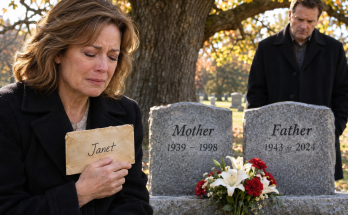
When spring arrived, I returned to the cemetery.
The oak tree had begun growing new leaves.
The ground was no longer hard with winter cold.
I brought flowers for both graves.
Dad's name was there now.
Beside Mom's.
I stood looking at them together.
For the first time, the sight brought more comfort than pain.
I placed the flowers carefully.
Then I took a small folded copy of Dad's letter from my coat pocket.
The original remained safely stored at home.
I read the final page again.
He hadn't wanted money to become the only thing his children remembered about him.
He hadn't wanted his death to destroy whatever remained of our family.
And he hadn't wanted his daughter spending her remaining years fighting over things he could no longer use.
I folded the letter.
“I've finished everything, Dad.”
I told him about the estate.
About the accounting.
About the house.
I told him that every dollar had been addressed according to the arrangements he had made.
Then I told him that Ray and I were speaking again.
Carefully.
Not as though nothing had happened.
But we were speaking.
I didn't know whether Dad would have considered that enough.
I hoped he would.
I sat on a nearby bench for a while.
The branches moved gently overhead.
I thought about the first telephone call Ray had made that Monday morning.
The way he had told me Dad was gone.
The way I had spent six hours driving home.
I had believed I was too late.
In one important sense, I had been.
Nothing would ever return the opportunity to see my father's face one last time.
I couldn't pretend that loss had been repaired.
It hadn't.
But I hadn't been too late for everything.
I had been there to uncover what Dad had tried to protect.
I had been there to defend his ability to make his own decisions.
I had been there to carry out the wishes that could still be fulfilled.
And I had been there beneath that oak tree when he finally joined Mom.
Before leaving the cemetery, I touched both headstones.
“Take care of each other.”
Then I walked back to my car.
At home, I opened the drawer containing Dad's envelope.
The county document was stored with the estate records.
The four-page letter rested inside a protective sleeve.
I had kept the original envelope separately.
My name remained visible across the front.
Janet.
Those five letters had changed everything.
I remembered Pete Dawson telling me that Dad had probably hidden the envelope because he didn't trust leaving it inside his house.
That thought still hurt.
But I also understood something else now.
Dad had known whom he wanted to receive it.
He had trusted me to listen when he could no longer explain himself.
I hadn't needed an inheritance to prove that he loved me.
I hadn't needed the house.
And I certainly hadn't needed my brother's humiliation.
What I had needed was the truth.
Dad had found a way to give it to me.
I closed the drawer.
Then I placed his reading glasses beside a photograph of my parents.
The glasses were scratched from years of use.
They weren't worth much.
Neither was the brown envelope.
But those were the things I chose to keep.
Whenever I looked at them, I remembered that my father had been more than an account balance, a house, or an elderly man who occasionally forgot where he had put his belongings.
He had been a person.
A husband.
A father.
A man who deserved to make his own decisions until his final day.
My brother had forgotten that.
I nearly allowed my grief to prevent me from defending it.
But Dad's letter reached me before it was too late to honor what remained of his wishes.
The sixty-two thousand dollars had been accounted for.
His will had been respected.
His ashes had been reunited.
And beneath the old oak tree, in the burial plot he had purchased all those years earlier, my father was finally resting beside the woman he loved.
Exactly where he had wanted to be.
The End
Read more original stories on Feel Every Story.
I Drove Six Hours to Say Goodbye to My Father, but My Brother Had Already Made a Decision Neither of Us Could Undo
Part 10 of 10

One Comment on “PART 10 – When the Estate Was Finally Settled, My Brother Learned That Our Father Had Left Us More Than Money and a House”