I used to believe that when someone hurt your child, you needed to make them understand what they had done.
I believed the right explanation could change things.
That if you found the right words, spoke calmly enough, and showed someone exactly where they had gone wrong, they might finally see it.
Rory had taught me otherwise.
Eleven years after our divorce, I was still learning that lesson.
But this time, something was different.
I hadn't called him.
I hadn't demanded an explanation.
I hadn't tried to make him feel guilty about the photograph.
Instead, I had called Darla.
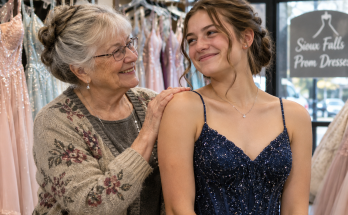
And she had taken Sadie shopping in Sioux Falls.
It sounded so simple when I put it into words.
A grandmother took her granddaughter shopping for prom.
Nothing complicated.
Nothing that should have needed a family argument.
Yet I couldn't stop thinking about how different the situation had felt before that happened.
I remembered the Tuesday evening in March.
The two bowls of chili on our kitchen table.
Sadie's phone beside her spoon.
Her father's voice coming through the speaker.
I remembered the moment he told her that money was too tight for a prom dress.
His welding work had been slow since Christmas.
That was the explanation.
I hadn't questioned it while he was speaking.
Neither had Sadie.
She had accepted his answer with a gentleness that made me sadder the more I thought about it.
She hadn't asked him to find another way.
She hadn't accused him of anything.
She had tried to spare his feelings.
Twice.
I wondered whether Rory understood how much restraint that required from a seventeen-year-old girl.
Maybe he thought she really didn't mind.
Maybe he took her words at face value.
I couldn't know.
But I knew my daughter.
I knew that when she was disappointed, she often tried to make the situation easier for everyone else.
Sometimes I admired that about her.
Sometimes I worried about it.
That evening, I had done both.
I watched her wash her bowl.
I heard the water running.
I saw her go upstairs.
Then I let myself believe that giving her space was enough.
Looking back, I wished I had reminded her that she didn't have to pretend with me.
She could be disappointed.
She could be angry.
She could want a beautiful dress without feeling guilty about it.
She was seventeen.
She deserved to have ordinary seventeen-year-old feelings.
But I hadn't said those things at the kitchen table.
Instead, I had waited.
Then the photograph appeared.
I still remembered the time.
9:40.
Tasha had posted Madison wearing a formal gown that cost six hundred dollars.
The dress had been purchased in Sioux Falls.
Madison was seventeen, just like Sadie.
And Rory had left a proud comment beneath the picture.
I could still remember the feeling in my stomach when I saw it.
Not because Madison looked beautiful.
There was nothing wrong with that.
Not because a teenager had received an expensive dress.
I didn't know who had paid for it.
And I wasn't going to pretend that I did.
What hurt was the contrast.
Rory had told Sadie there wasn't enough money.
Then he had publicly celebrated another girl's gown.
The two things happened on the same evening.
I couldn't stop seeing them together.
I had stared at that photograph for longer than I wanted to admit.
I read the details.
Then I read them again.
Six hundred dollars.
Sioux Falls.
A proud fatherly comment.
Each detail seemed ordinary by itself.
Together, they made me wonder what Sadie must have thought.
I hadn't seen her looking at the picture.
I couldn't say with certainty what she had seen or felt.
But I had heard her bedroom door close softly afterward.
That sound stayed with me.
It was such a small noise.
A door settling into its frame.
No shouting.
No crying that I could hear.
No angry footsteps.
Just silence.
And sometimes silence was harder for me to bear than an argument.
I had wanted to call Rory immediately.
I could have asked why he thought the photograph was appropriate after his conversation with Sadie.
I could have questioned how he had enough enthusiasm to celebrate Madison's dress but no help to offer his own daughter.
I could have told him how the timing looked.
But I knew where that conversation might lead.
And I didn't want Sadie's prom to become another dispute between her parents.
That was why I called Darla.
His mother.
A woman who had remained steady in Sadie's life long after our marriage ended.
I thought about her forty-one years working as a hairstylist in Howard.
I thought about how many ordinary days she had spent on her feet, earning her living.
I thought about her age.
Seventy-two.
And I thought about every birthday she had remembered.
Even during the terrible ice storm.
Those memories mattered.
They weren't dramatic.
They didn't involve expensive gifts or public announcements.
They involved someone being dependable.
That was what I wanted Sadie to recognize.
Dependability.
The simple comfort of knowing someone would remember you without needing to be reminded.
When I told Darla what had happened, she hadn't interrupted to defend Rory.
She hadn't demanded proof about the money.
She hadn't asked me to explain why I was upset.
She listened.
Then she asked whether Sadie was crying.
That question still moved me.
Because it was the first question that had been entirely about my daughter.
Not about the photograph.
Not about the dress.
Not about what Rory could or couldn't afford.
About Sadie.
I hadn't known how to answer.
I had to admit that I hadn't seen her cry.
She had gone upstairs.
Her door was closed.
That was all I knew.
I remembered feeling ashamed that I couldn't give her grandmother a clearer answer.
But perhaps I had been too hard on myself.
Sadie was seventeen.
She had a right to privacy.
She didn't have to show every feeling to her mother.
And I couldn't measure her hurt by whether I had seen tears.
I needed to learn to respect the things she kept private while still making sure she knew I cared.
That was harder than simply asking whether she was fine.
A quick question could receive a quick answer.
Real understanding sometimes required patience.
I was still learning that.
After Darla took Sadie shopping, I kept thinking about the difference between making a child feel grateful and making a child feel valued.
There was a difference.
Gratitude could become an obligation when adults weren't careful.
A child might feel she had to smile, say thank you, and pretend every uncomfortable feeling had disappeared.
I didn't want that for Sadie.
I didn't want her grandmother's kindness to become another situation where she felt responsible for making everyone else comfortable.
I wanted her to enjoy the experience.
To have the chance to think about prom without immediately thinking about her father's refusal.
To know that her wishes were worth someone's time.
I couldn't say exactly what she felt during the shopping trip.
I wouldn't put words in her mouth.
But I knew what Darla had done.
She had personally taken her granddaughter shopping in Sioux Falls.
And she hadn't needed me to start a fight with Rory before she could show Sadie kindness.
That was important.
I realized how often I had confused action with confrontation.
Sometimes I thought that if I wasn't arguing about a problem, I wasn't doing enough.
But that wasn't true.
I could support Sadie without fighting Rory.
I could recognize her disappointment without asking her to hate her father.
And I could appreciate Darla without turning her kindness into a judgment against her son.
That was the kind of mother I wanted to be.
Not someone who pretended everything was fine.
Not someone who made every disappointment into a war.
Someone who could see what mattered and respond with care.
I thought about Madison again.
She was also seventeen.
She hadn't asked to be part of a comparison.
I hoped she had enjoyed choosing her gown.
I hoped prom would be a happy memory for her.
I meant that.
It would have been easy to resent the girl in the photograph.
But that would have been unfair.
Madison wasn't responsible for Rory's conversation with Sadie.
And Sadie didn't need another teenage girl turned into an enemy on her behalf.
The girls deserved better than that.
They deserved adults who could recognize their individual feelings.
I reminded myself that the price of Madison's gown wasn't the measure of anyone's love.
Six hundred dollars was a significant amount.
But I didn't know enough about the purchase to draw conclusions about Rory's finances.
What I knew was that Sadie had been disappointed.
And the public celebration of Madison's gown had made that disappointment harder for me to understand.
I could hold on to those facts without pretending I knew everything else.
I had spent too much of my life trying to fill in the blanks of Rory's decisions.
Why he said something.
Why he didn't.
Why he seemed to understand one person's feelings and overlook another's.
I didn't always have the answers.
That was frustrating.
But it wasn't a reason to invent them.
Some things had to remain unanswered.
And one of those things was whether Rory understood what his comment had looked like to me.
I didn't know.
I still didn't.
I could only decide what to do with my own feelings.
The shopping trip gave me something better to think about.
Darla and Sadie.
A grandmother and granddaughter.
A day that could belong to them instead of the photograph.
I didn't need to know which dresses Sadie had looked at.
I didn't need to imagine conversations I hadn't heard.
I didn't need to describe details I couldn't honestly confirm.
The act itself was enough.
Darla had shown up.
She had taken time for Sadie.
She had helped turn attention back toward the girl whose prom mattered.
And that was something I could appreciate without exaggerating it.
I thought about the kitchen table again.
The chili had been getting cold while Sadie listened to her father.
She had sat there being so careful.
So understanding.
So quiet.
I wished she could have understood one thing about that evening.
Her father's answer was not a measure of her worth.
It wasn't proof that she was less important than Madison.
And it didn't mean her hopes were unreasonable.
I wanted her to know that.
I wanted her to know it whether or not Rory ever explained himself.
Because the truth was, I couldn't promise her that people would always make fair choices.
I couldn't promise that the adults she loved would never disappoint her.
I couldn't promise that every special occasion would go smoothly.
But I could promise myself something.
I would stop measuring my success as her mother by whether I could make Rory behave differently.
I would pay attention to Sadie.
I would listen more carefully when she said she was fine.
And I would remember that quiet children could need support just as much as the ones who shouted.
That lesson came from a bowl of chili.
A closed bedroom door.
A photograph posted at 9:40.
And a seventy-two-year-old grandmother who asked the right question.
I had called Darla because I knew she loved Sadie.
What happened afterward reminded me that love didn't always need a grand explanation.
Sometimes it looked like remembering a birthday.
Sometimes it looked like listening without judgment.
And sometimes it looked like taking your granddaughter shopping for prom.
I still wished Rory had handled that Tuesday evening differently.
I probably always would.
But I no longer wanted his decision to be the only thing I remembered.
Sadie's story contained more than her father's disappointment.
It contained her grandmother's care.
And I wanted to make sure that part wasn't forgotten.
Click here to continue reading: PART 10: The Photograph Never Explained Why Rory Could Celebrate One Dress but Deny Another, Yet Darla Showed My Daughter Something More Important
My Daughter Accepted Her Father’s Excuse About Prom, but One Photograph That Night Made His Words Hard to Believe
Part 9 of 10