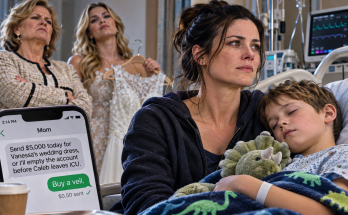
The first thing I learned was that a person could take money without ever believing they were stealing.
At least, that was how my mother seemed to see it.
Patricia had spent years treating every account she could reach as something she was entitled to use.
If the money belonged to me, she called it family support.
If the money came from my father, she called it part of her security.
And when the bank began examining the records, she wanted everyone to believe she had simply been doing what was necessary.
I was sitting beside Caleb when Mr. Reynolds contacted me again.
My son was sleeping with his stuffed triceratops resting against his arm.
The dinosaur blanket had slipped toward the foot of the bed.
I pulled it up before answering.
"Mrs. Whitaker, we've completed an important portion of the account review."
I looked toward Caleb.
"Have you found something?"
"Yes. I'd like to go through the records with you."
I felt my stomach tighten.
"Is the trust still protected?"
"The withdrawal attempted at the branch was stopped. But we need to discuss earlier activity."
Earlier activity.
Those two words stayed with me.
I had been concentrating on what Patricia and Vanessa tried to do after I froze their access.
I hadn't spent enough time thinking about what might already have happened.
"How much are we talking about?"
"I'd prefer to show you the supporting records before we discuss the total."
I understood.
I didn't like it.
But I understood.
We arranged another secure meeting.
I stayed at the hospital, just as I had promised Caleb I would.
I wasn't leaving him because my mother had created another emergency.
During the meeting, Mr. Reynolds began with the accounts I had originally allowed Patricia and Vanessa to access.
Some payments were easy to recognize.
Phone bills.
Insurance payments.
Transfers connected with rent.
Expenses I had approved because somebody told me they needed help.
I recognized more transactions than I wanted to.
Seeing them gathered together was different from seeing them appear one at a time.
A payment that seemed manageable by itself looked very different beside years of similar payments.
I stared at the account history.
I had spent so much time convincing myself each request was temporary.
But the requests hadn't stopped.
They had simply changed names.
First, my mother needed help after Dad died.
Then Vanessa needed assistance with ordinary expenses.
Then there were wedding arrangements.
And somewhere along the way, my willingness to help had become something they expected.
Mr. Reynolds let me examine the records.
I marked the transactions I remembered approving.
I marked others I needed to check more carefully.
I didn't want to claim every payment was unauthorized.
That wouldn't have been true.
I had agreed to some of them.
I had made mistakes.
But a mistake in judgment didn't mean I had approved everything that followed.
"Now we need to discuss the estate-related account activity," he said.
I sat straighter.
He explained that the review had identified transactions connected with funds that originated from my father's estate.
Some required further examination to determine whether the proper authority had been used.
He also showed me records relating to the separate trust for Caleb.
I looked at the account information.
My father's name appeared among the documents.
I hadn't seen it in that setting before.
For a moment, I couldn't concentrate on anything else.
Dad.
He was gone.
But here was proof that he had made arrangements for Caleb before his death.
Not just a promise.
An actual arrangement.
I felt a sudden ache behind my eyes.
Mr. Reynolds waited while I looked at the documents.
"Your father established this trust with Caleb as the beneficiary."
I nodded.
"You told me that before."
"Yes. The important point is that the trust has its own governing terms."
I looked at the screen.
"So my mother couldn't simply decide to take the money."
"Not without the authority required by those terms."
That was what I had needed to hear.
Not that Patricia was being unreasonable.
Not that she had upset me.
That the money wasn't hers to claim merely because she wanted it.
I asked him about the paperwork she and Vanessa had presented.
He explained that their attempted withdrawal had raised questions because the authority they claimed was not established by the documents presented.
The transaction had been stopped.
That was still true.
But the earlier records showed that Patricia had exercised access over other funds connected with the estate.
I tried to understand the distinction.
Money she had been allowed to handle.
Money she had actually moved.
And money she had attempted to withdraw without establishing the necessary authority.
They weren't automatically the same thing.
I asked Mr. Reynolds to explain each category separately.
He did.
And I wrote everything down.
I had promised myself I wouldn't let anger supply the answers.
Now that promise was being tested.
Some transactions made me furious.
Others made me ashamed.
A few were things I remembered agreeing to without understanding how long the arrangement would continue.
Then we reached the records I couldn't account for.
I studied the dates.
I studied the amounts.
I studied the descriptions.
I didn't recognize the purposes attached to several transfers.
I couldn't find any memory of approving them.
And I couldn't understand why money connected with my father's estate had been handled that way.
"Was my mother responsible for these requests?"
"Her authorization and involvement are among the matters documented in the review."
"Did she have the right to make them?"
"That requires examining the governing documents and the authority applicable at the time."
I pressed my hand against my forehead.
I wanted a simple answer.
Yes.
No.
Something definite.
But I had asked for a careful investigation.
I couldn't complain when the bank refused to go beyond what the evidence established.
I asked for copies of the relevant records.
Mr. Reynolds confirmed the secure process for obtaining them.
I asked what should happen next if the transactions were determined to be unauthorized.
He explained that the bank's review would address the account activity within its responsibilities and that questions about the estate and trust might require independent legal review.
I wrote that down too.
I didn't want to treat his explanation as a substitute for understanding the documents myself.
There was too much at stake.
The money mattered.
But the reason it mattered had changed.
I wasn't thinking about whether I could afford to help Patricia anymore.
I was thinking about whether the arrangements my father had made were being respected.
And whether Caleb's interests had been protected.
I thought about the last time I had spoken with Dad about family responsibilities.
He had always believed that helping someone was different from letting them make your decisions.
I had never taken that distinction seriously enough.
Now I wished I had.
I wanted to ask him whether he had expected this.
Whether he had worried about Patricia's relationship with money.
Whether he had known how easily I gave in when somebody said they needed me.
But he wasn't there to answer.
All I had were the records.
And the trust he had established.
When the meeting ended, I sat quietly.
Caleb was awake.
He watched me put down my phone.
"Did something happen?"
I looked at him.
He was still pale.
Still tired.
But he was watching me with those serious eyes that made him seem older than seven.
"Some grown-up things," I said.
"Bad things?"
"Things I have to take care of."
He considered that.
"Can you still stay here?"
My throat tightened.
"Yes."
That was the answer he needed.
And it was the truth.
I could handle the financial questions without leaving him alone.
I could make calls from the hospital.
I could review documents.
I could ask for professional help when something was beyond my understanding.
But I didn't have to abandon Caleb to do any of it.
He reached for my hand.
I took it.
"Good," he whispered.
I stayed beside him until he fell asleep again.
Then I looked at my mother's messages.
The five-thousand-dollar demand was still there.
So was the threat.
I hadn't deleted either one.
For years, Patricia had been able to make me doubt my own reactions.
She could say I had misunderstood.
She could tell me I was exaggerating.
She could insist she had only been asking for help.
But this time, the words were right in front of me.
She had threatened to empty an account while Caleb was still in intensive care.
And she had gone to the bank with Vanessa.
I wasn't imagining that.
I wasn't remembering it incorrectly.
It had happened.
I thought about contacting Vanessa.
I wanted to know whether she had understood what Patricia was trying to do.
Did she believe the money was available to her?
Did she know about the trust?
Had she questioned anything?
I didn't know.
And I wasn't going to invent answers just because she had been standing beside Patricia at the branch.
The bank's records could establish certain actions.
They couldn't tell me every thought in my sister's head.
That distinction mattered.
I had already spent too many years allowing assumptions to guide financial decisions.
I wasn't going to make another mistake by treating suspicion as proof.
Still, I knew one thing.
Vanessa had benefited from the support I provided.
And neither she nor Patricia had shown up when Caleb went into surgery.
That hurt.
I couldn't separate the money from that absence.
Not completely.
My son had asked whether his grandmother was lost.
He had wanted his aunt to know he wasn't afraid.
And neither woman had come.
Three days later, my mother wanted money for a dress.
It was impossible to forget.
I looked at the account review again.
The records showed how much I had allowed others to depend on my finances.
They also showed why the estate-related activity needed to be examined independently.
I didn't yet have every final determination.
But I had enough information to know I couldn't return to the old arrangement.
I couldn't restore Patricia's access.
I couldn't let Vanessa use my card again.
And I couldn't allow anybody to pressure me into treating Caleb's trust as an ordinary family account.
I made that decision without calling either of them.
For once, I didn't need their agreement.
The next step was to obtain appropriate advice about the estate documents and the trust.
I needed someone qualified to explain the legal duties and remedies involved.
Not because I wanted to punish my family.
Because I wanted to protect what my father had established.
I gathered the account records I had received.
I kept the threatening messages.
I organized the questions I still needed answered.
And I made sure the bank knew I wanted the review completed.
There were still amounts to reconcile.
Still transactions to classify.
Still documents requiring verification.
But I wasn't going to stop simply because the process had become uncomfortable.
I had stopped believing that keeping my mother happy was the same thing as keeping my family safe.
It wasn't.
Caleb was my family.
My father had been my family.
And protecting the arrangements Dad made for his grandson was a responsibility I was finally prepared to take seriously.
That night, I sat beside Caleb's bed with the records put away.
The monitors continued their steady rhythm.
His little hand rested on the dinosaur blanket.
I thought about how differently the week might have gone if Patricia and Vanessa had simply come to the hospital.
If they had asked how Caleb was doing.
If they had sat beside me for an hour.
If they had shown him that he mattered.
I would still have needed to examine the financial records eventually.
But I might not have felt so alone while doing it.
That was what I couldn't stop thinking about.
The money had exposed a problem.
Their absence had exposed another.
And I couldn't repair either one by handing over another five thousand dollars.
I looked at my sleeping son.
Then I looked at the folded notes beside my chair.
The bank had given me a clearer picture of the records.
The trust needed to be protected according to its terms.
And the financial arrangements I had allowed for years were over.
Whatever came next, I wasn't going to surrender that decision.
Click here to continue reading: PART 10: I Protected the Trust My Father Left for Caleb, Stopped Paying for My Mother’s Demands, and Learned What My Family Had Really Cost Me
While My Son Was Fighting for His Life, My Mother Decided My Sister’s Wedding Dress Was the Real Emergency
Part 9 of 10