I used to believe that being a good daughter meant being available whenever my mother needed something.
Money.
Time.
A favor.
An explanation.
I believed I was supposed to find a way to help, even when doing so hurt me.
I didn't believe that anymore.
By the time the bank's review reached its next stage, I had stopped asking whether Patricia would understand my decisions.
I was asking different questions.
Were my accounts secure?
Had the relevant records been preserved?
Was the trust my father established for Caleb being handled according to its terms?
And what needed to happen to resolve the disputed estate-related transactions?
Those were the questions that mattered.
I couldn't answer all of them myself.
So I didn't try.
I followed the bank's procedures for reviewing and disputing activity.
I kept copies of the relevant messages and records.
And I sought guidance on the estate and trust documents rather than relying on family explanations.
It wasn't dramatic.
There was no satisfying moment when everything became simple.
There were forms.
Questions.
Records that needed careful attention.
And conversations in which I had to admit I didn't understand something.
I used to find that embarrassing.
Now I preferred admitting uncertainty to making another decision I would regret.
I had already trusted the wrong things for too long.
I wasn't going to let pride become another problem.
The most important result was that Patricia and Vanessa no longer had access to my personal accounts.
The cards remained disabled.
Their authorization had been removed.
The linked transfers were no longer available.
And the passwords they had once relied on were no longer useful.
That part was finished.
I didn't need their permission to keep it that way.
I thought about the morning I had made those calls.
Caleb had been sleeping in intensive care.
I had been holding his dinosaur blanket with one hand and using my phone with the other.
The bank employee had asked whether I wanted a complete audit.
I had said yes.
It seemed like such a small word.
But that word had changed the direction of everything.
For years, I had been afraid to ask where the money went.
Now I was examining the records.
For years, I had tried to avoid upsetting Patricia.
Now I was making decisions she might never accept.
And for years, I had treated my father's estate as something I didn't want to argue about.
Now I understood that refusing to examine it could affect Caleb.
My father had created a separate trust for my son.
That fact remained at the center of everything.
I didn't know all the thoughts that had gone through Dad's mind when he made the arrangement.
I couldn't ask him.
But the documents established that Caleb was the intended beneficiary.
That was enough to give me a responsibility.
I needed to respect the trust.
Not use it as a way to win an argument with Patricia.
Not treat it as compensation for everything I had paid over the years.
And not assume that my relationship to Caleb gave me unlimited authority over the funds.
The trust had its own terms.
Those terms mattered.
I made sure the questions about account authority and the attempted withdrawal stayed within the formal review.
I wanted the people responsible for administering the trust to work from the documents.
Not from Patricia's demands.
Not from Vanessa's wedding expenses.
And not from my anger.
That distinction helped me.
I was still angry.
I didn't want to pretend otherwise.
But anger didn't have to make every decision for me.
The records needed to be examined.
Any unauthorized activity needed to be addressed through the appropriate processes.
And any money owed back would have to be determined from the evidence.
I wasn't going to invent a number.
I wasn't going to make an accusation I couldn't prove.
The account review had already shown how important it was to distinguish money I had willingly provided from transactions requiring further investigation.
That was uncomfortable.
Some of the spending had happened because I agreed to it.
Some happened because I didn't challenge it.
And some remained disputed.
I had to face all three.
I couldn't call my own past generosity theft merely because I now regretted it.
But I also didn't have to excuse improper access simply because I had been generous before.
I wished someone had explained that to me years earlier.
Maybe someone had.
Maybe I just hadn't been ready to hear it.
I thought about the first time Patricia asked for financial access after Dad died.
She said she was frightened.
She said she couldn't manage everything.
I wanted to believe giving her access would make her feel safer.
I didn't stop to think about what would happen when the emergency passed.
I didn't set limits carefully enough.
I didn't review the arrangement often enough.
And I didn't insist that temporary support remain temporary.
Those were my mistakes.
I could acknowledge them without accepting responsibility for every decision Patricia and Vanessa made afterward.
That was something I had to learn slowly.
I had spent years feeling guilty whenever somebody in my family was unhappy.
Their disappointment felt like evidence that I had done something wrong.
It wasn't.
Sometimes people were disappointed because I had stopped providing something they wanted.
That didn't make the decision wrong.
It made the boundary real.
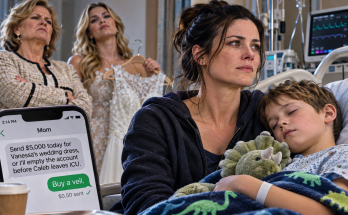
I looked again at the fifty-cent transfer.
Buy a veil.
I remembered how angry I had been when I sent it.
I remembered the paper cup beside Caleb's bed.
The smell of burnt coffee.
The way my hands shook as I opened the banking app.
I hadn't been trying to start a family war.
I had been refusing a threat.
That was all.
Patricia had demanded five thousand dollars for Vanessa's dress.
I had not agreed to pay it.
And I wasn't going to change my answer.
The wedding was Vanessa's responsibility.
Her dress was not Caleb's emergency.
It had never been.
I thought about how ridiculous it was that I had needed a seven-year-old child's surgery to make me say that plainly.
Yet there it was.
A wedding dress mattered to the person wearing it.
I could understand that.
But it didn't create a right to somebody else's money.
And it certainly didn't justify threatening to drain an account while a child remained in intensive care.
I no longer felt obligated to explain that distinction repeatedly.
My mother had made her demand.
I had given my answer.
The bank had stopped the attempted withdrawal.
The remaining financial questions would be handled through the proper review.
I didn't need to create another argument.
I needed to keep following through.
Caleb remained the part of my life that mattered most.
His recovery wasn't something I could rush because I wanted a happy ending.
I had watched him go into surgery.
I had heard the surgeon explain that the operation had gone well but that he remained fragile.
I had spent nights in the vinyl chair, listening to the monitors.
I knew better than to treat a reassuring moment as a guarantee.
So I listened to his medical team.
I asked questions.
I rested when I could.
And I stayed beside him.
One afternoon, Caleb asked about the dinosaur blanket again.
"Can I bring it when I leave?"
I smiled.
"Of course."
"Even though it's from home?"
"Especially because it's from home."
He thought about that.
Then he looked at me.
"Will you come too?"
I swallowed.
"Every step I can."
He seemed satisfied.
He pulled the blanket closer.
I watched him for a while.
I had spent so much time dealing with family members who demanded proof of my loyalty.
Caleb didn't demand any of that.
He just wanted to know I would be there.
And I was.
It made everything else seem clearer.
I didn't need to demonstrate love by paying for whatever Patricia wanted.
I didn't need to earn my place in the family through transfers and credit-card charges.
I didn't need to let Vanessa treat my finances as an extension of her wedding budget.
I needed to be present for my son.
I needed to act responsibly.
And I needed to stop confusing guilt with duty.
That didn't mean I had stopped caring about my mother and sister.
I wished things had been different.
I wished Patricia had visited the hospital.
I wished Vanessa had called after the surgery.
I wished Caleb had received a simple message saying she was proud of him.
He had wanted her to know he wasn't scared.
That memory still hurt.
I couldn't erase it.
And I couldn't make either woman care in the way I had hoped they would.
The loss wasn't only financial.
It was the loss of a belief I had carried for years.
I had believed that when something truly serious happened, my family would put aside their ordinary demands.
I had believed that if Caleb needed them, they would come.
I had believed there was a limit to how much money could matter when someone we loved was in danger.
Then Caleb had his operation.
And no one came.
Three days later, Patricia asked for five thousand dollars.
That told me something I couldn't pretend not to know.
I stopped building my decisions around the family I wished I had.
I began making them based on what had actually happened.
That change came at a cost.
I could no longer comfort myself with the idea that everything would return to normal if I simply gave in.
The old arrangement depended on my silence.
It depended on my willingness to pay.
And it depended on my fear of being called selfish.
I had removed those things.
There was no easy way back.
I didn't know whether Patricia would ever admit she had crossed a line.
I didn't know whether Vanessa would understand why I refused to pay for her dress.
And I didn't know whether either of them would ever take responsibility for missing Caleb's surgery.
Those answers belonged to them.
I couldn't manufacture an apology.
I couldn't force a change of heart.
And I couldn't decide that forgiveness meant restoring financial access.
It didn't.
If our relationship ever changed, it would have to happen without the expectation that my money was available whenever someone wanted it.
That was not a punishment.
It was a condition I needed for my own security and Caleb's protection.
I thought about my father again.
I wished I could tell him what I had learned about the trust.
I wished I could ask whether he had expected me to discover it this way.
Most of all, I wished I could thank him.
Not because the money could make Caleb well.
It couldn't.
Not because a trust could replace the people who had failed to show up.
It couldn't do that either.
But because my father had taken the time to make an arrangement intended for his grandson.
Something real.
Something that could be documented.
Something that deserved to be protected.
I was determined not to treat it carelessly.
I would continue cooperating with the review of the estate-related transactions.
I would keep the necessary records.
And I would make sure decisions about the trust were made by those with proper authority, according to its terms.
That was the responsible outcome I could pursue.
I couldn't promise that every disputed dollar would be recovered.
I couldn't say what every document would ultimately prove.
And I couldn't claim that my mother's attempted withdrawal had been the only problem the review might reveal.
Those matters depended on evidence and decisions that still had to be completed.
But I could promise one thing.
I would never again ignore financial warning signs just to avoid making Patricia angry.
I wouldn't let the same pattern continue for another year.
Or another month.
Or another day.
The access was gone.
The review was underway.
And the money my father designated for Caleb was no longer something I was willing to discuss as though it belonged to whoever demanded it most loudly.
That was where I drew the line.
I thought about the seven-year-old boy who had watched the hospital doors on the morning of his operation.
He had believed his grandmother might arrive.
He had believed his aunt would want to hear how brave he had been.
I had wanted to preserve those beliefs for him.
I still wanted him to feel loved.
But I was beginning to understand that protecting him didn't require pretending everyone had behaved well.
It required telling the truth when he was old enough to understand it.
Carefully.
Without asking him to carry my anger.
Without teaching him that he owed anyone money in exchange for affection.
I wanted him to grow up knowing he could help people without surrendering his boundaries.
I wanted him to understand that generosity was a choice.
Not a debt.
And I wanted him to know that love should never be measured by how much someone could take from him.
Those were lessons I had learned too late.
Maybe I could help him learn them earlier.
That evening, the hospital room settled into its familiar quiet.
Caleb rested with his stuffed triceratops beside him.
The dinosaur blanket was tucked beneath his chin.
My paper cup sat nearby.
This time, I picked it up before the coffee went cold.
I took a sip.
Nothing special.
Just coffee.
But I noticed how long it had been since I had done one small thing without feeling that someone was about to demand something else from me.
I looked at my phone.
There were no transfers left for Patricia to make through my old permissions.
No authorized cards for Vanessa to use.
No linked access I had to leave open because somebody claimed they needed it.
The financial work wasn't finished.
But that part of my life had changed.
And I wasn't going to undo it.
I set the cup down.
Caleb stirred.
"Mom?"
"I'm here, buddy."
He opened his eyes.
"Are you staying?"
I reached for his hand.
"Yes."
He smiled a little and closed his eyes again.
I sat beside him.
The monitors continued their steady sounds.
The bank records could be handled through the proper process.
The trust could be protected according to my father's instructions.
Patricia and Vanessa could make their own decisions about what they did next.
But my decision had already been made.
I would be Caleb's mother before I was anyone's source of money.
I would protect what I could.
I would tell the truth about what had happened.
And I would never again allow someone's demand to make me forget who needed me most.
My mother had wanted five thousand dollars.
I had sent fifty cents.
But the most important thing I finally withheld wasn't money.
It was permission.
Permission to threaten me.
Permission to use guilt instead of asking.
Permission to treat my son's future as something that could be sacrificed for another person's wants.
I wasn't giving that permission again.
Caleb slept.
I stayed.
And for the first time, I understood that I didn't need my mother's approval to be the parent my son deserved.
The End
Read more original stories on Feel Every Story.
While My Son Was Fighting for His Life, My Mother Decided My Sister’s Wedding Dress Was the Real Emergency
Part 10 of 10