
The signature was almost perfect.
That was what frightened me most.
It had the same sharp downward stroke on the M, the same exaggerated loop on the K, and even the tiny flourish I’d developed in law school because I thought it made me look more professional.
There was only one problem.
I had never signed that document.
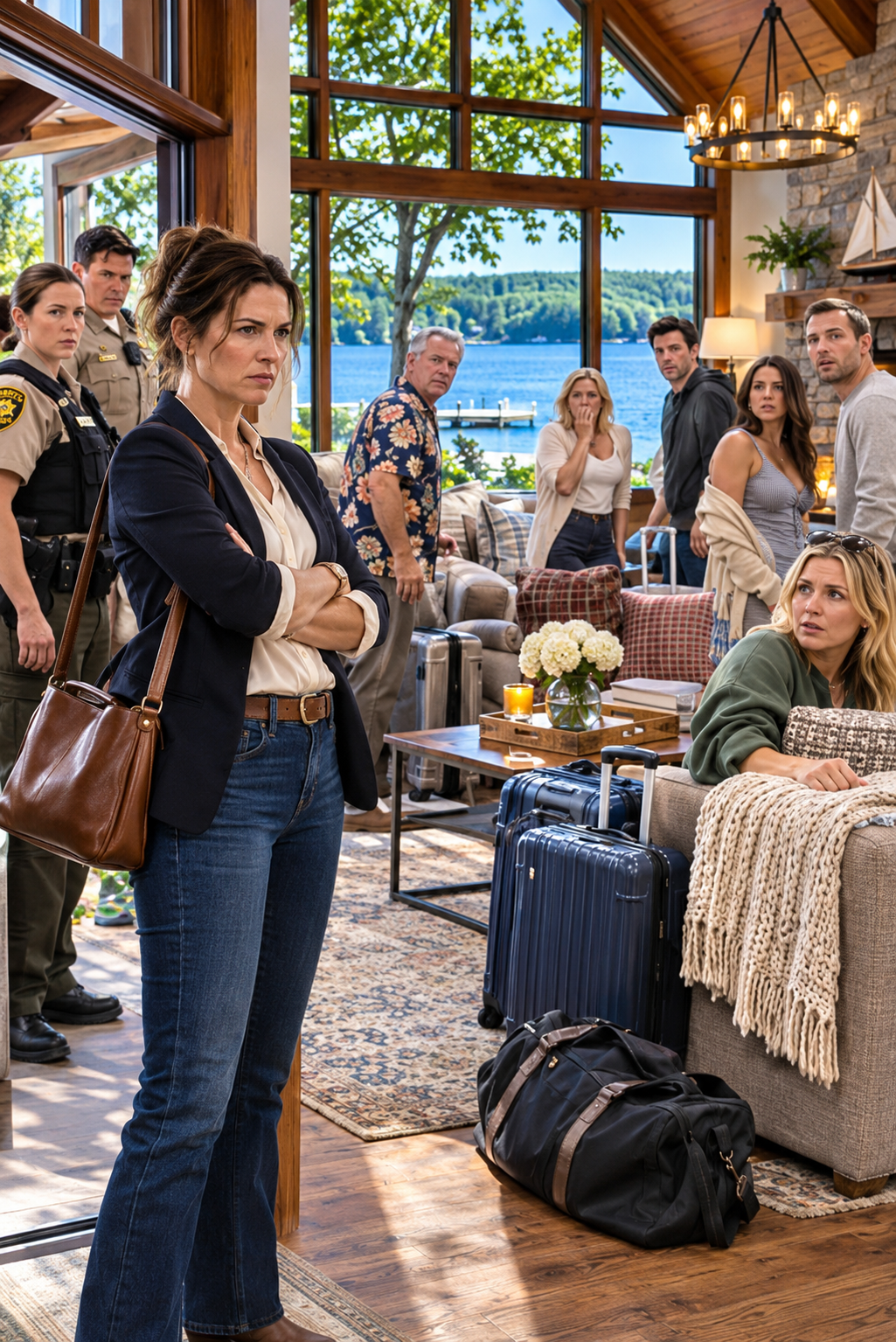
I stood inside my Wisconsin lake house, staring at a rental agreement that six complete strangers claimed gave them permission to occupy my property.
Two sheriff’s deputies stood beside me.
Behind them, an older man was angrily explaining that he’d paid $6,800 for the week.
His wife looked close to tears.
Four other guests stood surrounded by luggage, their vacation suddenly collapsing around them.
The female deputy, whose name tag read DALEY, tapped the bottom of the agreement.
“Ms.
Kellan, are you absolutely certain this isn’t your signature?”
“Positive.”
She turned the page slightly.
“Then perhaps you can explain this.”
Beneath my forged signature was another name.
Peter Kellan.
My father.
His signature appeared on the line marked Witness to Owner’s Authorization.
For thirty-four years, I’d believed my father was the quiet, reasonable member of our family.
My mother made demands.
My sister created emergencies.
Dad sighed, looked uncomfortable, and somehow always managed to stay out of the argument.
But his name was right there.
And suddenly, the last twenty-four hours made a terrible kind of sense.
My mother’s message telling me not to attend the $47,800 anniversary vacation.
My sister’s suspiciously expensive new suitcases.
The questions about the emergency keypad code at my lake house.
And now six strangers standing in a property that belonged exclusively to me.
My phone rang.
Mom.
I answered on speaker.
“Meredith!” she shouted.
“The estate manager just called!
Tell me you didn’t cancel our Napa reservations!”
“I did.”
“You selfish, ungrateful girl!
Do you have any idea how embarrassing this is?”
I looked at the forged agreement.
“Actually, Mom, I’m beginning to understand exactly how embarrassing things can get.”
“Don’t you dare ruin our anniversary!”
“I’m standing in my lake house with six people who paid Sabine to rent it.”
Silence.
Then, very quietly, she said something I would never forget.
“Meredith, whatever you do, please don’t involve the police.”
Deputy Daley raised an eyebrow.
“Little late for that,” I replied.
And then my father took the phone.
“Meredith,” he said, his voice trembling, “your mother needs to tell you the truth.”
I stared at his signature.
For the first time in my life, I wondered whether the man I had spent thirty-four years defending had been the most dangerous person in the room all along.
The Daughter Who Always Paid
My name is Meredith Kellan, and until that June weekend, I thought I understood my family.
I was thirty-four, single, and working as a commercial contracts attorney at a Chicago law firm.
My life wasn’t glamorous, despite what my mother liked to tell people.
I worked long hours.
I ate too many dinners at my desk.
I sometimes woke at three in the morning remembering a clause I’d forgotten to review.
But I’d built something I was proud of.
I owned a condominium in Chicago, had a healthy retirement account, and, after years of saving, had purchased a beautiful little lake house in Wisconsin.
The lake house was my favorite accomplishment.
Not because it was expensive, although it certainly hadn’t been cheap.
Because it was mine.
No family committee had approved the purchase.
Nobody had helped with the down payment.
Nobody had paid a single mortgage installment.
I’d earned every inch of that house through years of work, missed vacations, and Saturdays spent reviewing contracts while other people enjoyed themselves.
Sometimes I drove up on Friday evenings, opened the sliding glass doors, and sat on the porch listening to the water.
Those weekends were the closest thing I had to peace.
My family lived outside Cincinnati.
Mom, Marjorie, was sixty-three and had a talent for making ordinary conversations feel like complicated negotiations.
Dad, Peter, was sixty-five, a retired financial-services manager who preferred fishing, old detective novels, and avoiding conflict.
My younger sister, Sabine, was thirty-one.
She was beautiful, charming, artistic, and almost impressively incapable of accepting responsibility.
According to Mom, Sabine possessed a delicate creative spirit.
According to my bank statements, that spirit was extremely expensive.
Sabine had spent six years preparing to launch an online art business.
She painted abstract canvases, attended workshops, and regularly announced that she was on the verge of a breakthrough.
Every breakthrough seemed to require another financial contribution.
An apartment deposit.
A car repair.
New painting equipment.
An emergency credit-card payment.
Then came the art-school debt.
Mom called one evening sounding nearly hysterical.
“Meredith, your sister is barely sleeping.
She’s so worried about those loans.”
“Has she spoken to the lender about restructuring them?”
“She doesn’t need another lecture.”
“I wasn’t lecturing.”
“She needs someone to believe in her.”
I closed my eyes.
“How much?”
There was a pause.
“Almost nine thousand.”
I paid it.
The next morning, Sabine posted a photograph of herself holding champagne.
The universe finally rewards persistence.
I remember looking at that caption while eating a turkey sandwich at my desk.
I could have commented.
I could have reminded everyone who’d actually paid the balance.
Instead, I closed the app.
I had spent my entire life confusing silence with kindness.
When we were children, Sabine’s disappointments became family emergencies.
My achievements became expectations.
If she failed a school audition, Mom took her shopping.
If I won an academic award, Mom reminded me that I needed to remain humble.
Sabine’s eighteenth birthday was celebrated at an expensive restaurant.
Mine involved a homemade cake and a reminder that college applications were due soon.
I never thought of it as favoritism back then.
I thought Sabine needed more support because I was better at surviving without it.
Dad reinforced that belief.
“You’re our strong one, Merry,” he used to say, using the nickname he’d given me when I was little.
And I loved hearing it.
I thought it meant he admired me.
It took thirty-four years to understand that sometimes people praise your strength because it gives them permission to keep asking you to carry things.
Four years before the Napa disaster, Mom called about unexpected household expenses.
I began sending my parents $400 every month.
The arrangement was supposed to last three months.
It continued for eighteen.
Whenever I asked whether the emergency had ended, Mom became offended.
“Families help each other according to their abilities.”
Dad would quietly thank me.
Sabine would tell me I was lucky money came easily.
It didn’t come easily.
I was simply the only person in the family who understood that money had to be earned before it could be spent.
Still, I loved them.
That was why, when my parents’ fortieth wedding anniversary approached, I decided to do something extraordinary.
I wanted to give them a memory that would last forever.
I had no idea I was about to give myself one instead.
The Forty-Eighth Thousand-Dollar Mistake
My mother had dreamed of visiting Napa Valley since I was twelve.
She kept photographs of vineyards beside her cookbooks.
She loved describing sunlit terraces, elegant wine tastings, and long dinners overlooking the California hills.
Whenever she talked about Napa, her voice changed.
She sounded younger.
Happier.
For once, she talked about something that didn’t involve Sabine.
So in January, I began planning.
After weeks of research, I discovered Wrencrest Estate, a private twelve-acre property overlooking Napa Valley.
It had a magnificent main residence, guest cottage, vineyard terrace, and outdoor dining pavilion.
I booked seven nights in June.
I hired a private chef named Adrian Salcedo, arranged four guided tastings, scheduled a chauffeured vineyard tour, and coordinated everything through the estate manager, Oliver Saye.
I arranged flowers, special menus, transportation, and several private experiences.
My parents would have the master suite.
Sabine and her boyfriend, Nolan Price, would stay in the guest cottage.
I reserved an upstairs bedroom overlooking the vineyard.
I even ordered a supplemental American Express card for Mom with a $5,000 spending limit.
She could buy souvenirs or arrange something special without worrying about money.
By May, the entire celebration had cost $47,800.
Some expenses were refundable.
Others weren’t.
I didn’t care.
When I presented the itinerary to my parents, Mom cried.
She hugged me so tightly I could barely breathe.
Then she stepped back, wiped her eyes, and said, “Oh, Meredith, your sister is going to be absolutely thrilled!”
I remember feeling a small, familiar pinch in my chest.
But Dad smiled.
“This is something special, Merry.”
And for a moment, that was enough.
I spent the next few weeks making sure everything was perfect.
Then, two days before our scheduled Saturday arrival, Mom sent a text.
I was at my kitchen table reviewing a vendor agreement when my phone buzzed.
Honey, we’ve made a little adjustment for Napa.
I smiled automatically.
I assumed she wanted a different restaurant.
Then I continued reading.
Sabine has been having such a difficult time, and I promised her your bedroom in the main house because she really needs some peace and quiet.
My smile disappeared.
Nolan’s parents and his sister will be joining us, too, so we’re going to have a fuller family celebration.
I frowned.
Nolan’s parents?
His sister?
Nobody had discussed inviting them.
Then came the final paragraph.
You know how uncomfortable things get when you and Nolan disagree, and we don’t want anyone feeling judged, so I think it’s better if you sit this one out.
I hope you’ll be understanding.
I read it again.
And again.
There was no misunderstanding.
My mother had just uninvited me from the vacation I’d paid nearly fifty thousand dollars to create.
She’d taken my bedroom.
Invited three additional people.
And decided my absence would make everyone happier.
I called immediately.
She declined.
Thirty seconds later, another message appeared.
Please don’t turn this into a confrontation, Meredith.
This is our anniversary, and we deserve to enjoy it without unnecessary drama.
I sat staring at the screen.
Then I called Dad.
He answered from the garage.
“Dad, did you know Mom told me not to come?”
Silence.
“Your mother’s trying to keep everybody happy.”
“By excluding me?”
“Meredith, Nolan’s parents already bought their plane tickets.
Changing everything now would be embarrassing.”
I laughed once.
It wasn’t a happy sound.
“Embarrassing for whom?”
“Sweetheart—”
“Whose name is on the estate reservation?”
He sighed.
“Yours.”
“Who paid for it?”
“You did.”
“And you think I should stay home?”
Another silence.
Then he said the same thing he’d said throughout my childhood.
“You know how your mother gets.”
I ended the call.
Ten minutes later, Sabine posted a photograph of three designer suitcases beside her front door.
Her caption read:
A week in paradise with the people who matter most.
Nolan commented that he couldn’t wait to introduce his parents to the lifestyle they deserved.
His sister, Willa, replied with champagne emojis.
I stared at that post until something inside me went very still.
Then I opened my laptop.
I found the Wrencrest Estate agreement.
My name was on every contract.
My credit card had funded every service.
And the cancellation provisions were remarkably clear.
I called Oliver Saye first.
“Ms.
Kellan,” he said warmly, “we’re looking forward to welcoming your family.”
“Oliver, I need to cancel the reservation.”
There was a pause.
“I’m sorry to hear that.
Has something happened?”
“Yes.”
“Would you prefer to reschedule?”
“No.”
He sounded concerned.
“May I ask why?”
I looked at Mom’s text.
“Apparently, the person paying for the vacation isn’t welcome.”
Oliver said nothing for several seconds.
Then he cleared his throat.
“I see.”
I contacted all six vendors and service providers.
By the time I finished, the estate, chef, tastings, transportation, and remaining experiences had been canceled.
I would lose money on nonrefundable deposits and cancellation fees.
But I would recover a substantial portion of the total.
And most importantly, nobody would be enjoying a luxury vacation at my expense while pretending I didn’t exist.
When I finished, I opened a bottle of sparkling water and sat alone at my kitchen table.
For the first time all day, I felt calm.
Then I remembered something.
Six weeks earlier, Mom had asked whether I’d changed the emergency keypad code at my Wisconsin lake house.
She claimed a contractor might need access while I was traveling.
At the time, I’d thought nothing of it.
My parents knew the emergency code.
They’d always been allowed to enter when necessary.
But something about that conversation suddenly bothered me.
Why had she asked?
And why, of all things, had she mentioned contractors?
I checked my maintenance calendar.
There were no scheduled repairs.
No contractor appointments.
Nothing.
I called Mom again.
No answer.
I called Sabine.
Straight to voicemail.
I looked at the clock.
Then I picked up my car keys.
Something was wrong at my lake house.
I could feel it.
Six Strangers in My Living Room
I reached Wisconsin late Friday afternoon.
The drive from Chicago had been long enough for me to question myself at least a dozen times.
Maybe I was overreacting.
Maybe Mom had genuinely wanted to check on something.
Maybe my imagination was turning an ugly family argument into something worse.
Then I turned into the gravel driveway.
Three unfamiliar vehicles were parked outside.
My stomach dropped.
There were lights on inside.
The patio furniture had been rearranged.
Through the enormous living-room windows, I could see people moving around.
People I didn’t recognize.
I parked behind a black SUV and walked to the front door.
Voices floated from inside.
Laughter.
Music.
Someone had opened a bottle of wine.
Strangers were having a vacation in my house.
I stepped inside.
Six people turned toward me.
An older man with gray hair and a floral shirt stood beside the kitchen island.
A blond woman sat on the sofa.
Two younger couples were arranging food near the windows.
Suitcases occupied the hallway.
One of my favorite blankets lay crumpled across a chair.
The older man frowned.
“Can we help you?”
I stared at him.
“Who are you?”
He looked offended.
“Excuse me?”
“This is my house.”
The room fell silent.
A young woman with dark hair slowly put down her wineglass.
“Wait.
Are you Meredith?”
I turned toward her.
“How do you know my name?”
She exchanged a look with the others.
The older man pulled out his phone.
“We rented this property for the week.”
“From whom?”
“Your sister.”
I felt something cold move through my chest.
“What?”
“Sabine Kellan.
We paid her in advance.”
“How much?”
He hesitated.
“Six thousand eight hundred dollars.”
I stared at him.
“You’re telling me you paid my sister $6,800 to stay in a house she doesn’t own?”
The blond woman stood.
“She said she managed the property for the family.”
“She doesn’t.”
The older man’s expression hardened.
“Look, we’ve traveled several hours.
We have a rental agreement, payment receipts, everything.”
“Then you’d better show them to the sheriff.”
His jaw tightened.
“Are you threatening us?”
“No.
I’m calling the police because people are occupying my property without my permission.”
The younger woman stepped forward.
“I’m Grace.
Please, we’re not trying to cause trouble.
We honestly believed this was legitimate.”
I looked at her frightened face.
Then at the bags.
The groceries.
The birthday decorations someone had placed on my dining table.
They weren’t criminals.
They were vacationers who’d been lied to.
My anger shifted.
Not away from the situation.
Toward the person who had created it.
I called the county sheriff’s department.
Two deputies arrived twenty minutes later.
Deputy Daley introduced herself while her partner, Deputy Brant, spoke with the guests.
I showed my identification, property tax records, mortgage statements, and electronic ownership documents.
Then Grace handed over the rental agreement.
The deputies examined it.
And that was when Deputy Daley asked me about the signature.
It looked almost exactly like mine.
Except I hadn’t signed it.
Below it was my father’s signature.
Peter Kellan — Witness to Owner’s Authorization.
My vision blurred.
Dad?
I leaned closer.
There was another section.
Authorized Property Representative: Marjorie Kellan.
Mom.
All three names appeared on the document.
Mine.
My mother’s.
My father’s.
Only one of us owned the property.
Only one of us hadn’t agreed to rent it.
Me.
Deputy Daley photographed the papers.
“Ms.
Kellan, did you ever authorize either parent to lease this property?”
“No.”
“Did you authorize your sister?”
“No.”
“Have you ever signed a power of attorney giving them authority over it?”
“Absolutely not.”
She exchanged a glance with Deputy Brant.
“All right.
We’ll document this carefully.”
Grace looked miserable.
“So we have to leave?”
“I’m afraid so,” Deputy Daley said.
“The owner has not authorized your stay.”
The older man made an angry noise.
Grace put a hand on his arm.
“Henry, please.”
I looked around at their luggage.
I could see they’d been deceived.
It wasn’t their fault.
“I’ll give you time to collect everything,” I said.
“There’s a hotel about twenty minutes away.
I can call and check whether they have rooms.”
Grace’s eyes filled.
“I’m so sorry.”
“You don’t owe me an apology.”
She swallowed.
“We saved for this trip.”
I believed her.
And that somehow made everything worse.
While Deputy Brant helped the guests understand what information they’d need for a fraud report, my phone rang.
Mom.
I answered on speaker.
She was furious about Napa.
I told her I’d canceled everything.
She screamed.
I told her about the strangers.
And suddenly, she went quiet.
Then she whispered, “Please don’t involve the police.”
I looked directly at Deputy Daley.
“Too late.”
Dad came on the line.
“Meredith, your mother needs to tell you the truth.”
I stared at the document.
“Then maybe you should start, Dad.”
He said nothing.
“Your signature is on this agreement.”
There was a sharp intake of breath.
“Meredith—”
“Did you sign it?”
Silence.
“Answer me.”
Finally, he whispered, “Yes.”
The room seemed to tilt.
“Why?”
“Because your mother told me you’d agreed.”
I closed my eyes.
“She told you I agreed to let strangers rent my house?”
“She said Sabine was handling some arrangements.”
“Arrangements?”
“Merry, I didn’t understand what they were doing.”
I stared at the elegant forged signature above his name.
“Then why did you sign?”
He didn’t answer.
For the first time, I didn’t fill the silence for him.
I let him sit inside it.
The File That Shouldn’t Have Existed
That night, after the guests left, I walked through the lake house alone.
Nothing had been seriously damaged.
A few towels were in the wrong places.
Someone had moved my books.
The kitchen smelled of takeout food.
But the house felt different.
It no longer felt entirely safe.
I changed the keypad code immediately.
Then I called a locksmith and arranged to have the exterior locks rekeyed the following morning.
I disabled my parents’ access credentials.
I removed Sabine from every emergency-contact list associated with the property.
Then I sat at my dining table and opened my laptop.
I had spent years reviewing complicated business agreements.
I knew what a legitimate rental contract looked like.
And the document Grace had shown me wasn’t something Sabine could have casually assembled in an afternoon.
It contained detailed property descriptions.
Insurance provisions.
Occupancy limitations.
Indemnification language.
Even a clause requiring guests to acknowledge that the property was privately held.
I began comparing it with my own records.
That was when I noticed the property description.
It wasn’t simply the mailing address.
It included the full legal description of the parcel.
The lot number.
The subdivision reference.
The recording information.
Information someone had copied from my deed.
I opened the county records website.
My ownership information appeared normally.
But there was also a recently submitted document associated with the parcel.
I clicked it.
A scanned page appeared.
My heart began hammering.
It was a preliminary filing associated with a proposed transfer of interest.
The named recipient was a company called Willow Bay Holdings LLC.
The document contained another version of my signature.
A forged signature.
And beside it was a reference to a limited power of attorney.
I searched my files.
I’d never executed one.
My hands began shaking.
Renting my house to strangers was bad enough.
But transferring an ownership interest?
That was something else entirely.
I called my friend and colleague, Elena Park.
Elena was a real estate litigation attorney at my firm.
She answered on the fourth ring.
“Meredith?
Is everything okay?”
“No.”
“What’s happened?”
“I think my family is trying to steal my lake house.”
There was a brief silence.
Then her voice changed.
“Tell me exactly what you’ve found.”
I explained everything.
The Napa celebration.
The cancellation.
The strangers.
The rental agreement.
My father’s signature.
The county filing.
Elena listened without interrupting.
When I finished, she said, “Send me the documents.”
I forwarded them.
A few minutes later, she called back.
“Meredith, don’t contact the company named on that filing.”
“Why?”
“Because we need to preserve evidence before anyone has the chance to alter it.”
I rubbed my forehead.
“Can they actually take my house with a forged document?”
“A recording office accepting a document doesn’t make the underlying transfer valid,” she explained.
“But a fraudulent filing can create a serious title problem.
We need to act quickly.”
“What do I do?”
“We’ll notify the appropriate parties, challenge the filing, and get local counsel involved.
You also need to report the suspected forgery.”
I looked out at the dark lake.
“Elena?”
“Yes?”
“Do you think my parents knew?”
She was quiet for a moment.
Then she said something that hurt more than I expected.
“Meredith, stop asking what your parents intended.
Start looking at what they signed.”
The Morning After
I barely slept.
At seven the next morning, the locksmith arrived.
By eight-thirty, every exterior lock had been changed.
I called the bank associated with my mortgage and placed a fraud alert on the account.
I froze my credit through the major reporting bureaus.
I contacted my insurance company.
Then I sent Deputy Daley copies of the county filing and the rental agreement.
Shortly before noon, Grace called.
She’d found my number through the rental paperwork.
“Meredith, I’m sorry to bother you.”
“It’s okay.”
“We went through the messages again.
There are things you should know.”
I sat down.
“Go ahead.”
“Sabine kept telling us the property belonged to a family trust.
She said her father handled all the legal arrangements.”
My mouth went dry.
“Her father?”
“Yes.
She said he was a retired financial professional and that everything was properly documented.”
I closed my eyes.
Grace continued.
“She also sent us a video tour.”
“A video?”
“It looked professionally filmed.”
“Can you send it?”
“Of course.”
A minute later, the file arrived.
I pressed play.
The video began at my front door.
It moved through the living room, kitchen, bedrooms, and onto the lakeside deck.
Someone had filmed every room.
Every possession.
Every private corner of my sanctuary.
Then, near the end, I heard a voice.
A man’s voice.
“Make sure you get the view from the dock.
That’s what sells the place.”
I froze.
I replayed it.
The voice was familiar.
Painfully familiar.
It sounded like my father.
I called Grace back.
“Who sent this video?”
“Sabine.”
“Was anyone else copied?”
“Not initially.
But the payment instructions came from a company called Willow Bay Vacation Management.”
My heart sank.
Willow Bay.
The same name from the property filing.
“Do you still have those instructions?”
“Yes.”
“Please send everything.”
She hesitated.
“Meredith, do you think we’ll get our money back?”
I looked at my reflection in the window.
“I don’t know,” I said gently.
“But I’ll help you give the investigators everything they need.”
After we hung up, I sat motionless for several minutes.
I’d spent years defending my father.
Whenever Mom demanded money, I told myself Dad was embarrassed.
Whenever Sabine behaved badly, I told myself Dad simply wanted peace.
But he had signed the rental agreement.
His voice appeared to be on the video.
And the suspicious property filing involved a company connected to the same rental operation.
For the first time, I couldn’t pretend Dad was merely standing in the background.
The Anniversary That Never Happened
By Saturday afternoon, Mom had called seventeen times.
Sabine had sent nine messages.
Nolan had left two voicemails.
I ignored them all.
Then Mom sent a text.
You have no idea what you’ve done to this family.
I typed a response.
I know exactly what I’ve done.
I’ve stopped paying for people who don’t respect me.
Three dots appeared.
Disappeared.
Then returned.
You are destroying forty years of marriage over a misunderstanding.
I stared at the words.
Forty years of marriage.
That was how she described it.
Not a possible fraud.
Not a forged signature.
Not strangers occupying my home.
A misunderstanding.
I replied:
You had no authority to rent my property.
You had no authority to sign documents in my name.
The police have the agreement.
Mom called immediately.
This time, I answered.
“Meredith, listen to me very carefully.”
Her voice was low and tight.
“I need you to stop escalating this.”
“Escalating?”
“We can handle this privately.”
“People paid Sabine $6,800.”
“She was going to return it.”
“When?”
“That’s not the point.”
“Then what is the point?”
“Your sister is trying to establish a business!”
I laughed in disbelief.
“By renting out my house?”
“She needed some startup capital.”
“Mom, that’s fraud.”
“Stop using that word!”
I stood and walked toward the windows.
The lake looked peaceful.
It seemed impossible that I could be standing in such a beautiful place having this conversation.
“Did you know she was doing it?”
Silence.
“Mom?”
“Your father said there was a way for the property to generate income.”
I gripped the phone.
“What?”
She quickly continued.
“Only temporarily.
Until Sabine got established.”
“Income for whom?”
“For the family.”
I closed my eyes.
“Mom, you told me I couldn’t attend a vacation I paid for.
Then you let Sabine use my home to make money.
What exactly do you think I am to you?”
Her answer came immediately.
“You’re the one who can afford to help.”
There it was.
The entire philosophy of my childhood reduced to one sentence.
I wasn’t a daughter.
I was available capital.
I swallowed.
“And what happens when I can’t afford it anymore?”
She sounded genuinely confused.
“But you can.”
I ended the call.
Then I sat on the edge of the sofa and cried.
Not because I missed the Napa trip.
Not because of the money.
I cried because I finally understood that there was no amount I could give that would make my mother see me as someone who deserved consideration.
In her world, my success wasn’t something to celebrate.
It was something everyone else had a claim against.
The Sister Who Needed Everything
Sabine arrived at the lake house on Sunday afternoon.
I saw her car pull into the driveway.
She stood outside the locked front door for several minutes, pressing the keypad.
Then she called me.
“Meredith, the code isn’t working.”
“I changed it.”
“Why?”
I looked at the security camera feed.
“Because people were entering my house without permission.”
She let out an irritated breath.
“Can you just open the door?”
“No.”
“Seriously?”
“Yes.”
A pause.
“You’re being ridiculous.”
I almost laughed.
“Sabine, you rented my house to six strangers.”
“They weren’t strangers to me.”
“That doesn’t make it better.”
She sighed.
“Can we talk like adults?”
I considered leaving her outside.
Then I walked to the door and opened it.
Sabine stood on the porch wearing oversized sunglasses and a cream linen outfit that probably cost more than my monthly groceries.
She looked exhausted.
There were dark circles under her eyes.
“Are you happy?” she demanded.
“About what?”
“You ruined Mom and Dad’s anniversary.”
I stared at her.
“That’s why you came?”
“You didn’t have to cancel everything.”
“You told me I wasn’t invited.”
“Mom told you that.”
“And you happily accepted my bedroom.”
She folded her arms.
“Mom thought it would be better if Nolan’s family didn’t have to deal with your attitude.”
“My attitude?”
“You always make people feel judged.”
I stepped aside, allowing her to see the room.
“Tell me about the rental agreement.”
Her expression changed.
“Can we not start with that?”
“No.”
“It was supposed to be temporary.”
“How many people have stayed here?”
She looked away.
I felt my stomach twist.
“Sabine.”
She said nothing.
“How many?”
Finally, she whispered, “Three groups.”
My chest tightened.
“Three?”
“Not counting the people who came yesterday.”
I stared.
“You’ve rented my house four times?”
She shrugged miserably.
“Nobody damaged anything.”
“That’s not the question.”
“Meredith, I needed money.”
“For what?”
“My business.”
“What business?”
“My gallery.”
I waited.
She began pacing.
“Nolan knows people who can help me launch.
He found a location.
We just needed capital to secure it.”
“Then get a business loan.”
“We tried.”
“Then find investors.”
“That’s what we were doing.”
“By stealing rental income from me?”
Her face flushed.
“I wasn’t stealing!
Dad said the house could be considered a family asset.”
The words hit me like a slap.
“Dad said what?”
She stopped pacing.
“That because the family had always helped you, it was reasonable for the property to benefit everyone.”
I stared at her.
“What help?”
She looked uncomfortable.
“You know.
College.
Support.
All the things Mom and Dad did.”
I felt something hot rise in my chest.
I had scholarships.
Student loans.
Work-study jobs.
I’d paid those loans off myself.
My parents had helped with occasional groceries and rides to the airport, not the hundreds of thousands of dollars Sabine seemed to imagine.
“Sabine, who paid for your art-school debt?”
She rolled her eyes.
“Why are we talking about that?”
“Answer me.”
“You did.”
“Who paid your apartment deposits?”
“You.”
“Your car repairs?”
She said nothing.
“And who paid for this house?”
Her voice became small.
“You did.”
“Then why does Dad think it’s a family asset?”
She looked away.
That was when I noticed something.
Sabine wasn’t just embarrassed.
She was frightened.
“Sabine,” I said quietly, “what did Nolan tell you?”
She rubbed her forehead.
“He said everything was legal.”
“What was legal?”
“The business structure.”
“What business structure?”
She looked toward the door.
Then she whispered, “He said Dad had already worked it out.”
I felt a cold pressure behind my ribs.
“Worked what out?”
Sabine began crying.
And for once, I didn’t reach for my wallet.
Willow Bay Holdings
On Monday morning, Elena and I had a video conference with a Wisconsin attorney named Rachel Monroe.
Rachel specialized in real estate disputes and title litigation.
She was in her forties, with short dark hair and the blunt, efficient manner of someone who had little patience for nonsense.
“I’ve reviewed the filing,” she said.
“And we need to take this seriously.”
I sat straighter.
“Tell me.”
“The document appears designed to support a transfer of your property into Willow Bay Holdings LLC.”
“Who owns the company?”
“That’s what we’re investigating.”
“Can the transfer go through?”
“A forged deed is not a valid conveyance, but recording systems don’t independently verify every underlying fact.
We need to challenge the instrument and make sure no lender or buyer relies on it.”
I nodded.
Rachel continued.
“There’s also a draft financing package.”
My stomach dropped.
“Financing?”
“Someone appears to be seeking a substantial private loan secured by the property.”
“How substantial?”
She glanced at her notes.
“Approximately $385,000.”
I stared at the screen.
Three hundred and eighty-five thousand dollars.
Against my house.
For a business I had never approved.
I pressed my palms against the table.
“Is any of it funded?”
“We haven’t confirmed a completed loan.
The papers suggest funding is pending further verification.”
I exhaled shakily.
Rachel leaned closer to the camera.
“Meredith, I want you to understand something.
Your quick response may have prevented a much more complicated situation.”
I looked out at the lake.
If Mom hadn’t excluded me from Napa, I would have been in California.
If I hadn’t questioned the keypad request, I wouldn’t have driven to Wisconsin.
If Grace hadn’t handed over the rental agreement, I might never have discovered the forged signature.
My family’s attempt to humiliate me had accidentally exposed something far worse.
Rachel told us she’d contact the relevant parties to dispute the suspected fraudulent instruments and seek protective relief where appropriate.
We also prepared evidence for investigators.
Rental messages.
Payment records.
The video tour.
My mother’s texts.
My father’s signature.
Everything.
At the end of the call, Rachel asked one question.
“Meredith, do your parents have any financial problems you’re aware of?”
I hesitated.
“Mom said they had household expenses four years ago.”
“Anything else?”
“Dad retired two years ago.”
“Did he work in real estate?”
“No.
Financial services.”
Rachel paused.
“Then he would likely understand the significance of signing an authorization document.”
I swallowed.
“Yes.”
“Please don’t overlook that.”
The Man Who Never Took Sides
Dad called Monday evening.
I almost didn’t answer.
But something inside me needed to hear what he had to say.
“Hi, Merry.”
His voice sounded tired.
“Hi, Dad.”
“Your mother says you’ve hired lawyers.”
“Yes.”
He sighed.
“Is that really necessary?”
I looked at the stack of documents on my desk.
“Someone forged my signature and tried to use my house as collateral for a loan.”
He was quiet.
“Did you know about the loan?”
I asked.
“No.”
“Did you know about Willow Bay Holdings?”
Another pause.
“Only vaguely.”
My heart sank.
“Vaguely?”
“Your sister and Nolan were discussing some business ideas.”
“That’s not an answer.”
He sighed.
“Meredith, I’m trying to help.”
“Then tell me the truth.”
There was silence.
Finally, he said, “Your mother asked me to witness the rental authorization.
She told me you’d approved a short-term arrangement.”
“Did you speak to me?”
“No.”
“Did you see me sign it?”
“No.”
“Then why did you sign as a witness?”
His voice cracked.
“I trusted your mother.”
I stared at the wall.
“You signed a document saying you’d witnessed something you hadn’t witnessed.”
“I know.”
“And now my house is involved in a financing scheme.”
“I never wanted that.”
I could hear him breathing.
Then he said, “I should have stood up for you.”
For a moment, I felt like a child again.
Dad sitting beside me after a difficult day.
Dad telling me everything would be okay.
Dad calling me his strong girl.
My eyes filled.
“Then why didn’t you?”
He didn’t answer.
I waited.
Finally, he said, “I was afraid of losing the family.”
I pressed my fingers against my forehead.
“And you thought losing me was acceptable?”
He began crying.
It was the first time I’d heard my father cry in years.
“I’m sorry, Merry.”
I wanted desperately to believe him.
But Elena’s warning echoed in my mind.
Stop looking at what they intended.
Look at what they signed.
I took a breath.
“If you’re sorry, Dad, cooperate with the investigation.”
“I will.”
“Tell them everything.”
“I will.”
“And don’t call Mom or Sabine to coordinate stories.”
Another pause.
Then he whispered, “Okay.”
After we hung up, I cried for almost an hour.
Because I still loved him.
Because I wanted him to be innocent.
And because somewhere deep inside me, I already knew that wanting something to be true didn’t make it true.
The Woman Who Paid $6,800
Grace called again on Tuesday.
She and her husband, Henry, had returned to Milwaukee.
Their friends had gone home.
Their planned birthday trip was ruined.
But she had more information.
“We found another payment record,” she said.
“The initial deposit went to one account, but the remaining balance went somewhere different.”
“Different how?”
“The instructions listed Willow Bay Vacation Management, but the account holder wasn’t Sabine.”
My heart began beating faster.
“Who was it?”
“Peter Kellan.”
I stopped breathing.
“Are you certain?”
“I have the receipt.”
I stared at my phone.
“Please send it.”
A few seconds later, the email arrived.
The account information was partially masked, but the named recipient was unmistakable.
Peter Kellan.
My father.
Grace spoke softly.
“Meredith, is that your dad?”
“Yes.”
“I’m so sorry.”
I barely heard her.
I thanked her and hung up.
Then I forwarded the document to Elena, Rachel, and Deputy Daley.
For several minutes, I sat motionless.
I’d been trying to understand my father’s behavior as weakness.
He had signed papers without reading them.
He’d trusted Mom.
He hadn’t wanted conflict.
But now his name appeared on a payment record.
Not as a witness.
As the recipient.
I called him.
No answer.
I called again.
Voicemail.
Then I sent a message.
Dad, I have the rental payment receipt.
Why is your name on it?
He responded eleven minutes later.
We should discuss this in person.
I stared at the words.
Then I typed:
We can discuss it with my attorney present.
He didn’t reply.
That evening, Rachel called.
“Meredith, we have another development.”
I gripped the phone.
“What?”
“The company records show Willow Bay Holdings was organized several years ago.
We’re still tracing its ownership history, but there are indications it predates Nolan’s involvement with your family.”
I frowned.
“That doesn’t make sense.
Nolan and Sabine have only been dating two years.”
“Exactly.”
A chill moved through me.
I’d been assuming Nolan was the mastermind.
He was ambitious.
He bragged constantly.
He talked about investments, connections, and opportunities.
He liked describing my career as a useful family resource.
But if Willow Bay existed before Nolan entered our lives…
Then the scheme might have begun much earlier.
Much earlier than I wanted to imagine.
Dinner With the Enemy
Mom finally agreed to meet me on Wednesday.
Not because she’d suddenly developed remorse.
Because her American Express supplemental card had stopped working.
I’d canceled it the morning after the lake-house discovery.
She called furious.
“Meredith, I’m standing at a restaurant and your card has been declined!”
“That account is closed.”
“You can’t just do that!”
“It’s my account.”
“I was embarrassed in front of people!”
I stared at the ceiling.
“Mom, you tried to exclude me from my own vacation.
I’m no longer funding your entertainment.”
She threatened to tell the entire family what a selfish daughter I’d become.
I said she was welcome to tell anyone she liked, provided she included the part about the forged signatures.
She went quiet.
Then she agreed to meet.
We chose a restaurant near Cincinnati, halfway between her home and the office where Rachel had arranged a local attorney to be available if needed.
I drove down with Elena.
Elena didn’t sit at the table, but she remained nearby.
Mom arrived wearing a navy dress and pearl earrings.
Sabine came with her.
Neither apologized.
Mom sat down.
“I hope you’re satisfied.”
I folded my hands.
“With what?”
“You’ve turned our anniversary into a nightmare.”
“Mom, we’re here to discuss the rental fraud.”
She waved a hand.
“That word again.”
Sabine stared at her menu.
I looked at her.
“Did you tell Mom about the loan?”
Sabine’s face went pale.
Mom turned sharply.
“What loan?”
For a moment, nobody spoke.
Then Sabine whispered, “Nolan said Dad knew.”
Mom looked genuinely stunned.
“What are you talking about?”
I watched her carefully.
“The proposed $385,000 loan secured against my lake house.”
Mom’s mouth fell open.
“No.”
I reached into my bag and removed copies of the filings.
She stared at them.
“Peter never told me about this.”
Sabine began crying.
“He told Nolan it was okay.”
My heart hammered.
Mom looked at me.
“Meredith, I knew about the rentals.
Your father said we could use the house temporarily to help Sabine establish her business.”
“You knew you didn’t own it.”
Mom’s face reddened.
“You’re always so obsessed with ownership!”
I stared at her.
“Because ownership matters.”
“You’re making this sound like we were trying to rob you.”
“You signed a rental agreement for property that wasn’t yours.”
“I was trying to help your sister!”
“And who was helping me?”
She opened her mouth.
Then closed it.
I leaned forward.
“For thirty-four years, Mom, every crisis was Sabine’s.
Every solution was mine.
I paid for her debts, your household emergencies, and a vacation you told me not to attend.
Then you gave strangers access to my home.”
Tears filled her eyes.
“I never thought you’d turn against us.”
I sat back.
“That’s the problem.
You thought I never would.”
Sabine wiped her face.
“Meredith, I swear I didn’t know about the loan until Nolan mentioned financing last month.”
I looked at her.
“What did you think the rental money was for?”
“My gallery.”
“And how much did you receive?”
She hesitated.
“About four thousand.”
I stared.
“From four bookings?”
“Yes.”
I took out the payment summaries Grace had provided.
The most recent rental alone was $6,800.
“Where did the rest go?”
Sabine’s lips trembled.
“Dad said it covered management expenses.”
The restaurant seemed suddenly too loud.
Silverware clattered.
Someone laughed at a nearby table.
A server passed carrying hot plates.
And there, sitting across from me, were two women who’d spent their lives demanding my resources without ever questioning where those resources went.
But now they looked frightened.
Not because they understood the pain they’d caused.
Because they were beginning to suspect they’d been used, too.
Nolan’s Perfect Opportunity
Nolan Price called that evening.
His voice was cheerful, which immediately made me suspicious.
“Meredith!
Hey.
Can we clear the air?”
“No.”
He chuckled.
“Come on.
This whole situation has gotten way out of hand.”
“Then explain Willow Bay Holdings.”
There was a pause.
“What about it?”
“The forged documents.”
“That’s a strong accusation.”
“It’s supported by evidence.”
He sighed dramatically.
“Look, your family was trying to create an income-producing asset.
That’s not unusual.”
“My family doesn’t own my lake house.”
“Technically, sure.”
I closed my eyes.
“There’s no ‘technically’ about it.”
He changed tactics.
“Meredith, you have a great career.
You own multiple properties.
Sabine has talent but lacks access to capital.”
“Then she needs to build a business plan.”
“We had one.”
“Using my property without my consent.”
He made an irritated noise.
“You lawyers always get hung up on details.”
I almost laughed.
“Details like who owns the house?”
“Don’t twist my words.”
I leaned back.
“Nolan, did you prepare the financing documents?”
Silence.
“Did you forge my signature?”
“Absolutely not.”
“Did you know the loan would be secured against my property?”
Another pause.
Then he said, “Your father was handling the financial side.”
My pulse quickened.
“What exactly did my father tell you?”
“He said the asset belonged in a family holding company.”
I sat perfectly still.
“Did he say I agreed?”
“Yes.”
“Did you ever speak to me?”
“No.”
“Then why would you believe him?”
Nolan became defensive.
“He’s your father.”
I looked down at my notes.
“That doesn’t give him authority over my property.”
Nolan lowered his voice.
“Meredith, if you keep pushing this, everyone is going to get hurt.”
I stared out the window.
“Is that a threat?”
“No.
It’s reality.”
“Then here’s mine.
Do not contact me again except through counsel.”
I ended the call.
A minute later, he texted.
You’re making a huge mistake.
I forwarded it to Elena.
Her response came almost immediately.
Preserve everything.
Don’t engage.
I obeyed.
For the first time in my adult life, I stopped trying to manage everyone’s feelings.
I stopped cushioning consequences.
I stopped explaining boundaries as though they were invitations to negotiate.
I was finally treating my family the way I treated every serious contractual dispute: with evidence, documentation, and enforceable limits.
The Sister Who Finally Told the Truth
On Thursday, Sabine called.
This time, she wasn’t angry.
She sounded terrified.
“Meredith, can I come see you?”
“Why?”
“Because I found something.”
“What?”
“An email.”
“From whom?”
“Dad.”
I sat up.
“What kind of email?”
She began crying.
“One that proves he lied to all of us.”
I hesitated.
Then I told her to send it.
The email arrived a few minutes later.
It was dated seven months before the anniversary trip.
Seven months.
Long before I’d booked the Napa estate.
The subject line read:
RE: WILLOW BAY — PROPERTY UTILIZATION PLAN
I opened it.
The message was addressed to Nolan.
Dad had written:
The Wisconsin asset remains under Meredith’s direct ownership.
We need to establish a consistent short-term rental history before proceeding with the next phase.
Sabine can handle guest communications.
Marjorie can provide access authorization.
I will oversee the financial arrangements.
I stared at the screen.
Then I continued reading.
Meredith is unlikely to question family use of the property if we present it as a temporary accommodation.
She generally avoids confrontation.
My hands began trembling.
There was more.
Once sufficient rental activity is established, we can proceed with the holding-company structure.
I read that sentence several times.
Seven months earlier, Dad had already been planning to use my property.
He had discussed it with Nolan.
He had anticipated my reluctance to confront family.
And he had built that weakness into his strategy.
I called Sabine.
“Where did you find this?”
“Nolan left his laptop at my apartment.”
“Does he know?”
“No.”
“Did you copy anything else?”
“Yes.”
“Send it all to Rachel.”
She began crying again.
“Meredith, I thought Dad was helping me.”
I closed my eyes.
“I know.”
“He told me you wanted the house to benefit the family eventually.”
“I never said that.”
“I know now.”
For several seconds, neither of us spoke.
Then Sabine whispered, “I think he’s been using me.”
I looked at the email.
“Sabine, you still chose to rent my property without asking me.”
“I know.”
“You still took money from strangers.”
“I know.”
“And you let Mom exclude me from a vacation I paid for.”
Her voice broke.
“I know.”
It was the first time I’d ever heard my sister acknowledge wrongdoing without immediately blaming someone else.
I wanted it to feel like victory.
It didn’t.
It felt like standing in the remains of a house after a fire, discovering that the flames had started years before anyone smelled smoke.
The Other Life
The documents Sabine forwarded changed everything.
There were spreadsheets.
Bank transfer summaries.
Draft contracts.
Company records.
And correspondence with a private lender.
Rachel and Elena spent days reviewing them.
Investigators began requesting additional information.
The proposed loan was stopped before any new funds were released against my property.
The questionable filing was formally challenged.
The rental transactions became part of a broader fraud investigation.
Then, on Monday afternoon, Rachel called.
“Meredith, are you sitting down?”
I looked at the empty office around me.
“Yes.”
“We’ve confirmed the beneficial owner of Willow Bay Holdings.”
I gripped my phone.
“Who?”
She paused.
“Your father.”
I closed my eyes.
I had expected it.
Some part of me had known.
But hearing it confirmed still hurt.
Rachel continued.
“He’s also connected to several other entities.
We’re reviewing the records to understand their purpose.”
I swallowed.
“How many?”
“At least four.”
I stared at the wall.
“What was he doing?”
“Some of the companies appear to have been used for investment activity.
We’re still sorting through the transactions.”
“Was Nolan involved?”
“Yes.
But the records suggest Nolan joined an operation that was already established.”
I rubbed my forehead.
“How long ago?”
“Willow Bay’s earliest formation documents date back several years before Nolan met Sabine.”
My stomach twisted.
Dad hadn’t been manipulated by an ambitious boyfriend.
Dad had been running the financial arrangements.
And Nolan had become another participant.
Then Rachel said something even worse.
“Meredith, there’s evidence your father has substantial undisclosed liabilities.”
“How substantial?”
“We don’t know the final amount, but the records suggest several hundred thousand dollars.”
I stared at my desk.
Dad had retired comfortably.
At least, that was what he’d told us.
He’d always insisted that he and Mom were financially secure.
He accepted my $400 monthly payments reluctantly, or so I’d believed.
He spoke about responsible spending.
He criticized Sabine’s impulsiveness.
He reminded me to contribute to retirement accounts.
Now I was learning that the man who’d taught me financial discipline had been hiding debts through a network of companies.
“Rachel,” I whispered, “where did the money go?”
She hesitated.
“Some appears connected to failed speculative investments.
There are also transfers we haven’t explained.”
I closed my eyes.
Dad’s voice echoed in my head.
You’re our strong one, Merry.
And suddenly those words sounded very different.
Maybe my strength hadn’t simply been something he admired.
Maybe it had been something he’d planned to exploit.
The Visit
Dad arrived at my Chicago condo three days later.
He looked ten years older.
His shoulders were slumped.
His hands trembled.
For a moment, I wanted to hug him.
Then I remembered the email.
The rental payments.
The forged documents.
I kept the door partly closed.
“Why are you here?”
He looked at me with red eyes.
“Because I owe you an explanation.”
“You owe me a lot more than that.”
He nodded.
“May I come in?”
I hesitated.
Then I stepped aside.
He sat on the edge of my sofa.
I remained standing.
For several seconds, neither of us spoke.
Finally, he said, “I made mistakes.”
I folded my arms.
“That’s an interesting description.”
He looked down.
“I lost money.”
“How much?”
He swallowed.
“More than I should have.”
“How much, Dad?”
“About four hundred thousand.”
I stared at him.
“Four hundred thousand dollars?”
He nodded miserably.
“Investment losses.
Borrowing to cover them.
Then more losses.”
“Why didn’t you tell Mom?”
“I couldn’t.”
“Why?”
He looked at me.
“Because she’d never forgive me.”
I laughed bitterly.
“So you decided to steal from me instead?”
“No!”
His voice cracked.
“I never thought of it that way.”
“Then how did you think of it?”
“As borrowing against an asset the family had.”
I leaned forward.
“It was not a family asset.
It was my house.”
He flinched.
“I know.”
“No.
You don’t.
Because if you knew, you wouldn’t have done any of this.”
He began crying.
I waited.
Finally, he said, “I thought I could replace the money before you found out.”
I felt sick.
“You were going to borrow $385,000 against my house without asking me, then somehow pay it back?”
“That was the plan.”
“What if you couldn’t?”
He stared at his hands.
I waited.
“Would you have let me lose my home?”
He didn’t answer.
My chest tightened.
“Look at me.”
He raised his head.
“Would you have let me lose my home to protect yourself?”
Tears ran down his face.
“I don’t know.”
That answer hurt more than any lie.
Because it was probably the truth.
I stepped back.
“You need to leave.”
“Merry—”
“No.”
He stood shakily.
“I love you.”
For years, those words would have been enough to make me forgive him.
This time, I opened the door.
“Then cooperate fully with the investigators.”
He nodded.
As he passed me, he whispered, “I never wanted to hurt you.”
I watched him walk down the hallway.
And I realized something.
People don’t have to want your destruction to cause it.
Sometimes all they have to do is decide that saving themselves matters more.
The Letter From Wrencrest
A week later, I received an email from Oliver Saye, the Wrencrest Estate manager.
He’d processed the final refunds and wanted to confirm the amounts.
Of the original $47,800, I recovered most of the prepaid costs, though nonrefundable deposits and cancellation fees left me with a substantial loss.
I was grateful to recover anything.
But Oliver included a personal note.
Ms.
Kellan, I know your cancellation involved unusual family circumstances.
I hope you won’t mind my saying that your planning reflected tremendous thoughtfulness.
Every detail was designed around your parents’ preferences.
It was obvious how much effort you invested in making the celebration meaningful.
I read the words twice.
Then I began crying.
It was ridiculous.
A stranger I’d never met had noticed something my family hadn’t.
He’d seen the work.
The care.
The thoughtfulness.
He’d understood that the gift wasn’t just money.
It was love expressed through effort.
I wrote back thanking him.
Then I opened a folder containing the original Napa itinerary.
I’d included a handwritten note for my parents.
Forty years of memories deserve seven days of celebration.
Love, Meredith.
I stared at it for a long time.
Then I deleted the file.
Not because I regretted having loved them.
But because I was finished proving that love by sacrificing myself.
The Investigation
The following months were exhausting.
There were interviews.
Document requests.
Bank statements.
Title records.
Lawyers’ letters.
I spent more time reviewing evidence connected to my family than I’d ever spent on a professional dispute.
The investigators determined that several people had participated in the unauthorized rental operation.
Sabine had advertised the property and communicated with guests.
Mom had provided access information and signed authorization documents without my permission.
Nolan had assisted with the business arrangements and helped prepare paperwork.
Dad had managed the money and directed the larger financing plan.
The suspected forged signatures and transfer documents were treated separately from the rental transactions.
The investigation expanded as additional financial records surfaced.
Eventually, formal charges were filed against several participants, with the allegations and individual responsibilities addressed through the court process.
My attorneys worked to protect my ownership.
The fraudulent property instruments were challenged and ultimately cleared through the appropriate legal proceedings.
The proposed loan never funded.
My home remained mine.
But the emotional damage wasn’t as easy to repair.
Mom called repeatedly at first.
She accused me of destroying the family.
Then she begged me to help Sabine.
Then she threatened to tell everyone I was heartless.
I stopped answering.
Sabine’s messages were different.
She apologized.
At first, her apologies were full of explanations.
I was confused.
Dad told me it was okay.
Nolan handled the paperwork.
I responded once.
You don’t need to convince me you were confused.
You need to acknowledge that you knew the house wasn’t yours.
Three days later, she wrote:
You’re right.
I knew.
I chose not to ask because I was afraid you’d say no.
That was the first honest sentence I’d received from her in years.
I didn’t forgive her immediately.
But I kept the message.
Not as proof of her guilt.
As proof that perhaps, for the first time, she was capable of telling herself the truth.
Dad stopped calling.
I learned through counsel that his finances were far worse than he’d admitted.
He had borrowed against various assets.
He’d concealed losses.
He’d shifted money between companies.
And he’d used his professional knowledge to make increasingly desperate arrangements.
The scheme involving my lake house hadn’t emerged from a single bad decision.
It was part of a pattern.
A pattern that stretched back years.
But I still hadn’t discovered the worst part.
That came from a box of old papers.
The Box in the Basement
One afternoon in October, Sabine called.
“Meredith, Mom wants to sell the house.”
I was sitting in my office.
“Which house?”
“Their place outside Cincinnati.”
I leaned back.
“That’s their decision.”
“She’s sorting through Dad’s old paperwork.
She found some boxes.”
I waited.
“There’s one with your name on it.”
My stomach tightened.
“What kind of box?”
“I don’t know.
It’s sealed.”
“Then don’t open it.”
Sabine hesitated.
“Mom was going to throw it away.”
I closed my eyes.
“Send it to my attorney.”
A week later, a cardboard box arrived at Elena’s office.
We opened it together.
Inside were old bank statements, correspondence, property records, and photographs.
Some documents dated back more than fifteen years.
There were folders labeled with my name.
At first, I thought they were ordinary family records.
College documents.
Tax forms.
Copies of old financial aid applications.
Then I found a thick envelope.
On the front, in Dad’s handwriting, were the words:
MEREDITH — EDUCATION RESERVE
I opened it.
Inside were account statements from a savings account my grandparents had helped establish when I was young.
I remembered the account.
My maternal grandparents had contributed birthday money and holiday gifts to it.
They’d always told me the money was for college.
I hadn’t thought about it in years.
When I started university, Mom told me the account had been depleted by family emergencies.
I accepted that.
I got scholarships.
Took loans.
Worked part-time.
I never asked again.
Now I was holding the statements.
The balance had once been substantial.
Much larger than I’d been told.
There were transfers.
Large transfers.
Some dated to my senior year of high school.
The recipient name appeared repeatedly.
Willow Bay Investments.
I felt the blood drain from my face.
Elena leaned forward.
“Meredith?”
I couldn’t speak.
I turned another page.
Then another.
Money that had been earmarked for my education had been transferred into an investment company associated with my father.
Years before I’d graduated.
Years before I bought the lake house.
Years before Nolan entered our lives.
I stared at the documents.
“Elena,” I whispered, “he’s been using me since I was a teenager.”
She examined the statements.
“We need to determine who legally controlled the account, what restrictions applied, and whether the transfers were authorized.”
I nodded mechanically.
But I wasn’t thinking about legal distinctions.
I was remembering being seventeen.
Working evening shifts at a grocery store.
Studying for exams.
Worrying about tuition.
Dad telling me that hard work built character.
I was remembering him smiling proudly when I received my scholarship letter.
I was remembering him saying:
See, Merry?
You never needed anyone to rescue you.
I had believed him.
I had thanked him.
And now I was looking at records suggesting that money intended to help me had been redirected into his investments.
My hands began trembling.
Elena gently took the folder.
“Meredith, whatever these records ultimately establish, you didn’t deserve this.”
I pressed my hands over my face.
For the first time in my life, I felt genuine anger toward the little girl I’d once been.
Not because she’d done anything wrong.
Because she’d worked so hard to earn love from people who kept moving the finish line.
Then the anger changed.
It settled somewhere deeper.
And became something else.
Resolve.
The Truth About the Strong Daughter
Additional records and interviews helped clarify what had happened.
Some of the old account arrangements were legally complicated.
The documents required careful review.
But one fact became increasingly clear.
Dad had used funds originally intended to benefit me as part of his early investment activities.
Some transfers were authorized under the account structure.
Others raised questions that became part of the broader investigation.
The money had moved through entities connected to Willow Bay.
Some of those investments failed.
Others were used to fund new ventures.
As losses accumulated, Dad had borrowed more.
He’d developed a habit of covering one obligation with another.
And because he had always viewed the family’s resources as something he could rearrange, he eventually began looking at my property the same way.
I was the successful daughter.
The dependable daughter.
The daughter who paid bills without complaining.
The daughter who owned assets.
The daughter who could absorb losses.
The daughter who didn’t confront people she loved.
I’d spent my life believing that my strength was my family’s favorite quality.
Now I understood something heartbreaking.
My strength had also made me useful.
Dad hadn’t simply been a passive bystander while Mom favored Sabine.
He had benefited from the arrangement.
Mom demanded.
Sabine received.
I provided.
And Dad quietly managed what came in.
Sometimes the money went where I’d been told.
Sometimes it didn’t.
He was always the reasonable one.
Always the peacemaker.
Always the person telling me to understand.
Because understanding kept me generous.
And generosity kept the system running.
When I confronted him through a formal interview attended by counsel, he didn’t deny everything.
He admitted he’d made unauthorized decisions.
He acknowledged concealing losses.
He claimed he’d intended to restore the money.
The same explanation.
Again and again.
I was going to put it back.
Finally, I asked him one question.
“Did you ever actually see me as your daughter, or did you just see what I could provide?”
He stared at the table.
Then he looked up.
“Of course I saw you as my daughter.”
“Then why did you keep taking from me?”
His mouth opened.
No answer came.
I waited.
And for the first time, the silence gave me what years of conversations hadn’t.
The truth.
He couldn’t explain it.
Not in a way that made it acceptable.
Not in a way that made me responsible.
There was no childhood sacrifice, no family obligation, and no amount of love that could turn his choices into mine.
A House With New Locks
Winter arrived early that year.
The trees around my Wisconsin lake house turned orange, then gold, then bare.
I spent Thanksgiving alone there.
Not because nobody wanted me.
Because for once, I wanted the holiday to belong to me.
I cooked a small turkey breast, made mashed potatoes, and ate dinner overlooking the lake.
My friend Elena came up the next day.
We drank coffee on the porch beneath thick blankets.
She looked around.
“It’s beautiful here.”
I smiled.
“It is.”
“Does it feel different now?”
I considered the question.
“Yes.”
“Worse?”
I looked at the water.
“No.
Not anymore.”
That surprised me.
For months, the house had felt contaminated by the betrayal.
Every room reminded me of strangers walking through my private life.
Every phone call from an attorney brought another wave of anxiety.
But I’d reclaimed it.
I’d changed the locks.
Installed new security equipment.
Replaced the old guest linens.
Moved furniture.
Painted the living room.
Little by little, it became mine again.
Not just legally.
Emotionally.
Elena took a sip of coffee.
“Have you heard from Sabine?”
“Last week.”
“How is she?”
“Working.”
Elena raised an eyebrow.
“Actually working?”
I laughed.
“At a framing shop.”
“Good for her.”
“She says she’s paying back some of the money.”
“Do you believe her?”
“I believe the payment records.”
Elena smiled.
“That’s my girl.”
I looked toward the lake.
Sabine had begun making restitution under the legal arrangements that followed.
She’d also moved out of Nolan’s apartment.
Their relationship had collapsed as the investigation intensified.
Mom was staying with relatives while she sorted through her finances and the consequences of her involvement.
Dad was dealing with the criminal and civil proceedings arising from his actions.
Nothing had returned to normal.
And I no longer wanted it to.
Normal had meant everyone else making decisions while I paid for them.
Normal had meant swallowing anger to keep peace.
Normal had meant believing that the person who complained the least should sacrifice the most.
I was finished with normal.
The Day My Mother Finally Asked
Mom sent a handwritten letter in December.
It arrived in a plain white envelope.
For several minutes, I simply stared at it.
Then I opened it.
Her handwriting was familiar.
The same looping letters from birthday cards and childhood lunchbox notes.
Meredith,
I have thought about everything that happened.
I was wrong to exclude you from the anniversary trip.
I was wrong to allow Sabine to use your lake house.
I believed your father when he told me the arrangements were temporary and legal, but I also knew you hadn’t given permission.
I should have asked.
I didn’t because I knew you would say no.
I stopped reading.
That sentence mattered.
Not because it erased anything.
Because it was honest.
I continued.
I spent so many years telling myself that Sabine needed more help because you were strong.
I didn’t see how unfair that was.
Or perhaps I did, and I chose not to look too closely.
Tears blurred the page.
You tried to give us something wonderful for our anniversary.
Instead of being grateful, I treated your presence as something optional.
I am sorry.
I don’t expect you to forgive me.
I only wanted you to know that I finally understand why you left.
I read the letter twice.
Then I folded it.
I didn’t call.
I didn’t write back immediately.
But I didn’t throw it away.
Some apologies are beginnings.
They are not conclusions.
Mom would need to prove that she could respect boundaries without receiving something in return.
And I would need time to decide what kind of relationship, if any, I wanted.
For once, that decision belonged entirely to me.
The Hearing
The formal proceedings stretched into the following year.
I won’t pretend they were satisfying in the way revenge stories usually are.
There was no dramatic courtroom speech that magically healed thirty-four years of hurt.
There were attorneys.
Evidence.
Negotiated resolutions for some defendants.
Contested issues involving others.
Financial disclosures.
Restitution obligations.
And the slow, exhausting process of establishing responsibility.
Sabine accepted responsibility for her part in the unauthorized rentals and participated in the agreed restitution process.
Mom’s involvement was addressed separately.
Nolan faced consequences for his role in preparing documents and facilitating transactions.
Dad’s conduct was the most extensive.
His business records revealed a longer history of concealed losses and improper financial arrangements.
He eventually admitted substantial wrongdoing as part of the legal proceedings.
The exact financial consequences were complicated.
Some losses could be recovered.
Some couldn’t.
My attorneys pursued appropriate remedies.
And my ownership of the lake house was secured.
But the moment I remember most clearly wasn’t a legal ruling.
It happened in a hallway outside the courtroom.
Dad was standing near a window.
He looked smaller than I remembered.
When he saw me, he straightened.
“Merry.”
I stopped.
He held something in his hands.
A photograph.
I recognized it immediately.
I was nine years old.
Standing beside a little red bicycle.
Dad had taught me to ride it on our driveway.
The picture showed me grinning, with scraped knees and tangled hair.
He held it out.
“I found this while packing.”
I looked at it.
For a moment, I remembered the day.
Dad running behind me.
His hand on the bicycle seat.
His voice shouting, “You’ve got it, Merry!
Keep going!”
I remembered turning around and realizing he’d let go.
I’d been riding alone.
I smiled sadly.
“Why are you giving me this?”
His eyes filled.
“Because I want you to remember that I loved you.”
I looked at him for a long time.
Then I took the photograph.
“I do remember.”
Hope flickered across his face.
I continued.
“But I also remember everything else.”
His expression crumpled.
“I know.”
I looked down at the little girl in the photograph.
She looked so happy.
So trusting.
So certain her father would catch her if she fell.
Then I looked at the man standing in front of me.
“Dad, love doesn’t erase what you did.”
He nodded.
“I know.”
I took a breath.
“I hope you become someone who can live honestly.
But I can’t be responsible for getting you there.”
He began crying.
I wanted to comfort him.
The instinct was almost physical.
Then I remembered something Elena had told me.
You can love someone without volunteering to carry the consequences of their choices.
I held the photograph against my chest.
And walked away.
One Year Later
The following June, exactly one year after the canceled Napa celebration, I drove to Wisconsin.
The lake was bright beneath the morning sun.
A light breeze moved through the trees.
The house smelled of fresh coffee and wildflowers.
I had invited six people for the weekend.
Not my parents.
Not Sabine.
Not anyone who believed family entitled them to my resources.
These were people who had become important to me during the hardest year of my life.
Elena.
Rachel.
Two longtime friends.
And Grace and Henry.
Yes.
The couple who’d unknowingly rented my house from Sabine.
Grace had stayed in touch.
At first, our conversations concerned evidence and reimbursement.
Then they became ordinary conversations.
Work.
Family.
Books.
The strange ways life could change in a single afternoon.
Eventually, we became friends.
It wasn’t something I’d expected.
But the woman who’d once stood in my living room holding a fraudulent rental agreement had become someone I genuinely enjoyed spending time with.
That weekend, she arrived carrying a lemon cake.
“I thought we’d try this lake-house vacation again,” she said.
I laughed.
“This time the owner actually invited you.”
Henry grinned.
“Much better arrangement.”
We spent the afternoon swimming, cooking, and sitting on the dock.
No one demanded anything.
No one made me feel guilty for relaxing.
No one reminded me that I could afford to pay more.
At sunset, Grace sat beside me on the porch.
“Can I ask you something?”
“Of course.”
“Do you ever wish you’d just gone to Napa and never found out?”
I looked toward the water.
For a moment, I imagined it.
The beautiful estate.
The vineyards.
The private dinners.
The celebration I’d spent months planning.
If Mom hadn’t excluded me, I would have boarded that plane.
Maybe I would have spent the week smiling through uncomfortable conversations.
Maybe I would have ignored Nolan’s arrogance.
Maybe I would have continued paying for everything.
And perhaps the scheme involving my house would have progressed much further before I discovered it.
I shook my head.
“No.”
Grace studied me.
“Even after everything?”
“Especially after everything.”
She smiled.
Then she went inside to help with dinner.
I remained on the porch.
The sky was turning pink.
For the first time in years, I felt completely at peace.
But there was still one final surprise waiting.
The Last Envelope
Three weeks after that weekend, Rachel called.
“Meredith, we received some additional records from the old Willow Bay files.”
I closed my eyes.
“More bad news?”
“Not exactly.”
Her tone was unusual.
“There’s something you should see.”
I drove to her office the following afternoon.
She placed a folder on the table.
Inside were copies of old correspondence, including a handwritten note from my father.
The letter was dated almost seventeen years earlier.
At the top was my name.
Rachel watched me carefully.
“Read it.”
I unfolded the paper.
Dad had written it when I was seventeen.
He was discussing the education account my grandparents had established.
The letter appeared to be part of his internal correspondence about investment allocations.
Most of it was dry financial language.
Then I reached a paragraph that made my breath catch.
Meredith has always demonstrated unusual discipline and independence.
She is likely to become a high-income professional with substantial future earning capacity.
While her education account is useful today, her long-term financial prospects make her the family’s strongest potential source of support.
I stared at the words.
Seventeen.
I had been seventeen years old.
Studying for college entrance exams.
Worrying about scholarships.
Dreaming of becoming a lawyer.
And my father had already been describing me as a future source of financial support.
I read the next line.
Allocating these funds elsewhere is unlikely to materially impair her prospects.
She will find a way.
My vision blurred.
She will find a way.
Those five words explained more about my childhood than any apology ever could.
He had not simply believed I was strong.
He had used that belief to justify taking opportunities away from me.
He’d convinced himself I would survive.
And because I survived, he convinced himself he hadn’t harmed me.
I set the letter down.
Rachel waited.
Finally, I asked, “Why are you showing me this now?”
“Because I think you deserve to understand how long the pattern existed.”
I nodded slowly.
Then she added, “There’s something else.”
She opened another envelope.
Inside was a copy of a much older handwritten letter.
This one came from my grandmother.
It was addressed to my father.
I recognized her handwriting immediately.
She’d died when I was twenty-two.
She’d been the kindest person in my childhood.
The one who attended my school plays even when nobody else could come.
The one who made pancakes shaped like hearts.
The one who told me I could become anything I wanted.
I unfolded the letter.
Peter,
I know you believe Meredith doesn’t need as much help as Sabine.
But you are making a terrible mistake.
Children who appear strong still need protection.
Children who rarely ask for anything still deserve to receive.
And children who learn to carry everyone else’s burdens often grow up believing their own needs are a problem.
I stopped breathing.
Tears splashed onto the paper.
I continued.
Please do not mistake Meredith’s independence for permission to take from her.
She is not the family’s emergency fund.
She is your daughter.
At the bottom, Grandma had written one final sentence.
“If you keep treating her strength as something to use, one day she will become strong enough to leave.”
I pressed the letter against my chest.
For years, I’d thought nobody had noticed.
Nobody had seen the imbalance.
Nobody had understood how lonely it felt to be the dependable daughter.
But Grandma had.
She’d seen it.
She’d tried to warn him.
And he’d ignored her.
I began sobbing.
Not with anger.
Not with grief alone.
But with the strange, overwhelming relief of discovering that someone had understood what I was going through before I even had words for it.
Rachel quietly handed me a tissue.
I looked down at the letter.
“She knew.”
Rachel nodded.
“Yes.”
I laughed through my tears.
“All these years, I thought I was imagining it.”
“You weren’t.”
I folded the letter carefully.
Then I placed it back in its envelope.
And suddenly, I understood what the real ending of my story needed to be.
Not revenge.
Not another confrontation.
Not one more attempt to make my parents understand.
Freedom.
The Celebration I Finally Deserved
That autumn, I returned to Wrencrest Estate.
Not for my parents.
Not for their anniversary.
For myself.
Oliver Saye remembered me immediately.
“Ms.
Kellan,” he said warmly when I arrived.
“It’s wonderful to finally meet you.”
I smiled.
“You too.”
This time, the arrangements were different.
I booked a shorter stay.
I invited friends who had supported me through the difficult year.
No supplemental credit cards.
No unwanted guests.
No elaborate attempt to earn anyone’s gratitude.
We spent our days walking through vineyards, tasting wine, and enjoying long conversations beneath the California sun.
On our final evening, Chef Adrian Salcedo prepared dinner on the terrace.
The sky glowed orange over the valley.
Glasses clinked.
Someone told a ridiculous story.
Everyone laughed.
I looked around the table.
These people weren’t connected to me by blood.
But they knew me.
They respected me.
They showed up.
And none of them had ever suggested I needed to buy my place among them.
Elena raised her glass.
“To Meredith.”
I laughed.
“Oh, please don’t.”
She smiled.
“Too late.”
Everyone turned toward her.
“To the woman who spent her whole life taking care of everyone else,” she said, “and finally learned that she deserves to be taken care of, too.”
My eyes filled.
Glasses rose around the table.
“To Meredith!”
I looked at their faces.
And for once, I didn’t feel embarrassed by the attention.
I let myself receive it.
I let myself be loved.
I let the moment belong to me.
Later that night, I walked alone onto the vineyard terrace.
The air smelled of lavender and warm earth.
Beyond the railing, the valley stretched beneath a thousand distant lights.
I took out my phone.
There was a message from Sabine.
I hope you’re having a wonderful trip.
You deserve it.
I smiled faintly.
Then I noticed another message.
From Mom.
I saw the pictures.
You look happy.
I considered whether to respond.
Finally, I typed:
I am.
Nothing more.
No explanation.
No apology.
No attempt to make her feel better.
I slipped the phone into my pocket.
For thirty-four years, I’d believed that being a good daughter meant giving until there was nothing left to give.
I’d believed that love required sacrifice.
That success created obligation.
That saying no made me selfish.
And that peace meant keeping everyone else comfortable.
But now I knew better.
Love without respect isn’t enough.
Generosity without boundaries becomes exploitation.
And family isn’t defined by how much you’re willing to lose for people who refuse to value you.
My mother had told me not to come to the anniversary celebration I paid for.
My sister had rented out my lake house.
My father had signed documents designed to give others access to property I’d worked years to own.
They believed I would do what I’d always done.
Stay quiet.
Absorb the loss.
Find a way.
They were right about one thing.
I did find a way.
Just not the way they expected.
I found a way to protect my home.
I found a way to stop funding their choices.
I found a way to let consequences belong to the people who created them.
And, most importantly, I found a way to stop measuring my worth by how useful I was to everyone else.
As I stood beneath the California stars, I thought about the little girl in the photograph with the red bicycle.
The one smiling because she’d finally learned to ride without anyone holding the seat.
For years, I’d remembered that moment as proof that Dad believed in me.
Now I saw something else.
The little girl hadn’t known when he let go.
She’d simply kept pedaling.
And she hadn’t fallen.
I smiled through my tears.
Then I whispered into the warm night air:
“Grandma, I finally understand.”
The wind moved gently through the vines.
Behind me, my friends called my name.
Dinner was over.
Someone had ordered dessert.
They wanted me back at the table.
And for the first time in my life, when people called me toward a celebration, I knew exactly why.
Not because I was paying.
Not because they needed something.
Not because I was expected to fix a problem.
But simply because they wanted me there.
I turned toward the warm lights of the terrace.
And walked back to the people who had saved me a seat.
THE END.