Evelyn came home wearing the shirt Eleanor had packed for her.
I noticed that before anything else.
It was loose around her shoulders, and the neckline didn't cover the bruises that were still fading.
She walked carefully.
Every unexpected movement seemed to remind her that her ribs hadn't healed.
I carried her belongings while Eleanor helped her through the front door.
Evelyn stopped just inside.
For a moment, she didn't say anything.
Then she looked around.
“It's good to be home.”
I had heard those words from her countless times.
They had never meant quite so much.
Eleanor had prepared a comfortable place for her to rest.
There were extra pillows, clean blankets, and a small table where she could keep water and anything else she needed.
Nothing elaborate.
Just the ordinary preparations parents made when their child was unwell.
I carried her bag into the room.
“Do you need anything else?”
She shook her head.
“Maybe later.”
I left the door slightly open.
Then I remembered that she might prefer privacy.
“Open or closed?”
“Open, please.”
I left it exactly as she wanted.
That was how we began.
Small questions.
Small choices.
Things that belonged to Evelyn and nobody else.
During her first evening home, she became nervous when a vehicle slowed outside the house.
She sat up too quickly and immediately regretted it.
Eleanor helped her settle against the pillows.
I looked through the window.
There was nothing unusual happening.
The vehicle continued down the street.
“It's gone,” I told her.
Evelyn nodded.
But she didn't relax immediately.
Her body hadn't caught up with the knowledge that she was somewhere safer.
I understood that.
Knowing a threat wasn't immediately present didn't erase the experience of living with it.
She asked me to leave the curtains closed.
I did.
Later, Eleanor brought her something to eat.
Evelyn managed only a little.
She apologized for wasting the food.
My wife looked at her.
“You don't have to finish anything.”
Evelyn glanced down at her plate.
“I thought you might be upset.”
“Why would I be upset?”
Our daughter didn't answer.
Eleanor took the plate without making an issue of it.
I sat quietly nearby.
There were things we were discovering about Evelyn's relationship without her having to describe them directly.
Her constant apologies.
Her concern about inconveniencing people.
Her need to explain ordinary decisions.
They were habits she had developed while trying to avoid Dustin's anger.
We couldn't expect those habits to disappear simply because she had come home.
The following morning, I received another call concerning the investigation.
An officer asked whether I could provide a more detailed statement about the confrontation at the gym.
I agreed.
I also arranged to consult an attorney.
Eleanor was relieved when I told her.
She hadn't forgotten what I'd done.
Neither had I.
We both understood that my military background didn't place me above the law.
The attorney listened while I explained the events.
When I reached the part about locking the entrance, he interrupted me.
“You understand that's going to be an issue?”
“Yes.”
“Whatever your intentions were, people could reasonably have believed they weren't free to leave.”
I nodded.
There wasn't much I could say in response.
I'd known what I was doing when I locked those doors.
I'd wanted to prevent Dustin from walking away while I confronted him.
That was the truth.
The attorney asked me about the physical confrontation.
I told him what I remembered.
He advised me not to contact anyone involved.
I assured him that I wouldn't.
When I left his office, I felt strangely relieved.
Not because he'd promised that everything would work out.
He hadn't.
But because I had stopped pretending that the entire situation could be resolved through my own judgment.
I needed help.
There was no shame in admitting that.
A few days later, the investigators obtained relevant security footage from the gym.
I learned that it supported important portions of my account.
It showed the fighters surrounding me.
It showed the physical confrontation.
It also showed me unlocking the entrance and allowing people to leave.
The footage didn't make every decision I'd made appropriate.
It simply provided an independent record of what had happened.
Several witnesses had also supplied additional information.
One of the fighters acknowledged that Dustin had instructed them to remove me.
Another confirmed that the coach had threatened me.
Their statements mattered.
Especially because neither man had any particular reason to defend me.
When I told Eleanor, she sat down at the kitchen table.
“Does that mean you're in the clear?”
“Not yet.”
She nodded.
I could see how desperately she wanted certainty.
So did I.
But I wasn't going to give her an answer that nobody had established.
Meanwhile, the investigation into Evelyn's injuries was becoming more substantial.
Her medical records supported the seriousness of what she had reported.
Her statement gave investigators a direct account of the abuse.
The messages preserved on her phone provided evidence of Dustin's attempts to intimidate her.
Some of those messages referred to his uncle.
Others demanded that she remain quiet.
There were also messages in which Dustin appeared to acknowledge hurting her while blaming her behavior for what had happened.
I found those particularly difficult to hear about.
He seemed incapable of separating his own decisions from the excuses he made for them.
Everything was somebody else's responsibility.
Usually Evelyn's.
Eventually, the authorities arrested Dustin in connection with the assault and related threats.
When we received the news, Eleanor covered her mouth.
I looked toward Evelyn.
She sat very still.
“He's arrested?”
I nodded.
She asked what would happen next.
We explained what we understood and admitted what we didn't.
Then she asked about his uncle.
That was still the part that frightened her most.
The investigators were examining the threats and the uncle's possible involvement.
We had no reason to believe the danger had completely disappeared.
Protective measures remained important.
Evelyn listened.
Then she looked at the floor.
“I thought I'd feel different.”
Eleanor moved closer.
“Different how?”
“I thought I'd feel safe.”
I understood why she was disappointed.
Dustin's arrest was significant.
But fear didn't recognize legal milestones the way people expected it to.
She had spent a long time believing that Dustin could reach her whenever he wanted.
One telephone call wasn't going to erase that belief.
“You don't have to feel any particular way,” Eleanor told her.
Evelyn nodded.
A protective order was subsequently issued through the legal process.
Its terms prohibited Dustin from contacting her.
We kept the relevant information available and continued following the guidance we'd received.
I wanted to believe those measures would be enough.
But I also understood that they were part of a larger process.
We remained careful.
We stayed in contact with the appropriate authorities.
And we tried to allow Evelyn to have ordinary days.
One afternoon, she asked whether she could sit outside.
The weather was pleasant.
I brought a chair out for her.
She settled into it slowly, adjusting a cushion behind her back.
For several minutes, we sat without speaking.
Then she turned her face toward the sunlight.
“I missed this.”
I looked at her.
“What?”
“Being outside without having to explain where I was.”
I didn't know how to respond.
She wasn't talking about a vacation.
She wasn't talking about some extraordinary experience.
She was talking about sitting outside her parents' house.
Something so ordinary that I had never considered it a privilege.
I looked down at my hands.
I had spent years believing that freedom was something men might have to fight to protect.
My daughter was teaching me how quietly freedom could be taken away.
And how quietly it could begin returning.
Over the next several weeks, her physical condition improved.
Her headaches became less frequent.
She could move more comfortably.
She no longer needed quite as much help getting out of a chair.
But some days remained difficult.
Unexpected sounds frightened her.
A strange telephone number could ruin an otherwise peaceful afternoon.
She sometimes woke Eleanor during the night because she couldn't settle herself.
We didn't criticize her.
We didn't tell her she should be over it.
We reminded her that recovery wasn't something she had to complete on our schedule.
Evelyn also began receiving professional support.
She spoke with someone who understood the effects of abusive relationships.
After her first appointment, she came home looking exhausted.
I asked whether she wanted to talk.
“Not today.”
“All right.”
I made myself leave it there.
Later, she came into the kitchen of her own accord.
Eleanor was putting away dishes.
I was sitting at the table.
Evelyn stood beside us for a moment.
“She said I wasn't stupid.”
Eleanor stopped what she was doing.
“Of course you're not.”
Evelyn shook her head.
“I know. But I needed to hear it from somebody else.”
I understood.
There were things a parent could say a hundred times that a child might still struggle to believe.
Hearing those same words from someone outside the family could make them feel different.
Evelyn pulled out a chair.
She sat down carefully.
“I kept thinking I should've known better.”
I looked at her.
“Knowing better doesn't make another person's choices your responsibility.”
She considered that.
Then she nodded.
We stayed at the kitchen table for a long time.
There was no formal conversation.
We talked whenever something came to mind.
We stopped whenever she wanted silence.
At one point, Eleanor mentioned the bruises she'd first noticed on Evelyn's arms.
Our daughter looked embarrassed.
“I thought I was hiding them pretty well.”
Eleanor reached across the table.
“You shouldn't have had to hide anything.”
Evelyn's eyes filled.
She took her mother's hand.
I looked at the two of them.
This was the same kitchen where Eleanor had first told me about the fingerprint-shaped marks.
Back then, I'd been consumed by the question of who had caused them.
Now I was sitting across from the person who had endured them.
That distinction mattered.
A few days afterward, investigators contacted us again.
They had uncovered information suggesting that Dustin's uncle had been involved in criminal activity beyond our daughter's situation.
The threats against us had contributed useful information to a broader investigation.
The authorities were pursuing those matters separately.
I didn't ask for details they weren't permitted to provide.
I was grateful that the matter was being handled by people equipped to investigate it.
Dustin had used his uncle's reputation as a means of control.
Now those threats were being examined instead of whispered about behind closed doors.
Evelyn was understandably unsettled by the news.
But something about her response had changed.
“What do they need from me?”
Not what did Dustin want.
Not what would happen if he became angry.
What did the investigators need?
I told her that they would contact her through the appropriate channels if they required additional information.
She nodded.
Then she went back to the book she'd been reading.
I watched her turn a page.
That small movement stayed with me.
For months, Dustin's wishes had interrupted her life.
Now information about him had arrived, and she had been able to return to something she enjoyed.
It didn't mean she was no longer frightened.
It meant fear hadn't taken the entire afternoon from her.
That was progress.
One evening, I found my faded flannel shirt hanging in the closet.
I hadn't worn it since the day at the gym.
I took it down.
There was nothing particularly remarkable about it.
The cuffs were worn.
The fabric had softened over the years.
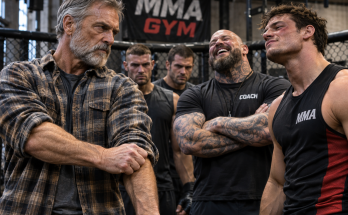
I remembered rolling those sleeves upward while Dustin's friends laughed.
At the time, I had been prepared to let my anger determine what happened next.
I stood holding the shirt for several seconds.
Then I put it with the laundry.
It was only a shirt.
It didn't need to become a monument to the worst decision I'd made as a father.
Later that evening, Evelyn called me into the living room.
She was looking through some photographs on her phone.
She showed me a picture of herself taken before she'd started dating Dustin.
She was smiling.
Her shoulders were uncovered.
Her expression was relaxed.
“I remember that day.”
I smiled.
“So do I.”
She looked at the picture again.
“I want to feel like that.”
I sat beside her.
“You don't have to become exactly who you were before.”
She looked at me.
“What do you mean?”
“You can become whoever you want to be now.”
She leaned against my shoulder.
Carefully.
Her ribs were still healing.
I remained still until she moved away.
When she finally stood up, she carried her phone with her.
There was no apology.
No explanation of where she was going.
She simply said she was tired and wanted to rest.
I told her goodnight.
And for the first time since Eleanor's hospital call, our house felt like a home rather than a place where we were waiting for something terrible to happen.
Click here to continue reading: PART 10: I Had Spent Fifteen Years Teaching Men How to Win a Fight, but My Daughter Taught Me What Winning Really Meant
I Spent Fifteen Years Teaching Men to Control Their Strength, but I Never Imagined My Own Daughter Would Make Me Question Everything
Part 9 of 10