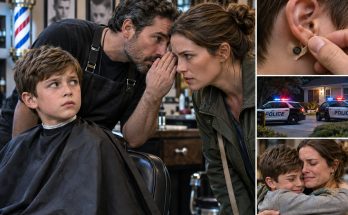
The officer didn't let me return to the entrance.
He asked Wesley and me to remain in the kitchen while his colleagues examined the doorway.
I could hear them speaking.
Their voices were calm, but their movements had become more purposeful.
One officer remained with us.
He pulled a chair away from the table and sat where he could see both Wesley and me.
“Has your son mentioned seeing that object before?”
I shook my head.
“Not until just now.”
He turned toward Wesley.
“What made you notice it?”
Wesley glanced at me.
“It's like the man's thing.”
The officer leaned forward slightly.
“What do you mean?”
“The little black thing.”
“Did the man at school show you something like that?”
Wesley nodded.
I wanted to interrupt.
I wanted to ask why he hadn't told me.
But I kept quiet.
The officer was speaking gently, and Wesley seemed less frightened answering him.
“Did he tell you what it was?”
“He said it was special.”
“Special how?”
“He said it belonged to Dad.”
I pressed my hands together beneath the table.
My husband had been named Daniel.
He had died when Wesley was six.
Even now, hearing someone mention him unexpectedly could make me feel as though I had missed a step on a staircase.
I had learned to live with that feeling.
I hadn't learned how to protect my son from someone deliberately creating it.
The officer asked Wesley whether he remembered the man's face.
“A little.”
“Had you met him before?”
“I don't think so.”
“Did he tell you his name?”
Wesley shook his head.
The officer didn't press him.
Instead, he thanked him for answering.
Then he asked me whether I had somewhere safe to stay if we needed to leave the house.
I thought immediately of my sister.
She lived close enough that Wesley could continue attending school.
“Yes.”
“Good. We may recommend that.”
I looked toward the hallway.
“Is there something dangerous in my house?”
“We haven't established that.”
“Then what did you find?”
He paused.
“Something that needs to be examined.”
I was becoming tired of hearing that.
I understood why the officers couldn't give me definite answers.
But every uncertain answer left more room for my imagination.
A specialist arrived a short while later.
He carried a case and spoke with the officers near the entrance.
They explained that he would examine the object behind Wesley's ear.
I asked whether removing it would hurt.
He told me he would be careful.
Wesley sat in a kitchen chair.
I stood in front of him and held both his hands.
“Look at me.”
He did.
“Remember your soccer game?”
He nodded.
“Tell me about that goal you nearly scored.”
He began explaining.
His voice shook at first.
Then he became more interested in describing the game.
While he talked, the specialist worked behind his ear.
I watched Wesley's face.
He winced once.
“Almost finished,” the specialist said.
A moment later, he stepped away.
The object had been removed.
I felt an enormous wave of relief.
I had to remind myself that removing it didn't explain who had placed it there.
The specialist secured the object for examination.
He showed me the small patch of irritated skin that remained behind Wesley's ear.
There was no obvious serious injury.
I touched my son's shoulder.
“It's gone.”
Wesley reached toward his ear.
“Don't scratch it,” I said.
He lowered his hand.
“Can we go somewhere else?”
I looked at the officer.
He nodded.
“That's probably a good idea.”
I packed a bag under an officer's supervision.
I took clothes for Wesley and myself, his toothbrush, a few important documents, and his favorite sweatshirt.
The process felt strangely familiar.
I had packed similar bags for hospital visits during Daniel's illness.
Back then, I had never known how long we would be away from home.
I remembered standing in the same bedroom, deciding which clothes might be useful.
I had hated that uncertainty.
Now it was back.
Before leaving, I called my sister, Rachel.
She answered on the second ring.
“Everything okay?”
“No.”
My voice broke.
She immediately stopped whatever she was doing.
“What happened?”
I explained as much as I could.
She didn't interrupt.
When I finished, she told me to come straight over.
“I'll get the spare room ready.”
I thanked her.
Then I called Wesley into the bedroom.
“We're staying with Aunt Rachel for a little while.”
“Tonight?”
“Yes.”
“Can I bring my soccer ball?”
“Of course.”
He went to retrieve it.
An officer accompanied him.
Watching a uniformed police officer follow my son through our house was one of the strangest experiences of my life.
I had always considered our home a private place.
A place where Wesley could leave his toys on the floor and complain about vegetables.
Now strangers were examining the doorway.
They were documenting objects.
They were asking who had visited and when.
I understood that they were helping.
Still, I felt as though something precious had been taken from us.
Before we left, the officer gave me instructions about contacting them if anyone unfamiliar approached us.
He also asked me not to discuss the investigation publicly.
I agreed.
I wasn't interested in telling the neighborhood.
I wanted answers.
Wesley carried his soccer ball to the car.
I carried our bag.
As I backed out of the driveway, I looked at the front entrance.
There were still officers standing nearby.
I had never imagined being afraid to return to my own house.
Rachel was waiting outside when we arrived.
She hugged Wesley first.
“Hey, little man.”
“I'm not little.”
“Of course not.”
She smiled at him.
Then she looked at me.
I could tell she wanted to ask questions.
She waited until Wesley was occupied in the living room.
We stood together in her kitchen.
“Tell me everything.”
I started with the haircut.
By the time I reached the part about Daniel, I was crying.
Rachel handed me a tissue.
“Who would say something like that to him?”
“I don't know.”
“Did Daniel have someone from work you didn't know about?”
“Probably plenty of people.”
Daniel had worked for a regional property management company.
His job involved financial records, contracts, and payments to outside businesses.
I hadn't understood every detail of his work.
He rarely discussed confidential matters at home.
When he became ill, work had stopped being important to us.
Appointments became important.
Medication became important.
Getting Wesley to school while Daniel rested became important.
After Daniel died, I received his personal belongings from his employer.
A cardboard box.
Some photographs.
A few notebooks.
A framed picture of Wesley.
I had stored most of those things in a closet.
Rachel asked whether Daniel had ever mentioned being threatened.
“No.”
“Any arguments at work?”
“Nothing serious that I remember.”
I thought about it.
There had been occasions when he came home distracted.
He sometimes sat at the kitchen table after dinner, looking through paperwork.
But people brought work home.
People worried about deadlines.
I hadn't considered those evenings evidence of anything.
Rachel poured coffee into two mugs.
Neither of us drank much.
“Maybe someone knew him and thought you had something they wanted.”
The suggestion unsettled me.
“What would I have?”
“I don't know.”
Neither did I.
That afternoon, an investigator called.
She introduced herself as Detective Elena Morris.
She asked whether she could meet with me at Rachel's house.
I agreed.
She arrived carrying a notebook and a folder.
Her manner was quiet.
She didn't begin by telling me what she suspected.
She began by asking about Daniel.
His full name.
His former employer.
His responsibilities.
The circumstances of his death.
I explained that he had died following a serious illness.
There had been nothing mysterious about his death.
We had known he was sick.
We had known the treatment wasn't working.
We had simply run out of time.
Detective Morris listened.
Then she asked about people who had remained in contact with us afterward.
I mentioned several relatives and a few former colleagues.
One name came to mind more readily than the others.
Martin Hale.
He had worked with Daniel.
He attended the funeral and brought us groceries afterward.
For several months, he occasionally called to ask how we were managing.
Eventually, those calls stopped.
“Do you have his contact information?”
“I think so.”
I searched my phone and found an old message thread.
Detective Morris recorded the number.
“Anyone else?”
I mentioned Daniel's former supervisor.
A woman from his office who had helped arrange the return of his belongings.
A couple of friends from work whose surnames I couldn't remember.
The detective wrote everything down.
Then she asked about Daniel's possessions.
“Did he leave you any business documents?”
“Not intentionally.”
“Computers?”
“His personal laptop.”
“External storage devices?”
“I don't know.”
She looked up.
“Would you be willing to let us examine the belongings you received from his employer?”
“Yes.”
I didn't hesitate.
Whatever Daniel had left behind, I wanted to know whether it had anything to do with Wesley.
The detective closed her notebook.
She explained that the objects recovered that morning would undergo further examination.
They appeared to be electronic devices.
Their exact functions had not yet been confirmed.
“Do you think someone was watching us?”
She answered carefully.
“We're investigating that possibility.”
I looked toward the living room.
Wesley was sitting on the carpet with his soccer ball between his knees.
Rachel had put on a movie for him.
He seemed absorbed in it.
For the first time that day, he looked like an ordinary child again.
I didn't want to take that away from him.
Detective Morris asked whether Wesley could speak with a trained child interviewer later.
I agreed.
She explained that it was important not to repeatedly question him ourselves.
I promised I wouldn't.
After she left, Rachel sat beside me.
“Do you remember where Daniel's things are?”
“In the hall closet.”
“Have you opened the box recently?”
“No.”
I remembered sealing it after his funeral.
At the time, I couldn't bear to look through everything.
His handwriting was difficult enough.
The smell of his old jacket had been worse.
I had put the box away because grief made ordinary objects unbearable.
Now someone might be interested in those same objects for reasons I didn't understand.
That evening, Wesley asked if he could call Tobias.
“Why?”
“To tell him thank you.”
I looked at my son.
He was sitting on the edge of Rachel's spare bed.
His hair was shorter around his ears.
The small irritated spot was still visible.
“That's a lovely idea.”
“Did he know it was bad?”
“I think he knew something wasn't right.”
Wesley considered that.
“I'm glad he looked.”
“So am I.”
I kissed his forehead.
After he fell asleep, I sat beside the bed for a long time.
I thought about the barber.
A stranger who had noticed something I hadn't.
A man who had taken a few seconds to look carefully and decided not to ignore what he saw.
I would always be grateful for that.
Then I thought about Daniel's cardboard box.
I had spent three years avoiding it.
Now I needed to open it.
Click here to continue reading: PART 4: I Finally Opened the Box My Husband’s Employer Returned After His Funeral and Discovered Why His Former Colleague Might Remember Our Family
I Thought Taking My Son for His Saturday Haircut Was the Safest and Most Ordinary Thing We Could Do Together
Part 3 of 10