
Darlene arrived shortly after lunch.
I heard her knock before Ada noticed that someone was at the door.
Nate went to answer it.
His mother stood outside holding a small bag for the children.
She greeted him quietly.
Then she looked past him toward me.
“Hello.”
“Hi, Darlene.”
Nate invited her inside.
Ada came running.
“Grandma!”
Darlene bent down and hugged her.
For a moment, she looked like the woman I had known before that Sunday dinner.
Just a grandmother pleased to see her granddaughter.
She asked the children how they liked the new house.
Ada took her hand.
“Come see our kitchen.”
I looked at Nate.
He glanced at me.
Neither of us interrupted.
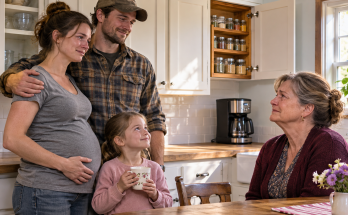
Ada led her grandmother toward the kitchen.
Darlene stopped near the doorway.
Her eyes moved across the white cabinets.
Then she noticed the butcher block.
She stood there for several seconds.
I wondered whether she was remembering the same things I was.
The years we had lived upstairs.
The work Nate had done.
The afternoon she found us carrying everything downstairs.
Ada pointed toward one of the cabinets.
“Daddy put that back.”
Darlene nodded.
“I see.”
“And that's where the coffee goes.”
Ada pointed again.
Darlene followed her finger.
Her expression tightened slightly.
Then she looked at me.
“It looks nice.”
“Thank you.”
She turned back toward the children.
I didn't know how difficult those words had been for her to say.
I only knew they sounded different from the things she had said on Good Friday.
We let her spend some time with the children.
She listened while Ada talked about the move.
She asked a few questions.
Then she looked at my stomach.
“How are you feeling?”
“Pretty good.”
“Everything going well?”
“Yes.”
She nodded.
“That's good.”
I waited.
She hadn't asked me that during Sunday dinner.
She hadn't asked when she found us on the staircase.
Hearing it now brought back some of the hurt I had been trying not to carry.
But I answered her politely.
Eventually, Nate helped the children find something to occupy themselves.
I offered Darlene coffee.
She accepted.
I opened the cabinet above the coffee maker and reached for what I needed.
The little wooden spice rack caught her attention.
“Nathan made that, didn't he?”
“Yes.”
She looked at him.
“You used some old wood from the barn.”
Nate nodded.
“Leftover poplar.”
Darlene studied it.
Then she sat down.
I brought her coffee to the table.
For a while, we discussed ordinary things.
The weather.
The farm.
Nate's work at the feed mill.
The children.
I could tell she was avoiding the reason she had really come.
I wasn't going to begin the conversation for her.
After another minute, she placed her cup on the table.
“I suppose you're still angry with me.”
Nate looked up.
I rested my hands in my lap.
“Yes,” I said.
Darlene seemed surprised by my answer.
Perhaps she had expected me to reassure her.
That was what I usually did.
Whenever things became uncomfortable, I found a way to make them easier for everybody else.
I had decided not to do that anymore.
She looked down at her coffee.
“I didn't mean for things to turn out this way.”
Nate leaned back.
“How did you think they'd turn out?”
She hesitated.
“I thought you'd find somewhere bigger.”
“We weren't looking for somewhere bigger.”
“You were going to need more room eventually.”
Nate shook his head.
“That was for us to decide.”
Darlene didn't answer.
I watched her fingers move around the handle of her cup.
Then she spoke.
“My sister helped us when we bought the farm.”
“I know,” Nate said.
“She didn't have to do that.”
“I know.”
“I wanted to do something for Tanner.”
I could understand her desire to repay her sister.
What I couldn't understand was the way she had chosen to do it.
“Darlene, why didn't you talk to us first?”
She looked at me.
“What do you mean?”
“Before you promised him our apartment.”
She opened her mouth.
Then she stopped.
I waited.
Finally, she said something that I had suspected for days.
“I thought you'd understand.”
I nodded slowly.
“We understood what you wanted.”
She looked confused.
“But you didn't seem interested in what it would mean for us.”
Nate remained quiet.
I continued.
“We had two children and another baby coming. We had invested thirty-eight thousand dollars upstairs. We thought we were going to live there for years.”
Darlene's eyes returned to her coffee.
“You did live there for years.”
“Yes.”
“And you never paid rent.”
There it was again.
The same argument.
Only this time, I was sitting at my own table.
I didn't feel the need to defend myself as quickly as I had before.
“We appreciate that you let us live there.”
Nate nodded.
“We both do.”
Darlene looked at him.
“Then why did you take everything?”
Nate answered quietly.
“Because appreciation isn't the same as ownership.”
She stared at him.
He continued.
“We didn't remove the things that belong to the farmhouse. We took the things we purchased.”
Darlene looked toward the cabinets.
“But they were part of the kitchen.”
“They were our kitchen.”
The room became quiet.
I thought about Ada's question on Good Friday.
She hadn't needed an explanation about the distinction.
She had known those things belonged to her family.
Somehow, the adults had made it much more complicated.
Darlene finally looked at me.
“Replacing everything is going to cost a fortune.”
I nodded.
“I know.”
She waited.
Perhaps she expected me to suggest a way we could help.
Perhaps she wanted us to offer some of the cabinets back.
I couldn't tell.
But I didn't make an offer.
Nate took a sip of coffee.
“How's Tanner?”
Darlene sighed.
“He's waiting.”
“Has he found somewhere else?”
“Not yet.”
She explained that the upstairs wasn't ready for him.
Myron had been looking at affordable materials and secondhand cabinets.
They were trying to work out what they could install without spending more than they could manage.
Nate listened without interrupting.
Then he said something simple.
“That's what we did when we moved in.”
Darlene looked at him.
He wasn't being sarcastic.
He was reminding her that the kitchen hadn't appeared by itself.
We had started with an unfinished space too.
We had spent time and money turning it into something comfortable.
Now she understood how much work that required.
I could see it in her face.
She looked older than she had on Good Friday.
Not because anything about her appearance had changed.
Because she no longer seemed certain that she had been right.
“I thought the upstairs would be good for Tanner,” she said.
“It probably will be,” Nate answered.
“Once you've fixed it up.”
She lowered her eyes.
A few moments passed.
Then she asked whether we had considered moving back.
I looked at Nate.
He set his cup down.
“No.”
Darlene seemed taken aback.
“Even if we worked something out?”
“No, Mom.”
She looked at me.
I shook my head.
“We've signed a lease.”
“You could get out of it eventually.”
“That isn't the point.”
I took a breath.
“We don't want to live upstairs anymore.”
It felt strange saying those words aloud.
For years, I had wanted nothing more than to feel secure in that farmhouse.
Now I didn't want the farmhouse at all.
Darlene looked around our kitchen.
“You're paying eleven hundred dollars every month.”
“We know.”
“That money could go toward something else.”
Nate nodded.
“It could.”
He paused.
“But we're paying for a place where we know the terms.”
Darlene looked at him.
“You could have trusted us.”
Nate's expression changed.
“We did.”
He didn't say anything else.
He didn't need to.
I watched Darlene lower her head.
For the first time during the visit, she seemed to understand that we weren't discussing cabinets anymore.
We were discussing trust.
We had believed her when she told us the upstairs would eventually be ours.
We had made financial decisions based on that understanding.
We had planned our family's future around it.
Then she had given our home to somebody else over Sunday dinner.
There was no way to make that disappear by offering us another arrangement.
“I never wanted to hurt the children,” she said.
I believed her.
But intention and consequence were different things.
“The children are fine,” I told her.
“We'll make sure they stay fine.”
She looked toward the other room.
“I miss having them upstairs.”
Nate glanced at me.
I felt sorry for her.
I hadn't expected to feel that.
But I did.
She had grown accustomed to hearing the children move around above her.
She had been able to see them whenever they came downstairs.
Those ordinary moments had probably seemed as permanent to her as the kitchen had seemed to us.
Now they were gone.
And she couldn't simply purchase replacements.
“You can still see them,” I said.
She turned toward me.
“We don't want to keep them away from you.”
Nate nodded.
“But you'll need to arrange visits with us.”
Darlene listened.
“And we need you to respect our decisions about our family.”
She took another sip of coffee.
Then she nodded.
“All right.”
It wasn't a dramatic apology.
I hadn't expected one.
But a little later, when she stood to leave, she turned toward me.
“I shouldn't have told you like that at dinner.”
I waited.
She looked down.
“I should have talked to both of you first.”
“Yes,” I said.
“You should have.”
She nodded again.
Then she looked at Nate.
“I'm sorry.”
His expression softened.
“Thank you, Mom.”
She hugged the children before leaving.
Nate walked her to the door.
I remained in the kitchen.
I didn't feel victorious.
I didn't feel as though we had won something.
Mostly, I felt tired.
The money we had put into the farmhouse wasn't coming back.
The six years we had spent believing in a promise couldn't be returned to us.
But neither could Darlene take those years away entirely.
There had been good mornings upstairs.
There had been laughter.
There had been birthdays and ordinary meals.
I didn't want to remember every one of those moments through the anger of our departure.
That would have been another loss.
Over the following weeks, our lives settled into a new routine.
Nate continued driving for the feed mill.
I kept track of our household expenses.
We paid our rent.
Eleven hundred dollars became a regular figure in our monthly budget.
It wasn't easy.
Some months required more careful planning than others.
But there was something reassuring about making the payment.
We received something definite in exchange.
Nobody spoke about what might belong to us someday.
Nobody suggested that our investment would eventually become an inheritance.
We knew what our money covered.
And when we purchased something for ourselves, we kept the paperwork.
Nate made sure of that.
Myron eventually helped prepare the upstairs for Tanner.
They found some used cabinets and arranged a simpler kitchen than the one we had removed.
Tanner thanked Nate again for explaining what had happened.
There was no lasting argument between the cousins.
I was glad about that.
He had needed somewhere to begin his adult life.
Our family had needed somewhere secure to continue ours.
Those needs didn't have to make us enemies.
Darlene visited occasionally.
Things between us improved slowly.
There were still uncomfortable conversations.
There were still moments when I remembered what she had said at dinner.
But she began calling before visiting.
She asked instead of assuming.
I appreciated those small changes more than any grand declaration.
Myron came by too.
Sometimes he helped Nate with things around the rental.
Sometimes he simply spent time with the children.
He seemed more willing to speak his mind than he had been before.
Perhaps he had learned something from Good Friday as well.
Months later, as my pregnancy progressed, Nate finished making adjustments to the kitchen.
Everything had a place.
The farmhouse sink was being used again.
The butcher block had found its place.
The stove was ready for ordinary family meals.
And the cabinet above the coffee maker looked as though it had always belonged there.
One morning, Ada opened it while Nate was nearby.
She pointed toward the wooden spice rack.
“Daddy made that.”
“I sure did.”
She looked pleased with herself.
Then she closed the door.
I stood nearby with one hand resting against my stomach.
The baby moved.
I smiled.
For a moment, I thought about the afternoon light at the farmhouse.
The empty wall.
Darlene's astonished face.
Nate stepping backward down the narrow staircase while I held the other end of the cabinet.
I remembered how frightened I had felt.
Not of losing the kitchen.
Of losing the security I thought we had.
It had taken me a while to understand that those were separate things.
Our home had never been the promise Darlene made.
It had been the work Nate and I did together.
The children we cared for.
The decisions we made.
The ordinary things we saved and carried from one place to another.
We had spent thirty-eight thousand dollars learning a lesson I wished had cost us less.
But we hadn't left empty-handed.
We still had our kitchen.
We still had our marriage.
We still had our growing family.
And the next time somebody offered us something important on the strength of a promise, we knew enough to ask for it in writing.
That morning, Nate poured me a cup of coffee.
Ada sat at the table with her little cup.
Sunlight reached across the butcher block.
I opened the white cabinet and took down what I needed.
The little rack made from scrap poplar was still inside.
Nothing fancy.
Nothing particularly valuable to anybody else.
But it was ours.
And this time, we knew exactly what that meant.
The End
Read more original stories on Feel Every Story.
After Six Years of Making That House Feel Like Home, I Found Myself Carrying Our Kitchen Down the Stairs
Part 10 of 10

One Comment on “PART 10 – My Mother-in-Law Finally Walked Into Our New Kitchen, and the Conversation We Had There Changed the Meaning of Her Old Promise”