The first thing I bought for our apartment was a kitchen table.
It wasn't new.
I found it through a woman who was moving closer to her daughter.
There were scratches across the surface, and one of the chairs needed tightening.
But it was sturdy.
I paid her forty dollars.
My sister helped me carry it inside.
Owen immediately climbed onto one of the chairs.
“This one's mine.”
Wyatt chose the chair across from him.
I took the remaining chair beside the window.
For the first time since leaving Scott, we ate breakfast around a table that belonged to us.
I made pancakes.
Owen wanted blueberries.
Wyatt wanted his plain.
I had stopped noticing their differences as something remarkable.
They were simply my children.
That was how it should have been all along.
After breakfast, Owen helped me clear the plates.
Wyatt carried the syrup bottle to the counter.
A little syrup dripped onto his fingers.
He laughed.
I handed him a damp cloth.
Nobody wrote anything down.
Nobody asked why his brother hadn't done the same thing.
I had become protective of these ordinary moments.
They were the parts of childhood I wanted my sons to remember.
Not the notebook.
Not the haircut.
Not the questions they couldn't answer.
Just pancakes on a Saturday morning.
Scott called shortly before lunch.
He wanted to know whether the boys had settled into the apartment.
“They're doing well.”
“Sleeping okay?”
“Yes.”
He paused.
“Are you sleeping okay?”
“Better.”
“Good.”
I heard him clear his throat.
“I've been thinking about what you said when we moved their beds.”
I waited.
“About not being able to promise anything.”
“Yes.”
“I understand why you said it.”
His voice sounded different.
Less defensive.
He asked whether I would meet him sometime during the week.
He wanted to discuss our future.
I agreed.
Then I handed the phone to Owen.
The boys talked to their father about the apartment.
They told him about the kitchen table.
Wyatt explained that one of the chairs squeaked.
Owen insisted that his bed was in the best part of the bedroom.
Scott listened.
He asked questions about their new surroundings.
Not questions that needed matching answers.
Just the kind a father asked when he wanted to know about his children's day.
When they finished talking, Owen handed me the phone.
“Daddy says he can fix the chair.”
I smiled.
“That's nice.”
I wasn't ready to invite Scott into our daily routine.
But I was glad he had offered something useful.
The following Tuesday, I met him at the coffee shop.
He was already seated when I arrived.
There were two cups on the table.
He remembered how I liked my coffee.
That small kindness made me unexpectedly sad.
“Thanks.”
He nodded.
For a while, we talked about the boys.
Then he reached into his jacket and took out a folded piece of paper.
“I wrote something.”
I looked at it.
“Another notebook?”
He shook his head.
“No.”
He unfolded the paper.
“I wanted to make sure I said everything properly.”
I sat quietly.
Scott looked down at what he had written.
Then he looked at me.
“I've spent a lot of time thinking about why I did those things.”
I didn't interrupt.
He said his counselor had helped him recognize how much importance he had placed on being right.
When the boys gave matching answers, he had treated those moments as confirmation of his ideas.
When they didn't, he had searched for reasons to dismiss the differences.
Their choices had stopped being their choices.
They had become obstacles to what he wanted to believe.
“I wasn't listening to them,” he said.
“No.”
“And I wasn't listening to you.”
I nodded.
He admitted that when I first challenged him about the haircut, he had been more concerned about defending himself than understanding why I was frightened.
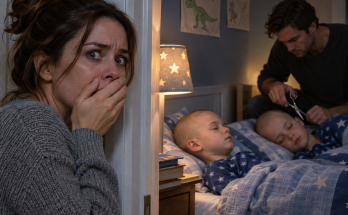
Then he talked about the scissors.
His hands moved nervously across the table.
“I keep thinking about what would have happened if you hadn't woken up.”
I felt my stomach tighten.
“What do you mean?”
“I would have gone ahead and trimmed their hair while they were sleeping.”
He looked ashamed.
“I would have convinced myself it was nothing.”
I stared into my coffee.
That was what frightened me most.
He hadn't needed to intend something worse for his actions to be wrong.
The decision itself had been enough.
“You didn't think they deserved to be asked.”
He nodded.
“I understand that now.”
For a moment, neither of us spoke.
Then he apologized again.
Not just for frightening me.
For making me question my judgment.
For accusing me of overreacting.
For treating my departure as a betrayal instead of asking himself why I had felt compelled to leave.
And for changing the locks.
“I punished you for standing up to me.”
I hadn't expected him to put it that plainly.
I looked at him.
“Yes, you did.”
He didn't argue.
He folded the paper.
Then he asked the question I had known was coming.
“Do you think we could start again?”
I took a breath.
I had rehearsed my answer several times.
Saying it was harder.
“I think we can become better parents together.”
He watched my face.
“But?”
“I don't think I can return to our marriage.”
His eyes filled.
He looked toward the window.
I felt the familiar urge to soften what I had said.
To leave a little opening.
To tell him that perhaps I would change my mind.
But I had spent too many years confusing kindness with avoiding difficult truths.
“I've thought about it carefully, Scott.”
He nodded without looking at me.
“Is this what you really want?”
“Yes.”
The word came out quietly.
It was still the truth.
He rubbed his eyes.
I waited.
I wasn't angry with him in that moment.
I wasn't pleased to see him hurting.
I wished there had been a way for us to reach a different outcome without sacrificing the safety I had finally found.
There wasn't.
“I'm sorry,” he said.
“So am I.”
We sat there for several minutes.
The coffee grew cold.
Eventually, Scott asked whether I had spoken with my attorney.
I told him I intended to.
He nodded.
“I guess I knew this might happen.”
I didn't know what to say.
He folded the piece of paper again and returned it to his pocket.
Before we left, I reminded him that ending our marriage didn't mean I wanted to erase him from the boys' lives.
He was their father.
He had responsibilities.
He also had an opportunity to become someone they could trust without fear.
“I want that,” he said.
“Then keep working toward it.”
He nodded.
Outside the coffee shop, we said goodbye.
There was no argument.
No accusation.
No demand that I reconsider.
I drove home with both hands on the steering wheel.
Halfway there, I began crying.
I pulled into a parking lot.
For several minutes, I let myself grieve.
I wasn't grieving the house.
I wasn't grieving the keys.
I was grieving the future I had once imagined.
The family photographs we would have taken.
The holidays we would have celebrated.
The mornings when I had expected to find Scott making breakfast while the boys argued over cartoons.
I had loved that future.
Letting go of it hurt.
When I arrived home, my sister was sitting with the boys.
She took one look at me.
“You told him?”
I nodded.
She stood and hugged me.
I cried again.
Then Owen appeared carrying a drawing.
“Mommy, look.”
I wiped my face.
He had drawn our apartment.
There were three people standing beside it.
He pointed to the tallest figure.
“That's you.”
I smiled.
“Thank you.”
Wyatt came running from the bedroom.
He wanted to show me something, too.
Within minutes, I was sitting on the floor between them.
Life hadn't stopped because my marriage was ending.
There were pictures to admire.
Shoelaces to untangle.
Dinner to prepare.
That evening, after the boys were asleep, I contacted my attorney.
I explained my decision.
She arranged an appointment.
The following morning, I opened the small envelope containing the two house keys.
I placed them on the kitchen table.
The old key no longer worked.
The new one did.
I picked them up separately.
For months, they had represented everything Scott and I had been fighting about.
Now they represented a practical matter that needed resolving.
I returned them to the envelope.
Later that week, the formal process began.
There were documents to complete.
Questions about finances.
Discussions about the house.
Scott and I communicated through our attorneys when necessary.
Neither of us enjoyed it.
But we managed to avoid turning every disagreement into another battle.
Our priority remained the children.
Their counselor continued seeing them.
Scott continued attending his own appointments.
The supervised visits continued while the appropriate professionals assessed his progress and the boys' comfort.
Nothing changed overnight.
I was thankful for that.
One Sunday afternoon, Scott brought a small toolbox to our apartment with my agreement.
The boys were excited to see him.
He examined the kitchen chair.
Owen watched closely.
Wyatt became bored and returned to his coloring book.
Scott tightened the loose connection beneath the seat.
Then he tested it.
“No more squeak.”
Owen climbed onto the chair.
He bounced a little.
“It works!”
Scott smiled.
I stood beside the kitchen counter.
For a moment, the scene looked so familiar that it hurt.
Scott fixing something.
The boys watching.
Me preparing lunch.
But there was something different this time.
When Wyatt walked away, Scott let him.
He didn't call him back.
He didn't ask why he wasn't interested.
He simply finished repairing the chair with Owen.
Afterward, he packed his tools.
Before leaving, he looked at me.
“Thanks for letting me do that.”
“Thank you for fixing it.”
He smiled.
It was a small exchange.
Nothing extraordinary.
Yet it reminded me that we didn't have to remain enemies simply because we could no longer remain married.
The following week, the boys asked why Daddy didn't live with us.
I sat with them on the living room carpet.
I had discussed how to approach the conversation with their counselor.
I wanted to be honest without giving them adult burdens.
“Daddy and I have decided to live in different homes.”
Owen looked at me.
“Forever?”
“We're planning to keep living separately.”
Wyatt frowned.
“Because of our hair?”
I reached for his hand.
“No, sweetheart.”
Owen moved closer.
“Because we got different answers?”
“No.”
I took both their hands.
“Nothing you did caused this.”
Wyatt looked down.
“Daddy was sad.”
“Yes.”
“Are you sad?”
“Sometimes.”
Owen thought about that.
“Are you still our mommy?”
I nearly broke down.
“Always.”
“And Daddy's still Daddy?”
“Always.”
They seemed satisfied with that.
Wyatt leaned against me.
Owen asked whether we could watch a movie.
I said yes.
We spent the rest of the evening beneath a blanket on the couch.
I didn't expect one conversation to answer every question they would ever have.
There would be more.
I would be there for those, too.
A few days later, Scott called.
He told me the boys had asked him similar questions.
“What did you tell them?”
“That this wasn't their fault.”
I closed my eyes.
“Thank you.”
He continued.
“I told them I made some mistakes, and grown-ups have to take responsibility for their mistakes.”
I felt a quiet sense of relief.
He hadn't blamed me.
He hadn't blamed the children.
He hadn't tried to turn his apology into an argument for our reconciliation.
That mattered.
The next afternoon, I took the boys to a park.
Owen ran toward the swings.
Wyatt wanted to collect leaves.
I sat on a bench where I could watch them both.
At one point, Owen called for his brother.
Wyatt shook his head.
“I'm busy.”
Owen shrugged and continued swinging.
I smiled.
That was what freedom looked like at their age.
A swing.
A handful of leaves.
The ability to say no without believing someone would stop loving you.
When we returned home, I placed their jackets on separate hooks.
One blue.
One green.
Then I noticed the pencil marks beside their bedroom door.
They had already grown a little.
Time was moving forward.
And so were we.
Click here to continue reading: PART 10: Months After the Night I Found Scott Holding Scissors, My Twin Sons Taught Me What It Really Meant to Give Them Their Childhood Back
Three Weeks After Leaving With My Twin Boys, I Returned Home and Discovered That My Husband Had Shut Us Out
Part 9 of 10