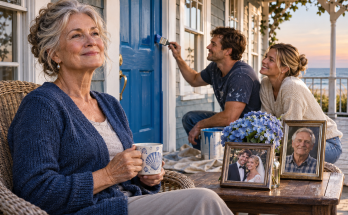
The first thing Cullen asked me that morning was whether I needed help painting the front door.
I looked at him.
“The blue door?”
He smiled.
“It's starting to peel a little near the bottom.”
I had noticed the same thing.
The sea air wasn't particularly kind to painted wood.
Nile used to complain about it every summer.
“Your father always hated scraping old paint,” I told him.
Cullen laughed.
“I remember.”
Several months had passed since the gathering on September 26.
Cullen and Blythe were still living in their apartment.
They paid their own bills.
They bought their own furniture.
They made their own arrangements.
Sometimes things were difficult.
Cullen occasionally mentioned expenses during our conversations.
But he no longer presented those expenses as problems I was responsible for solving.
That made a tremendous difference.
Blythe had changed in quieter ways.
Whenever she wanted to visit, she telephoned first.
She asked before moving anything in my house.
She never again treated my bedroom as a room she would eventually occupy.
These weren't extraordinary accomplishments.
They were ordinary acts of consideration.
But ordinary consideration had been missing from our relationship for too long.
Cullen brought his painting supplies to the porch.
I watched him prepare the door.
“Same color?” he asked.
“Exactly the same.”
He nodded.
“I thought you'd say that.”
He began working.
I sat nearby with my coffee.
The porch looked nothing like it had on the afternoon of the failed housewarming celebration.
There were no suitcases.
No moving boxes.
No rows of folding chairs.
Just my son working on a door his father had painted years earlier.
I was grateful for the simplicity of it.
Blythe arrived later.
She carried a bag containing lunch.
“Is it all right if we eat outside?”
“Of course.”
She set everything on the table.
Then she went inside to wash her hands.
When she returned, she glanced at Cullen.
“He's doing a good job.”
“He certainly is.”
We watched him work.
After a while, Blythe sat beside me.
“Evelyn, can I tell you something?”
“Certainly.”
“I used to think having a beautiful home meant we'd made it.”
I looked toward the house.
“And now?”
She smiled a little.
“I think keeping our own apartment going has taught me more than living here would have.”
I appreciated her honesty.
She continued.
“It's not always easy.”
“No.”
“But it's ours.”
I nodded.
That word mattered.
Ours.
Not something borrowed through deception.
Not something acquired because somebody else had been pressured to surrender it.
Something they were paying for and maintaining themselves.
I remembered how proud Nile and I had been when we purchased the damaged beach house.
It certainly hadn't looked like a million-dollar property then.
There was work everywhere.
We had spent six summers making improvements.
Sometimes the progress seemed painfully slow.
But every repair made the place feel more like home.
We had earned that feeling.
I hoped Cullen and Blythe would eventually discover something similar.
“I'm proud of you,” I told her.
She looked surprised.
“Really?”
“Yes. Building a life together takes work.”
She smiled.
For the first time, I felt that she and I were developing a relationship that didn't depend on the beach house.
Later, while we were eating lunch, Cullen mentioned Miles.
“He asked me about the apartment yesterday.”
“What did you tell him?”
“That we're doing fine.”
“And are you?”
“We are.”
He smiled at Blythe.
“It's not fancy, but it's comfortable.”
I smiled too.
There was nothing wrong with comfortable.
Comfortable had served Nile and me perfectly well.
Laurelai remained more distant.
She hadn't apologized for arranging the housewarming gathering without my permission.
Nor had she apologized for insisting that I surrender the keys in front of her guests.
I hadn't received an invitation to discuss what happened.
And I hadn't pursued one.
Some relationships didn't recover simply because you wanted them to.
I had accepted that.
Miles, on the other hand, had contacted me several weeks after the gathering.
He apologized for believing Cullen without checking with me.
He admitted that the celebration should never have been organized without my approval.
I accepted his apology.
We didn't need to revisit every detail.
He understood what had gone wrong.
That was enough.
After lunch, Cullen returned to the door.
I collected the coffee cups and carried them inside.
Nile's photograph caught my attention.
I stopped beside the fireplace.
The image hadn't changed in fourteen years.
But the woman standing in front of it had.
I no longer felt that being a mother required me to ignore disrespect.
I no longer believed that generosity meant giving people whatever they expected.
And I had finally accepted that protecting myself wasn't a betrayal of my family.
I touched the photograph's frame.
“You were right,” I whispered.
I could almost imagine Nile smiling.
Later that afternoon, Cullen called me outside.
“Finished.”
I looked at the door.
The blue paint was fresh and even.
It looked beautiful.
I stepped closer.
“You did a wonderful job.”
He smiled.
“Dad would probably find something wrong with it.”
I laughed.
“He would.”
Cullen laughed too.
For a few minutes, we talked about Nile.
Not his property.
Not his will.
Not the inheritance.
Just the man we remembered.
Cullen recalled how particular his father had been about painting.
I remembered how Nile always insisted on cleaning his brushes immediately afterward.
Those little memories returned easily.
I hadn't realized how much I had missed sharing them with my son.
When the conversation grew quiet, Cullen looked at me.
“Mom, there's something I've been wanting to say properly.”
I waited.
“I know I've apologized before.”
“Yes.”
“But I don't think I really understood what I did until I had some time to think about it.”
He rubbed a small spot of dried paint on his finger.
“I treated you like the house was more important than you were.”
I felt my throat tighten.
He continued.
“And when you changed the locks, I acted like you'd taken something from me.”
I nodded.
“Something that had never been mine.”
He looked directly at me.
“I'm ashamed of that.”
I hadn't expected him to use that word.
For months, I had wondered whether he had been ashamed of me.
Now he was ashamed of his own behavior.
There was a difference I couldn't ignore.
“I wish you'd invited me to your wedding,” I said.
“I know.”
“I'll probably always wish that.”
He nodded.
“I can't change it.”
“No.”
“But I can make sure I never treat you that way again.”
I wanted to believe him.
And this time, I had more than words to consider.
I had watched him establish a home of his own.
I had watched him respect my boundaries.
I had watched him return to the beach house without asking for a key.
Those actions mattered.
He stood quietly beside me.
Then I reached for his hand.
“I love you, Cullen.”
“I love you too, Mom.”
I squeezed his fingers.
“Just remember that loving somebody doesn't mean owning what belongs to them.”
He nodded.
“I understand.”
Blythe joined us on the porch.
She admired the freshly painted door and took a photograph.
Then she looked at her phone.
For a moment, I remembered their wedding cake.
That little replica of the house had once caused me enormous pain.
It had represented everything they expected to receive without earning.
Now the real door stood before us.
And Cullen had spent an afternoon restoring it without expecting anything in return.
That was progress.
Before they left, Blythe asked whether I would join them for dinner at their apartment the following weekend.
I accepted.
She looked delighted.
Cullen smiled.
“We'll cook.”
“I'd like that.”
The next weekend, I visited their apartment.
It was smaller than the beach house.
Much smaller.
Their furniture wasn't particularly expensive.
There were no sweeping ocean views.
No wraparound porch.
No gray roof shingles that anyone would reproduce on a wedding cake.
But when Blythe opened the door, she welcomed me warmly.
Cullen took my coat.
They showed me where they lived.
A few boxes still needed unpacking.
Some things didn't match.
I recognized the familiar uncertainty of two people beginning their married life.
It reminded me of being young with Nile.
Blythe apologized because the dining table was small.
“It's perfectly fine,” I told her.
And it was.
We sat together and ate dinner.
Nobody discussed the value of my property.
Nobody asked about my attorney.
Nobody mentioned inheritance.
We talked about ordinary things.
Their apartment.
Their plans.
Meals they had tried cooking together.
I enjoyed myself more than I could have imagined.
When dinner was over, Cullen showed me a framed wedding photograph.
It stood on a shelf in their living room.
Beside it was another picture.
Nile.
I stopped.
Cullen noticed where I was looking.
“I wanted Dad here too.”
I felt tears gathering.
“That's lovely, sweetheart.”
He smiled.
For a moment, I thought about finding Nile's original photograph face down beneath those takeout menus.
The memory still hurt.
But seeing his picture displayed in Cullen's own home meant something different.
It told me my son was beginning to appreciate what his father represented.
Not a source of future wealth.
A father.
A man worth remembering.
When I returned to the beach house that evening, I placed my keys on the kitchen counter.
I removed my coat.
Then I walked into the living room.
Everything was where I had left it.
My wedding photograph remained near the window.
Nile's photograph remained on the mantel.
My home was peaceful.
I made a cup of coffee and stepped outside.
The blue door looked beautiful beneath the porch light.
I sat down.
At seventy-one, I had learned that the most painful disappointments sometimes came from the people we loved most.
But disappointment didn't have to become the final definition of a relationship.
Cullen and I would never recover the wedding day I had missed.
I would never stand beside him in those photographs.
That loss was permanent.
I didn't pretend otherwise.
Still, he had been given an opportunity to repair what he could.
And I had been given the opportunity to stop surrendering my dignity whenever someone demanded something from me.
Neither opportunity required giving away my house.
My estate arrangements remained secure.
Cullen knew where he stood.
He understood that whatever he might eventually inherit was a gift, not something he could claim in advance.
Until then, the beach house belonged to me.
Every room.
Every window.
Every piece of the porch Nile and I had restored.
I could enjoy it without apologizing.
I could invite people inside without giving them control.
I could love my son without purchasing his affection.
I reached into my pocket and took out my keys.
They rested against my palm.
Such small objects.
Yet so many people had once gathered outside my home expecting me to hand them over.
They had believed those keys represented wealth, success, and social standing.
They had been wrong.
To me, they represented the right to live my own life.
The right to decide who entered my home.
The right to enjoy whatever years remained to me without becoming a guest in a place I owned.
I finished my coffee.
Then I stood and walked toward the blue door.
Inside, Nile's photograph waited on the fireplace mantel.
I switched off the porch light and stepped through the doorway.
Before going to bed, I checked the lock.
It turned smoothly.
I smiled.
My son had his own home now.
And I still had mine.
For the first time in a long while, neither of us needed to take something from the other to feel that we belonged somewhere.
That was the future Nile had wanted for us.
And it was worth considerably more than $1.94 million.
The End
Read more original stories on Feel Every Story.
My Only Son Called From the Airport to Announce His Marriage, but His Plans for My Beach House Hurt Even More
Part 10 of 10