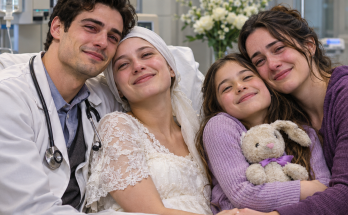
I used to believe that being a good doctor meant never getting too close.
Then I met Alicia.
I was thirty years old when she came into my life, and until that point, I thought I understood the difference between caring about someone and loving them.
I was wrong.
My parents had never been wealthy.
My father repaired machinery, and my mother worked behind the counter at a small grocery store.
When I told them I wanted to become a doctor, my father looked at our kitchen table and rubbed his forehead.
“We'll find a way, Lucas.”
They couldn't afford my tuition.
I knew that before he said it.
During medical school, I worked weekends, studied late into the night, and sometimes fell asleep with my shoes still on.
There were months when I counted every dollar.
There were mornings when coffee was my breakfast and lunch.
But I never considered quitting.
When I finally received my medical degree, my mother cried harder than anyone else in the auditorium.
My father shook my hand before pulling me into his arms.
“You earned this, son.”
I remembered those words whenever a difficult day made me question my career.
And there were plenty of difficult days.
By thirty, I had become accustomed to hospital corridors, unanswered questions, exhausted families, and the strange silence that followed terrible news.
I could explain treatment options without stumbling.
I could discuss frightening test results.
I could walk into a room where someone was dying and keep my voice steady.
At least, I thought I could.
Alicia Morgan was eighteen when I first met her.
She was sitting against two pillows, wearing a faded blue hospital gown and holding a crossword puzzle she had apparently abandoned.
Her dark eyebrows lifted when I entered.
“Another doctor?”
“I'm Lucas.”
“Do they make you practice that serious expression in medical school?”
I looked up from her chart.
“What expression?”
“That one.”
She pointed at my face.
Then she laughed.
I tried not to smile.
That only encouraged her.
“You know smiling doesn't cost anything, right?”
I had been working for eleven hours.
Somehow, that ridiculous conversation was the first pleasant thing that had happened all day.
I asked about her pain.
She answered honestly.
Then she wanted to know whether hospital pudding qualified as a human rights violation.
That was Alicia.
She found something amusing in rooms where nobody else remembered how to laugh.
Over the following weeks, I saw her regularly.
Her treatment was difficult.
Some days, she could barely lift her head from the pillow.
Other days, she insisted on sitting up and talking to every nurse who entered.
She learned everyone's name.
She remembered who had children, who was getting married, and who was struggling through nursing school.
She remembered things about me that I had forgotten telling her.
One afternoon, she asked whether my father was feeling better.
I stopped beside her bed.
“How did you know he was sick?”
“You told me last Tuesday.”
I barely remembered the conversation.
She did.
“Call him tonight,” she said.
“I will.”
“Don't just say that.”
I called him that evening.
He sounded surprised to hear from me.
We talked for forty minutes.
Afterward, I wondered how an eighteen-year-old fighting for her own life had managed to remind me to pay attention to mine.
Alicia's older sister, Emily, visited almost every day.
She carried a brown handbag that seemed permanently stuffed with tissues, snacks, paperwork, and spare clothing.
She looked tired.
Not ordinary tiredness.
The kind that settled into someone's shoulders after months of pretending everything would be all right.
Whenever Alicia made a joke, Emily smiled a little too quickly.
Whenever I discussed treatment, she listened without blinking.
Sometimes I caught her watching her sister while Alicia slept.
There was something in that expression I couldn't quite understand.
I assumed it was fear.
Much later, I learned that fear was only part of it.
As the weeks passed, Alicia's condition deteriorated.
Her appetite disappeared.
She lost her hair.
The medication that had once offered hope began losing its effectiveness.
One morning, I reviewed her latest results with the other members of her medical team.
Nobody spoke for several seconds after the final numbers appeared.
We had reached the point every physician dreaded.
There were no reasonable treatment options left that could reverse what was happening.
I stared at the computer screen longer than necessary.
I wanted another explanation.
Another test.
Another possibility.
There wasn't one.
A senior physician gently reminded me that the priority now was Alicia's comfort.
I understood.
I hated understanding.
When we entered her room to explain the situation, Alicia listened quietly.
Emily sat beside her, gripping her hand.
There were tears before anyone finished speaking.
But Alicia didn't cry immediately.
She looked toward the window.
Outside, someone was pushing an empty wheelchair along the sidewalk.
Finally, she turned back toward us.
“How much time?”
It was the question we had hoped she wouldn't ask.
We explained that nobody could predict the exact moment.
Her condition suggested that she might have only a few days remaining.
Emily covered her mouth.
Alicia nodded slowly.
“A few days.”
She repeated it as though she were trying to understand a language she had never heard.
Then she asked whether she could still eat chocolate.
One of the nurses began crying.
Alicia reached for her hand.
“Hey. I'm the patient. You're supposed to make me feel better.”
That afternoon, I went into the staff restroom and locked the door.
I stood over the sink.
For the first time in years, I couldn't look at my own reflection without feeling helpless.
I had studied countless textbooks.
I had passed every examination.
I had sacrificed birthdays, holidays, weekends, and sleep.
None of it could give that young woman another year.
Not another month.
Maybe not even another week.
When I returned to her room, Emily had gone downstairs for coffee.
Alicia was alone.
She pointed toward the chair beside her bed.
“Sit with me?”
I did.
She asked what I had wanted to become before deciding on medicine.
I told her I had never seriously considered anything else.
“That sounds boring.”
“Probably.”
She smiled.
Then her expression changed.
“Have you ever been in love?”
The question caught me completely off guard.
I told her I had dated people but had never married.
“Why not?”
“I've been busy.”
She studied me for a moment.
“You're always busy.”
I didn't have an answer.
She looked down at her hands.
“I had plans too.”
Her voice was softer now.
She told me she had imagined having a beautiful wedding someday.
Nothing extravagant.
Flowers.
A white dress.
Someone who looked happy to be standing beside her.
“I never wanted anything huge,” she said.
I felt a tightness in my chest.
She was eighteen.
She should have been worrying about ordinary things.
Friends.
School.
Her first apartment.
Instead, she was discussing the life she would never have.
After a long silence, she reached toward me.
“Lucas?”
“Yes?”
“Would you do something for me?”
“Tell me.”
She hesitated.
Then she gave me the familiar mischievous smile that had become part of every visit.
“I want you to marry me.”
I thought she was making another joke.
I even smiled.
But she didn't laugh.
“Alicia?”
“I'm serious.”
I looked at her.
She looked back.
There was no embarrassment in her expression.
Only hope.
And underneath it, something that frightened me.
She squeezed my fingers.
“I'd like to know what it feels like to have somebody choose me.”
For several seconds, I couldn't speak.
I had been trained to answer complicated medical questions.
Nobody had prepared me for this one.
Click here to continue reading: PART 2: When Alicia Told Me About Her Final Wish, I Discovered That Saying Yes Would Require More Courage Than Any Decision I Had Made Before
I Had Spent My Entire Adult Life Learning How to Save People, Until One Young Woman Asked Me for Something Medicine Could Not Give Her
Part 1 of 10