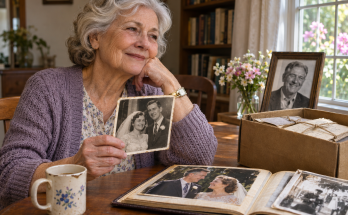
Several weeks passed before I opened Henry's cardboard box again.
By then, my days had returned to their usual rhythm.
My grandchildren visited.
I spoke regularly with my children.
I looked after the garden and made occasional trips to the grocery store.
There was comfort in ordinary things.
I had always appreciated that comfort, but now I noticed it more.
One morning, while looking for something in the bedroom closet, I saw the box.
I took it out and carried it to the kitchen.
The faded strings were still wrapped around the bundles of letters.
Henry's final apology rested on top.
I wondered whether keeping everything was necessary.
Part of me believed I should destroy the letters.
Another part felt that destroying them would be an attempt to erase something that had genuinely happened.
I no longer wanted to erase it.
The experience belonged to my history.
It simply didn't need to control my future.
I made coffee and sat beside the box.
Then I began arranging the letters in chronological order.
The earliest ones were particularly difficult to handle.
Their envelopes had yellowed.
The paper was fragile around the folds.
I remembered how desperate I had once been to receive even one of them.
Now I had all fifty.
There was something sad about that.
Henry had spent years expressing himself to pieces of paper.
The words had existed.
The explanations had existed.
The apologies had existed.
But the woman who needed them had never received them.
I picked up the first letter.
Nine days after the wedding.
I imagined myself during that week.
I would have recognized the handwriting immediately if the envelope had arrived in the mail.
I would have opened it with trembling fingers.
Perhaps I would have cried.
Perhaps I would have become angry.
Whatever my response, at least I would have known.
I returned the letter to its envelope.
There was no reason to punish myself with possibilities.
What mattered was what I knew now.
As I sorted through the remaining papers, I noticed how much Henry's handwriting had changed over the decades.
The earlier letters were confident and clear.
The later ones were less steady.
Time had left its marks on him, just as it had on me.
We had both grown old.
But we had grown old in completely different lives.
I thought about that for a while.
Then I fetched one of our family albums.
Robert and I had kept photographs from nearly every important period of our marriage.
There were pictures of our children when they were small.
Pictures from birthdays.
Pictures taken during ordinary afternoons that had seemed unimportant at the time.
Those ordinary afternoons meant a great deal to me now.
I opened the album.
One photograph showed Robert holding one of our children.
His shirt was wrinkled.
His hair was untidy.
He looked exhausted.
He also looked completely happy.
I laughed softly.
I remembered how tired we had both been when the children were young.
Some evenings, we barely managed to finish a conversation before somebody needed us.
There were bills to pay.
Meals to prepare.
Clothes to wash.
Things that broke and needed fixing.
Our marriage hadn't been a perfect collection of beautiful moments.
It had been real.
That was precisely why I treasured it.
Robert and I had disagreed occasionally.
We had worried about money.
We had experienced illnesses and disappointments.
But when difficulties arrived, we faced them together.
Neither of us disappeared.
I turned another page.
There was a photograph of the two of us standing in our kitchen.
One of the children had taken it years earlier.
Robert was holding his coffee mug.
The same mug I still used.
I looked at the little chip in its handle.
I remembered when it happened.
He had accidentally struck it against the sink while washing dishes.
I had suggested throwing it away.
“There's nothing wrong with it,” he had said.
“It has a chip.”
“So do most things worth keeping.”
I hadn't thought much about his answer at the time.
Now it made me smile.
Robert had never demanded perfection from the people or things he loved.
He understood that something could be imperfect and still be precious.
I closed the album.
Henry's letters were spread across the other half of the table.
Looking at the two collections together, I realized how differently they made me feel.
Henry's letters told me what might have been.
The photographs showed me what had been.
There was no competition between them.
My heart knew where it belonged.
Later that afternoon, my eldest child came over.
We sat together in the kitchen.
I explained that I was organizing the letters.
“Are you going to keep them?”
“Some of them, I think.”
“Which ones?”
“The first letter. The final apology. The documents that explain what happened.”
My child looked at the remaining bundles.
“And the others?”
“I don't think I need fifty reminders of his regret.”
We sat quietly.
Then my child asked something that surprised me.
“Do you ever wish Henry hadn't left?”
I considered the question carefully.
“When I was twenty-two, I wished that every day.”
“And now?”
“Now I wish he had handled things differently.”
I rested my hand on the family album.
“But wishing he hadn't hurt me isn't the same as wishing I hadn't married your father.”
My child smiled.
“I understand.”
“I wouldn't change having any of you.”
I thought about all three of my children.
“Not for anything.”
My child reached across the table and squeezed my hand.
We continued discussing the letters.
Eventually, we found a smaller container for the documents I wanted to preserve.
I placed the photograph from the church inside it.
Then I added Henry's first unsent letter and his final apology.
I included the papers concerning his father's debts.
I wanted to retain enough information to remember the truth accurately.
The remaining letters went back into the cardboard box.
I wasn't ready to decide what would happen to them.
But I knew I didn't need to read them again.
That evening, I returned the box to the closet.
The smaller container went into a drawer.
Then I called Daniel.
“I wanted to let you know that I visited Henry's grave.”
“How was it?”
“I'm glad I went.”
“I'm pleased to hear that.”
“I also wanted to thank you again.”
“You're very welcome.”
There was a pause.
“Did you find the answers you were looking for?”
“Yes.”
I looked toward Robert's photograph.
“Although I think I found something more important.”
“What was that?”
“I finally stopped blaming myself.”
Daniel was quiet for a moment.
Then he spoke gently.
“I believe that's what Henry hoped would happen.”
“I think so, too.”
Before we ended the conversation, I asked whether there was anything else I needed to know about Henry's instructions.
“No. He simply wanted the materials delivered to you.”
“Then I suppose that's everything.”
“Yes.”
I thanked him once more.
After putting down the phone, I felt a sense of finality.
For the first time in fifty years, there was no conversation with Henry that I was waiting to have.
There were no explanations left to pursue.
There was no reason to wonder whether someone might someday arrive with another piece of information.
The unanswered question had finally been answered.
I went into the living room.
Robert's photograph caught the evening light.
I sat beside it.
“It's finished,” I told him.
I smiled.
Then I turned on the television and watched one of the programs we had once enjoyed together.
Nothing extraordinary happened that evening.
And that was what made it wonderful.
My life could simply continue.
The following Sunday, all three of my children came over.
My six grandchildren were there, too.
The house became wonderfully noisy.
Someone opened the refrigerator before saying hello.
Someone else complained that the cookies were disappearing too quickly.
There were jackets draped over chairs and shoes near the entrance.
Robert would have loved it.
I spent much of the afternoon watching everyone.
My children were adults now, with responsibilities and families of their own.
Yet sometimes I could still see the little people they had once been.
A familiar expression.
A particular laugh.
The way one of them tilted their head while listening.
I could see Robert in those things.
His absence was still painful.
But pieces of him remained everywhere.
One of my grandchildren found the old family album.
“Grandma, look at Grandpa!”
Everyone gathered around.
They laughed at the old hairstyles and clothes.
They asked questions about photographs taken before they were born.
Eventually, someone found a picture from our wedding.
Robert and I were standing together.
He was smiling at me.
I was smiling back.
“Grandma, you look so happy.”
“I was.”
“Were you nervous?”
“A little.”
“Why?”
I looked at the photograph.
Because I knew what could happen at a wedding.
Because I had once believed a promise that someone else had broken.
Because standing beside Robert had required me to trust again.
But those explanations weren't necessary at that moment.
“Sometimes important things make people nervous,” I said.
My grandchild accepted the answer.
Then another photograph attracted everyone's attention.
I remained looking at the wedding picture.
Robert's hand was holding mine.
It was a small detail.
But I remembered it clearly.
Unlike Henry, Robert had never moved away.
I remembered the feeling of his fingers around mine.
I remembered knowing that he meant what he was promising.
And I remembered the enormous relief of walking out of that ceremony together.
That had been the beginning of the marriage I was fortunate enough to experience.
I quietly returned the photograph to the album.
Then I went into the kitchen to prepare more food.
My eldest child followed me.
“You seem happier lately, Mom.”
“I feel more peaceful.”
“Because of Henry?”
I shook my head.
“Because I understand something now.”
“What?”
“That I spent too much time wondering why someone left when I had so many reasons to appreciate the people who stayed.”
My child smiled.
Then we carried the plates into the living room.
We ate together.
We talked.
We laughed.
For a little while, the house felt exactly as it had during the years when Robert was alive.
I knew those years couldn't return.
But the family we had created together remained.
That was a comfort nobody could take from me.
After everyone left, I found a few crumbs beneath the kitchen table.
There were cups beside the sink and a forgotten jacket hanging over a chair.
I smiled at the mess.
An empty, perfectly organized house had never been my idea of happiness.
I washed the dishes.
Then I prepared another cup of coffee.
I used Robert's chipped mug.
Outside, the sky was growing dark.
I sat beside the window and looked at the flowers beneath it.
I thought about the young woman who had sewn her wedding dress fifty years earlier.
She had imagined happiness in a very particular way.
She had believed it depended on marrying Henry Whitmore.
When he ran from the church, she thought her entire future had disappeared with him.
She couldn't have known how wrong she was.
Her future was waiting somewhere else.
It was waiting in Chicago.
It was waiting in the kindness of a patient man named Robert.
It was waiting in the voices of three children and six grandchildren.
It was waiting in ordinary mornings, crowded family dinners, and a coffee mug with a chipped handle.
I wished I could speak to her.
I wished I could sit beside her on those cold church steps.
I would tell her that she had nothing to be ashamed of.
I would tell her that the people whispering about her didn't know the truth.
I would tell her that Henry's fear was not a reflection of her worth.
Most importantly, I would tell her to stop waiting for him.
Not because loving him had been a mistake.
But because there was an entire life ahead of her.
A beautiful life.
An imperfect life.
A life filled with people who would love her without making her question whether she deserved it.
I finished my coffee.
Then I went into the bedroom and opened the closet one last time that evening.
Henry's cardboard box was still there.
I rested my hand on its lid.
I no longer hated him.
I no longer wished he would return.
I hoped that somewhere near the end of his life, he had found some measure of peace.
I was grateful he had finally told me the truth.
But gratitude didn't require me to spend the rest of my days thinking about him.
I closed the closet door.
Then I returned to the living room.
I picked up Robert's photograph.
For a moment, I studied the smile I knew so well.
“Thank you for staying,” I whispered.
I placed the photograph back on the shelf.
At twenty-two, I believed the worst thing that could happen to me was losing the man I intended to marry.
At seventy-two, I understood that losing Henry hadn't been the end of my happiness.
It had been the beginning of a different journey.
One I could never have predicted.
Henry had left me with a question.
Robert had given me a lifetime of answers.
I had finally learned which of those things deserved most of my attention.
Fifty years earlier, I had remained outside a church, waiting for someone who never returned.
Now I sat inside a home filled with the memories of someone who always came back.
There was nothing left for me to wait for.
My life had already given me more love than I could have imagined.
And for the first time in half a century, when I remembered that terrible wedding day, I no longer saw a woman who had been rejected.
I saw a young woman whose greatest happiness was still ahead of her.
She simply hadn't met Robert yet.
The End
Read more original stories on Feel Every Story.
I Had Sewn Every Stitch of My Wedding Dress Myself, Never Imagining I Would Leave the Church Without a Husband
Part 10 of 10