The following morning, I woke earlier than usual.
For a few seconds, I forgot about Henry's box.
Then I remembered.
It was still sitting on the kitchen table.
I made breakfast and carried my coffee over to it.
There were several bundles I hadn't opened.
Part of me wanted to put everything away for another day.
But after waiting fifty years, I found it difficult to ignore the answers sitting in front of me.
I reached for Daniel's business card.
Before calling him, I wrote down several questions.
I didn't want emotion to make me forget what I needed to ask.
The first question concerned Henry's father.
The second concerned the people who had been demanding money.
The third concerned Henry himself.
I dialed the number.
Daniel answered after a few rings.
“Daniel Carter speaking.”
“It's me. You brought Henry Whitmore's box yesterday.”
“Of course. How are you doing?”
“I'm still reading.”
“I understand.”
“I have some questions.”
He told me to take my time.
I asked whether he believed the documents were genuine.
“Yes. They were retained among Mr. Whitmore's personal records for many years.”
“Did Henry ever tell you whether I was actually in danger?”
Daniel paused.
“He believed you were. Whether leaving you was necessary is a different question.”
I appreciated the distinction.
“Did his father exaggerate what was happening?”
“Henry eventually came to believe that his father had exaggerated the danger and the urgency of the situation. But the debts themselves were real.”
I closed my eyes.
For fifty years, the direction of my life had been influenced by a frightened young man's reaction to his father's mistakes.
There was something terribly wasteful about that.
“Did Henry ever try to find me?”
“Yes.”
“When?”
“During the early years after the wedding, according to what he told me. Later, he knew you were married.”
I pressed my fingers against the kitchen table.
“Finding someone and contacting them are two different things.”
“They are.”
Daniel didn't offer excuses.
I found that reassuring.
I wasn't looking for someone to persuade me that Henry had behaved honorably.
I wanted an accurate understanding of what had happened.
“Did Henry marry?”
“No.”
The answer surprised me.
I had imagined him with a family somewhere.
Perhaps children and grandchildren of his own.
I had wondered whether another woman had eventually received the life he had promised me.
Apparently, that hadn't happened.
“Never?”
“Never.”
I didn't know how to respond.
Part of me felt sad for him.
Another part resisted the temptation to interpret his remaining unmarried as proof of some great devotion.
A person could spend his life alone for many reasons.
I wasn't willing to romanticize Henry's choices.
“Did he have anyone looking after him?”
“He received professional care during his illness. He also had a few people he trusted.”
“Was he lonely?”
“I think there were periods when he was.”
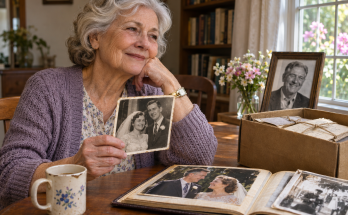
I looked toward the photograph of Robert and me on the nearby shelf.
We had been older when that photograph was taken.
Neither of us looked anything like the young people who had married.
But I loved the picture.
Robert's arm was around my shoulder.
I was laughing at something he had said.
It captured a familiar feeling.
I wondered whether Henry had experienced that kind of companionship.
Apparently, not in the way Robert and I had.
“Did he know Robert had died?”
“Yes.”
I lowered my coffee mug.
“How?”
“He occasionally kept informed about your family through publicly available notices and people who remembered you.”
I felt a mixture of discomfort and sadness.
Henry had known things about my life that I hadn't known he knew.
“Did he consider contacting me after Robert died?”
“He told me that he did.”
“Then why didn't he?”
“He didn't believe your husband's death gave him permission to enter your life again.”
I was quiet for a moment.
That was the one decision of Henry's I could genuinely appreciate without hesitation.
When Robert died, I had been devastated.
An unexpected visit from Henry would have been difficult to bear.
I had needed my children.
I had needed familiar people.
I hadn't needed an old wound reopened while grieving my husband.
“I suppose he was right about that,” I said.
Daniel agreed.
Then I asked the question I had been avoiding.
“Why did he choose the fiftieth anniversary?”
Daniel took a moment before responding.
“He said that the date had belonged to an unanswered question for too long. He wanted it to become the day you received an answer.”
I looked toward the box.
There was something strangely thoughtful about the arrangement.
And something deeply frustrating.
Henry had remembered the date.
He had carefully selected the time.
He had organized the letters.
He had done everything except sit across from me and answer my questions himself.
“Was he afraid to see me?”
“I believe so.”
“At the end of his life, after everything?”
“Yes.”
I wasn't surprised.
Fear had been present throughout every letter I had read.
It appeared that Henry had never completely escaped it.
Daniel continued.
“He spoke about your wedding more than once during his final months.”
“What did he say?”
“He said he wished he had walked you out of the church instead of leaving you there.”
I felt my eyes fill with tears.
That image was almost unbearable.
If Henry had taken my hand and asked me to leave with him, everything would have been different.
Not necessarily better.
But different.
We could have spoken privately.
We could have considered the situation together.
We might even have decided not to marry.
But I wouldn't have been abandoned without an explanation.
I wouldn't have spent months questioning my own character.
That was what Henry had taken from me.
Not simply a marriage.
The opportunity to understand my own life.
“There's another envelope at the bottom of the box,” Daniel told me.
“He asked that you read it after the other letters.”
I glanced toward the cardboard box.
“I haven't reached it.”
“There's no hurry.”
We spoke briefly about the documents.
Then I thanked him and ended the call.
I sat quietly.
Eventually, I opened another bundle.
The letters from Henry's later years were shorter.
His handwriting became increasingly unsteady.
He wrote less about what had happened and more about what he wished he had done differently.
One sentence caught my attention.
I used to tell myself that staying away was an act of kindness, but I know now that silence can be another form of selfishness.*
I read that sentence several times.
It was painful because it was true.
Henry's silence had protected him from an uncomfortable conversation.
It had never protected me from the consequences of his decision.
The next letter had been written around the time Robert died.
Henry expressed sympathy.
He didn't claim to understand the grief of losing a husband.
He didn't suggest that Robert's death created a new opportunity for us.
He simply wrote that he hoped my family would surround me with love.
I was thankful for that.
I didn't want Henry's regret to diminish Robert's place in my life.
Robert deserved better.
So did I.
I turned toward another family photograph.
All three of my children were in it.
Six grandchildren stood around us.
There were smiles, crooked collars, and one child who hadn't been looking toward the camera.
It wasn't a perfect photograph.
That was part of its charm.
The people in it represented the most important decisions of my life.
Henry's absence had influenced the road I took.
But it hadn't created the happiness I eventually found.
Robert and I had created that ourselves.
I couldn't give Henry credit for it.
Nor did I need to blame him for every difficult thing that happened afterward.
I had lived my own life.
That realization brought me a quiet sense of strength.
I spent the remainder of the morning reading.
By the time I reached the final bundle, I no longer felt the desperate need to understand every sentence.
I understood the essential truth.
Henry had loved me.
Henry had frightened himself into making a terrible choice.
Henry had lacked the courage to correct that choice when he had the opportunity.
Those things could all be true together.
Love didn't make his behavior acceptable.
Regret didn't repair the damage.
But understanding both allowed me to see him as a flawed person rather than an impossible mystery.
At the bottom of the box lay a thick envelope.
My name was written across it.
Beneath my name, Henry had added four words.
For your own peace.*
I lifted it carefully.
Then I set it beside Robert's coffee mug.
For the first time, I didn't feel afraid of what Henry might tell me.
Whatever was inside that envelope, I already knew the most important thing.
I hadn't been abandoned because I was unworthy of love.
Click here to continue reading: PART 8: Henry’s Final Letter Asked for Nothing From Me, and That Was When I Began to Understand What Forgiveness Could Mean
I Had Sewn Every Stitch of My Wedding Dress Myself, Never Imagining I Would Leave the Church Without a Husband
Part 7 of 10