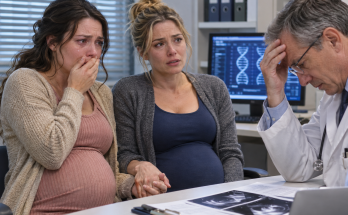
I kept waiting for the doctor to tell us what he had found.
He had already said enough to frighten me.
But not enough to help me understand.
The genetic results were still on his computer screen.
I could see them from where I sat.
Two sets of information.
One for my pregnancy.
One for Emily's.
I had no idea how to read them.
Before that morning, I had never been particularly interested in understanding every detail of a genetic test.
I had trusted the people trained to interpret those details.
Now that trust was being tested in a way I had never imagined.
I looked at the doctor.
He had told us the findings were unusual.
He had said confirmation was necessary.
And he had warned that the results might have important implications for our children's future.
Those were the facts I had.
Nothing more.
I wanted to ask him a dozen questions at once.
Were our babies healthy?
Had somebody made a mistake?
Was there something unusual about Daniel?
Had we misunderstood the medical information we were given?
But asking a question didn't mean the answer was available.
That was the hardest part.
I wanted certainty.
The doctor had told us he didn't yet have it.
Beside me, Emily was quiet.
That was unusual for us.
For twenty-five years, one of us had usually known what to say when the other became frightened.
We had helped each other through failed relationships.
We had supported each other when our plans for the future fell apart.
And we had made the decision to become mothers together because we believed our friendship would make the journey easier.
But neither of us knew how to respond to this.
There was no childhood memory that could explain a genetic test.
No familiar conversation that could make the uncertainty disappear.
We had entered the office expecting information.
Instead, we were confronting how much we didn't understand.
I remembered the months before we became pregnant.
The medical consultations.
The tests.
The conversations about choosing a donor.
I remembered how relieved I had felt when we selected Daniel.
He was thirty-five years old.
He had been described as healthy.
He had agreed to donate sperm.
At the time, those details seemed to answer the questions that mattered most.
We had wanted the same biological father for our children.
We had found someone who could make that possible.
And eventually, we had both become pregnant.
Only three weeks apart.
Everything had seemed to fall into place.
Now I was sitting in a doctor's office wondering whether I had confused a successful pregnancy with an uncomplicated future.
They were not the same thing.
I understood that now.
I looked at Emily.
She looked back at me.
I could see that she was struggling with the same uncertainty.
I wanted to tell her we had done nothing wrong.
I wanted to remind her that our plan had been carefully considered.
But I couldn't bring myself to say either thing with confidence.
We had acted with good intentions.
That was true.
We had wanted children.
We had wanted them to share a biological father.
We had wanted to raise them together.
None of that had changed.
But good intentions did not tell us what the doctor was seeing on his screen.
I had learned that lesson in other parts of my life.
My marriage had begun with good intentions too.
I had believed I was building a permanent family.
Five years earlier, that marriage had ended.
I had spent a long time accepting that wanting something to last did not guarantee it would.
Yet I had somehow forgotten that lesson when Emily and I made our plan.
I had believed in the future we imagined so strongly that I treated it as though careful preparation could make everything certain.
I felt ashamed of that assumption.
Not of wanting my baby.
Never that.
I was ashamed that I had thought my desire to be responsible meant I fully understood the responsibility.
There was a difference.
I could see it now.
The doctor had not told us the babies were sick.
He had not explained precisely what the unusual genetic similarities represented.
He had not confirmed that something was wrong.
Those distinctions mattered.
I tried to remember them.
But fear is not always reasonable.
It doesn't wait until every fact has been established.
Sometimes it begins in the silence between a question and its answer.
That was where I found myself.
I thought about how happy Emily and I had been when we discovered we were both pregnant.
I remembered our excitement over baby clothes.
I remembered discussing names.
I remembered imagining two children growing up together, knowing from the beginning that they shared the same father.
We had spent so much time thinking about what their relationship would mean emotionally.
We hadn't imagined sitting together while a genetic specialist explained that their biological similarities deserved closer attention.
I had considered those similarities a gift.
Now I didn't know what to think.
I wanted to ask whether the decision to use the same donor had been a mistake.
But I stopped myself.
The doctor hadn't established that.
There was no confirmed explanation yet.
And I didn't want to turn uncertainty into a conclusion simply because I was frightened.
I looked again at the screen.
The information seemed almost cruel in its silence.
Somewhere in those results was the reason the clinic had called us.
Somewhere in those findings was the concern that had made an experienced doctor hesitate.
But I couldn't see it.
I couldn't understand it.
And I couldn't change it.
I had never felt so helpless during a medical conversation.
I had always believed doctors were people who could explain what was happening.
That was why we went to them.
That was why we completed the consultations and tests before pregnancy.
But medical knowledge did not always mean immediate certainty.
The doctor had been clear about that much.
The results needed confirmation.
So whatever concern he had identified remained unresolved.
I tried to focus on that.
Unresolved did not mean confirmed.
Unusual did not automatically mean dangerous.
A frightening possibility was not the same as a diagnosis.
I repeated those distinctions to myself.
They helped a little.
Not enough.
I wanted to return to the morning before the clinic called.
Before the nurse's tense voice.
Before the doctor closed his office door.
Before I saw our genetic results displayed together.
I wanted to be the woman who was thinking about baby names again.
The woman who could picture Emily's child beside mine without wondering what medical significance their shared genes might carry.
But I couldn't go backward.
And perhaps that was the part of the experience that changed me most.
I had spent years wishing I could move forward into motherhood.
Now I was finally there.
And for the first time, I wished time would slow down enough for me to understand what was happening.
I placed my attention on the doctor again.
He was the only person in the room who might be able to explain the results.
But his explanation had reached a limit.
He knew the findings were unusual.
He knew they needed confirmation.
He knew the implications might matter greatly.
What those implications actually were had not yet been established.
I felt the disappointment of that uncertainty.
Then I felt guilty for being disappointed.
He wasn't refusing to help us.
He was being careful about something important.
Something involving children who had not yet been born.
I understood why he couldn't simply offer reassurance without evidence.
I also understood why he shouldn't make a frightening declaration before the findings were confirmed.
What I couldn't understand was how I was supposed to sit with the uncertainty.
I looked down for a moment.
I thought about my baby.
The child I had wanted through all the years after my divorce.
The child who had finally made me feel that my life was moving toward something I had dreamed about since I was young.
I loved that baby already.
I didn't need a name.
I didn't need to know whether the child would look like me.
I didn't even need to know what the future would bring.
I simply wanted that future to exist.
I wanted my baby to be safe.
I wanted Emily's baby to be safe too.
The two wishes felt inseparable.
They always had.
That was the whole point of our arrangement.
We wanted to experience motherhood together.
We wanted our children to grow up together.
And now we were experiencing fear together.
It wasn't the experience we had imagined.
But it was happening.
I remembered something Emily had said when we first discussed sharing a donor.
She had wanted our children to be more than friends.
She had wanted them to belong to the same family.
I had laughed before I understood how serious she was.
Then I had started imagining the same future.
I realized that I still wanted it.
Even sitting in that office.
Even while frightened.
I wanted my child.
I wanted Emily to have hers.
And I wanted both children to have the chance to grow up and decide for themselves what their relationship would become.
The thought made something painfully clear.
Our babies were not extensions of our friendship.
They were not proof that our plan had worked.
They were people whose lives would matter independently of everything Emily and I had imagined.
I had known that in theory.
Now I felt it.
The distinction was no longer abstract.
I didn't know what the tests would eventually reveal.
I didn't know whether the doctor's concerns would be confirmed.
And I didn't know whether the future we had pictured would unfold as we hoped.
But one thing had changed.
I no longer wanted reassurance simply because it would make me feel better.
I wanted an accurate answer.
Even if the answer frightened me.
Even if it forced me to reconsider assumptions I had carried into pregnancy.
I wanted to understand.
I thought about the twenty-seven years the doctor had spent working in genetics.
He had described our findings as rare in his experience.
That was serious enough to deserve attention.
But rarity alone wasn't an explanation.
I needed to remember that too.
I looked at Emily again.
For a moment, I saw the girl I had known when we were children.
The friend who had shared everything with me.
The person who knew what my silence meant.
We had always believed we could face difficult things together.
Now that belief was being tested.
Not because we were arguing.
Not because one of us had betrayed the other.
But because we were afraid of the same unknown.
And there was nothing either of us could say that would make the medical results clearer.
I had thought our greatest achievement was becoming pregnant three weeks apart.
I had celebrated the timing as though it proved the future was finally giving us what we wanted.
Now I understood that becoming pregnant had only begun our responsibility.
We still had to listen.
To ask questions.
To accept uncertainty without pretending it was knowledge.
And to place our babies' welfare ahead of the story we had once wanted to tell about them.
I looked at the two sets of results again.
I still couldn't interpret them.
The doctor still hadn't given us a confirmed explanation.
And the future remained uncertain.
But I was beginning to understand something about myself.
I had entered motherhood believing I needed to make the right decisions.
Now I realized I also needed to admit when I didn't know the answers.
It was a smaller realization than the dramatic revelation I had feared.
But it mattered.
Because the truth was that Emily and I had reached the limit of what we knew.
We had chosen Daniel.
We had become pregnant.
We had been happy.
And now a doctor with twenty-seven years of experience was telling us that our genetic results required confirmation.
I couldn't change those facts.
I couldn't turn them into a reassuring answer.
But I could stop pretending that everything was certain simply because I wanted it to be.
For the first time since the clinic called, I stopped trying to explain the results to myself.
I accepted that I didn't understand them yet.
And I knew that whatever came next, I wanted it to begin with the truth.
Click here to continue reading: PART 7: My Best Friend and I Wanted Our Babies to Share a Father, but the Genetic Results Left Us Facing Questions We Could Not Answer
I Thought Sharing a Father Would Bring Our Children Closer, Until One Doctor Made Me Question Everything We Had Planned
Part 6 of 10