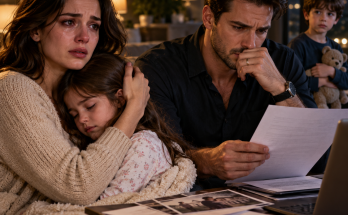
Tyler waited on the phone while snow struck the windows hard enough to sound like handfuls of gravel. I could hear Chloe speaking behind him, fast and low, and another voice—older, probably her mother—asking whether anyone had found more blankets.
“Mom?”
“I’m here.”
“Are you coming?”
I looked at Ray.
He shook his head once.
Not because he disliked Tyler. Ray had known my son since Tyler was twelve. He had taught him to drive a riding mower and had once spent an entire Saturday helping him build a treehouse.
But Ray also knew roads.
“You can’t safely make that run right now,” he said.
Tyler heard him.
“Is that Ray?”
“Yes.”
“Put him on.”
“No.”
“Mom, please.”
“Tyler, listen to me. You have walls around you. You have blankets. You have food. Stay inside and wait for emergency crews.”
“The temperature is dropping.”
“I know.”
“Chloe’s mom is seventy-two.”
That landed exactly where he intended.
I looked toward Leo. He sat on the rug beside the train set, knees tucked under the quilt.
“You told me not to come tonight,” I said quietly.
“I know.”
“You celebrated Christmas without me.”
“I know.”
“Your wife told me your family felt lighter without me.”
He said nothing.
“And now you want me to drive through a blizzard because suddenly the things I own are useful.”
“That’s not fair.”
“No?”
“Mom, people are scared.”
“So am I.”
That silenced him.
I rarely admitted fear to Tyler. Perhaps that had been one of my mistakes. I had spent his entire life making problems look solvable. Broken bicycle? I fixed it. College shortfall? I paid it. First business failure? I covered three months of rent without telling his father.
Somewhere along the way, reliability had become an obligation.
“I’m not saying I won’t help,” I told him. “I’m saying I will not risk becoming another emergency because you want an immediate rescue.”
His breathing slowed.
“All right.”
“Keep your phone charged. Shut interior doors. Put everyone in the smallest safe room you can manage. Stay away from exterior walls if branches start coming down.”
“Okay.”
“And Tyler?”
“Yes?”
“Do not go outside.”
“I won’t.”
I ended the call.
Ray was already checking the weather radar on his phone.
“It’s getting worse faster than they predicted.”
“How long?”
“Worst band passes sometime after midnight, maybe.”
“That’s hours.”
“Yeah.”
Elena came from the kitchen carrying three mugs.
“You have a generator?”
“In the detached garage.”
“Fuel?”
“Enough.”
“Then your house is safer than most.”
I looked around.
She was right.
My home sat on slightly higher ground than Tyler’s neighborhood. I kept emergency supplies because my company handled snow removal for commercial properties. I had fuel, food, tools, blankets, chains, radios, and equipment.
For years Tyler had teased me about being prepared for civilization to collapse.
Tonight, preparation felt less funny.
The lights flickered.
Leo froze.
Then everything went dark.
The train stopped beneath the tree.
A second later, Ray turned on his flashlight.
“Stay put.”
“I know where the panel is.”
“I know you do, Hazel.”
“I’ve lived here thirty-one years.”
“And I’ve known you twenty-four. You’ll walk into a wall while explaining that you know where it is.”
Elena laughed softly.
Five minutes later the generator was running.
The refrigerator hummed back to life. Lamps glowed. Leo restarted the train.
I stood at the kitchen counter and realized that strangers were helping me more naturally than my own family had in months.
My phone buzzed.
A message from Chloe.
PLEASE COME.
Then another.
MOM IS GETTING VERY COLD.
I stared at the screen.
Anger and compassion make poor roommates. Each insists on occupying the whole house.
I typed:
Keep her wrapped. Emergency crews know your location.
Chloe answered immediately.
YOU HAVE A PLOW.
I deleted the first response that came to mind.
Instead I wrote:
A plow is not magic.
No answer followed.
Ray sat opposite me.
“You’re thinking about going.”
“I’m thinking about an elderly woman who had nothing to do with what happened between Chloe and me.”
“Good. Think. Don’t drive.”
“I hate when you’re sensible.”
“I practice when you’re not around.”
Elena had moved to the window.
“Hazel.”
Something in her voice made us turn.
Headlights were moving slowly beyond the curtains.
A vehicle stopped near my driveway.
Ray stood.
“I’ll check.”
“No.”
He looked at me.
“My house.”
“Your stubbornness is exhausting.”
“So I’ve heard.”
We went together.
A utility truck sat at an angle near the road, wheels buried almost to the hubs. Two men climbed out, both wearing reflective jackets crusted with snow.
One raised his hands.
“Sorry. We saw your lights.”
“You stuck?”
“Completely.”
I looked toward my garage.
“Come inside.”
“We don’t want to impose.”
“You can impose or freeze. Choose quickly.”
That was how my Christmas gathering began.
The utility workers were named Sam and Luis. Ten minutes after they came inside, another call reached Ray’s radio about an elderly couple trapped three streets over.
I stared at the plow truck.
Ray saw where I was looking.
“No.”
“Three streets.”
“Hazel.”
“Not Tyler’s neighborhood.”
He rubbed both hands over his face.
“You’re impossible.”
“Get your coat.”
We brought the couple back twenty-five minutes later.
Their names were Frank and Dorothy. Frank carried an oxygen concentrator. Dorothy apologized six times for the snow dripping from her boots.
By nine, my house held eight people.
By ten, it held eleven.
The county emergency line had somehow learned I had heat, power, and a cleared driveway. A young father arrived carrying a six-month-old baby beneath his coat. Another neighbor walked over after a tree crushed the corner of her garage.
Nobody asked whether they had been invited.
Nobody needed to.
Elena organized the kitchen as though she had lived there for years.
Ray kept the generator fueled.
The utility workers monitored the radio.
Leo became unofficial commander of the train set, showing two younger children how to control its speed without derailing it.
I made soup.
The table I had prepared for Tyler’s family filled with strangers.
Something inside me loosened.
At 10:37, Tyler called again.
I stepped into the mudroom.
“How bad?”
“Forty-eight degrees inside.”
“Everybody together?”
“Yes.”
“Your mother-in-law?”
“Shivering.”
“Is she alert?”
“Yes, but she says her fingers hurt.”
“Keep watching her.”
“Mom.”
I leaned against the wall.
“I know.”
“Chloe is sorry.”
I almost laughed.
“Did she ask you to say that?”
“No.”
“Then why isn’t she saying it?”
He had no answer.
“Tyler, I love you.”
“I love you too.”
“But I’m not driving into that neighborhood until I know the route is passable.”
“Okay.”
His acceptance surprised me.
Then he said, “There’s something else.”
“What?”
“I thought I heard somebody outside.”
My grip tightened around the phone.
“Where?”
“Near the garage.”
“Do not investigate.”
“I already looked through the window.”
“Tyler.”
“I didn’t go out.”
“What did you see?”
“Nothing.”
“Then lock every door.”
“They’re locked.”
“Check them again.”
He hesitated.
“Mom, I know you’re angry.”
“This isn’t about that anymore.”
“I know.”
“No, listen. If you hear anything outside, you stay inside. Weather makes people do stupid things. Don’t open the door unless you know who’s there.”
“All right.”
After we disconnected, I told Ray.
He frowned.
“Could be a branch.”
“Could be.”
“You don’t believe that.”
“I don’t know what I believe.”
At eleven, the county issued a shelter-in-place warning.
Several roads near Tyler’s neighborhood were officially closed.
A tree had fallen across Cascade.
Two municipal plows were stuck near the school.
Emergency crews were prioritizing medical calls.
I stared at the map.
Tyler’s street sat inside the worst zone.
My phone buzzed.
This time it was Chloe.
A photograph.
Her mother sat wrapped in blankets, her face gray and exhausted.
Beneath it Chloe had written:
I KNOW YOU HATE ME. PLEASE DON’T PUNISH HER.
Heat rose through me so quickly I almost dropped the phone.
I typed three sentences.
Deleted them.
Typed another.
Deleted that too.
Finally I wrote:
I do not hate you. And I would never punish your mother for something you did.
The reply came slowly.
I’M SORRY.
I did not know whether she meant tonight or everything.
Before I could ask, another message arrived.
PLEASE HELP US.
I walked into the living room.
Eleven people had found warmth in my house.
A baby slept against his father’s chest.
Dorothy sat beside the fire holding Frank’s hand.
Leo lay on his stomach beneath the Christmas tree, watching the train.
I had spent years believing Christmas meant keeping my own family together.
Tonight, my family had shut me out, and somehow my house had become useful to everyone else.
Ray approached.
“Don’t.”
“I haven’t said anything.”
“Your face did.”
“I can clear part of the route.”
“No.”
“I know those roads.”
“You know roads. You don’t control weather.”
Elena stood nearby.
“He’s right.”
I looked at her.
“That makes two annoying people in my house.”
“Three,” Leo called from the rug.
For the second time that evening, laughter broke through the room.
Then the emergency radio crackled.
Sam reached it first.
A dispatcher’s voice reported a transformer failure and multiple heating emergencies.
One address was on Tyler’s street.
I moved closer.
Sam adjusted the volume.
The report repeated.
I recognized the house number.
Tyler’s neighbor.
Then came another transmission.
Gas service irregularities had been reported in the area.
Luis frowned.
“That’s odd.”
“What?”
He glanced at me.
“Gas shouldn’t go out because electrical service fails.”
My stomach tightened.
“Could lines be damaged?”
“Sure. But not usually one house at a time.”
My phone rang.
Tyler.
I answered immediately.
“Mom.”
“What happened?”
His voice shook.
“The heat isn’t just off.”
“What do you mean?”
“I checked the furnace.”
“I told you not to—”
“I stayed inside. The gas isn’t flowing.”
I looked at Luis.
He had heard enough to understand.
“Exterior shutoff?” he asked.
I repeated the question.
Tyler said, “I don’t know.”
Luis took the phone.
“Do not touch anything. Do not attempt to relight the furnace. If you smell gas, everybody leaves immediately. Understand?”
Tyler answered.
Luis handed the phone back.
“Mom,” Tyler said, “something’s wrong.”
Outside, wind struck the house hard enough to shake snow from the eaves.
“What makes you say that?”
“Because I checked the security app.”
My skin prickled.
“And?”
“The side camera went offline.”
“When?”
“About an hour before the heat stopped.”
Ray and I exchanged a look.
“Tyler, stay away from the garage.”
“Mom—”
“Promise me.”
“I promise.”
“Keep everyone together.”
“Okay.”
I was about to hang up when he spoke again.
“Mom?”
“Yes?”
“I’m sorry I told you not to come.”
I closed my eyes.
There are apologies you wait years to hear.
Sometimes they arrive at exactly the wrong moment.
“We’ll talk about that later.”
“If there is a later.”
“Don’t say that.”
The line went silent.
Then Tyler whispered, “I think somebody was outside our house before the storm got bad.”
A chill moved through me that had nothing to do with winter.
And suddenly the question was no longer whether my son deserved my help.
It was whether someone had deliberately made sure he would need it.
Click here to continue reading: PART 3: I Opened My Home to Strangers While My Son’s House Froze, Then the County Found Something the Blizzard Couldn’t Explain
I Was Carrying Christmas Dinner to My Son When One Phone Call Told Me I Was No Longer Invited
Part 2 of 35