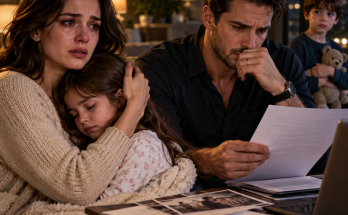
The envelope was opened at a federal office the next morning.
I was not present.
That irritated me.
It also reassured me.
The case had moved beyond any role I could legitimately claim.
I sat at my dining table with Chloe while rain slid down the windows.
She was wearing one of my old sweaters and had finally eaten half a piece of toast.
At 8:05, Daniel called.
“They authenticated the paper as old.”
“How old?”
“Consistent with eleven years.”
“The handwriting?”
“Preliminary match to Adrian.”
“What did he write?”
Daniel paused.
“I’m sending a redacted image you’re permitted to see.”
My phone chimed.
The letter was short.
Eleanor,
You do not know me well, but I know your work on Hale. If you are reading this, assume the financial case is larger than it appears. Victor is not the architect. He is the broker.
There are people behind him who survive because everyone stops at Victor.
Samuel has copies.
If Samuel is gone too, find Meridian’s original ledger.
Do not trust any digital version unless it matches the paper.
A.C.
I read it twice.
Then a third time.
Chloe watched me.
“What does it mean?”
“That Victor may not have been at the top.”
“Who was?”
“I don’t know.”
“Samuel?”
“No. Adrian says Samuel had copies. That sounds like Samuel was helping him.”
“Then why did Samuel run?”
Good question.
“Maybe he did not.”
She understood.
“You think he might not be dead.”
“I think I distrust paperwork produced overseas by people connected to fraud.”
Daniel stayed on the call.
“There’s more.”
“The recorder.”
“Yes.”
“Audio usable?”
“Mostly.”
“Who speaks?”
“Adrian.”
“Alone?”
“For the first recording.”
“And the others?”
A long pause.
“Samuel.”
Chloe leaned toward the phone.
“My grandfather?”
“Yes.”
She had never met him.
Marcus had grown up describing Samuel as a distant memory. A father who traveled. A father who died before Chloe entered the family.
“What does he say?” I asked.
Daniel’s voice lowered.
“Enough that federal investigators are reopening the disappearance.”
“Tell me what you can.”
“The first tape is Adrian documenting concerns.”
“About Victor?”
“Victor and others.”
“Names?”
“Some are redacted pending verification.”
“Samuel?”
“Yes.”
“As suspect or source?”
“Source.”
That mattered.
“The second tape?”
“A conversation between Adrian and Samuel.”
“Recorded knowingly?”
“Appears so.”
“What do they discuss?”
“Money moving through Meridian.”
“Victor?”
“Yes.”
“What else?”
“A person identified only as R.”
I frowned.
“R?”
“Yes.”
“Male?”
“They refer to ‘he.’”
“Role?”
“According to Adrian, R selected which companies would receive money. Victor handled access. Samuel handled books. Adrian reconstructed transactions.”
“So Samuel was involved.”
“Yes.”
“Criminally?”
“At first, probably.”
“At first?”
“Samuel tells Adrian he wants out.”
Chloe closed her eyes.
“What happened?”
“Adrian says leaving isn’t enough because they know too much.”
“Who is ‘they’?”
“Unclear.”
“What does Samuel say?”
Daniel hesitated.
“He says if anything happens to him, Sylvia knows where the paper ledger is.”
Every suspicion in the room shifted.
Sylvia.
Not merely Marcus’s domineering mother.
Not merely the woman who cleaned blood from a living room.
The keeper of something Adrian had considered more reliable than any digital evidence.
“Did she know about Samuel’s work?” I asked.
“Apparently.”
“Did Marcus?”
“Unknown.”
Chloe stared at her hands.
“Maybe that’s why she searched Adrian.”
“Maybe.”
“Maybe that’s why she left the case number.”
“Maybe.”
“Then why clean the house?”
“People can protect one secret while committing another crime.”
She looked at me.
“You think Sylvia was trying to help us?”
“I think Sylvia was trying to control something.”
Those are not the same.
At 9:12, Ramos called.
Sylvia had requested another interview.
Her attorney was present.
“She wants to talk about Samuel,” Ramos said.
“What changed?”
“The locker.”
Of course.
“Does she admit the key came from her?”
“Yes.”
“Envelope?”
“Yes.”
“Why anonymously?”
“She says she was afraid.”
“Of Victor?”
“No.”
“Marcus?”
“No.”
“Then who?”
“She won’t say until federal prosecutors discuss protection.”
That was rational.
It was also manipulative.
“What does she claim happened to Samuel?”
“She says he is dead.”
“Actually dead?”
“Yes.”
“Then why the suspicious paperwork?”
“She says Victor arranged the identification and cremation.”
“Why?”
“Because Samuel had agreed to testify.”
I closed my eyes.
Of course.
“Body?”
“She says there was one.”
“Did she see it?”
“No.”
“Then she does not know.”
“Correct.”
“Does she know where the ledger is?”
“She says she did.”
“Past tense?”
“Yes.”
My attention sharpened.
“What happened to it?”
“Marcus took it.”
Chloe stood so quickly the chair scraped the floor.
“When?”
I put the call on speaker.
Ramos continued.
“According to Sylvia, six months ago.”
That matched when Sylvia moved into Marcus and Chloe’s house.
“Why did she move in?” I asked.
“She says because Marcus discovered Samuel’s old records at her condominium.”
Chloe’s face tightened.
“He told me she sold because maintenance was too expensive.”
“She did sell,” Ramos said. “But Sylvia says Marcus pressured her.”
“What records did he find?”
“A paper ledger and several old recordings.”
“The same recordings from the locker?”
“Some.”
“Why wasn’t the ledger in the locker?”
“Marcus took it before she could move it.”
“What did he do with it?”
“She doesn’t know.”
“Then how did the rest reach the bus terminal?”
“Sylvia rented the locker years ago under a false name.”
I looked at Chloe.
A hidden archive sitting less than thirty feet from where Marcus later abandoned her.
“Did Marcus know about the locker?”
“Sylvia says no.”
“Does she explain why Marcus chose that terminal?”
“No.”
Coincidence remained possible.
I disliked coincidence.
“Why leave the key at my house now?”
“She heard Marcus tell Chloe he had called you.”
“Before Chloe left?”
“Yes.”
“Then she searched my name.”
“Yes.”
“She found my old connection to Victor.”
“Yes.”
“She put Adrian’s case number on my porch before I arrived at the terminal.”
“Yes.”
“Then why not simply tell me?”
“She says she thought Marcus might be watching.”
“Was he?”
“Unknown.”
I remembered his car idling while Chloe sat on the bench.
Maybe he was simply humiliating her.
Maybe he was waiting to see who arrived.
“What happened to the ledger?” Chloe asked.
Ramos answered.
“Sylvia believes Marcus gave it to Victor.”
“When?”
“Possibly within the last month.”
That coincided with Victor’s visit.
And the argument near Chloe’s car.
“Did Sylvia know about the brake damage?”
“She denies it.”
“Insurance policy?”
“She admits knowing a policy existed.”
Chloe’s face changed.
“Did she know it was secret?”
“Yes.”
I heard her breathing accelerate.
“What did she say?”
Ramos waited.
“She says she confronted Marcus.”
“When?”
“August.”
“The month my brakes failed.”
“Yes.”
“Did she know what he was planning?”
“She says no.”
“Do you believe her?”
“That is not a useful question yet.”
Good answer.
At 10:46, federal agents arrived at my house.
Special Agent Lena Ortiz introduced herself.
Mid-forties, direct gaze, no wasted words.
I liked her immediately, which is dangerous.
“We need to discuss your old Hale case.”
“Fine.”
“Specifically a witness.”
“Which one?”
“Robert Vane.”
The name struck somewhere deep in memory.
Then surfaced.
Robert Vane had been an executive at a regional bank that processed transactions linked to Victor.
He had cooperated briefly.
Then recanted.
“R,” I said.
Ortiz did not confirm it.
She did not need to.
“Where is Vane now?” I asked.
“Dead.”
“When?”
“Five years ago.”
“Cause?”
“Cancer.”
“Actually?”
“Yes.”
That was almost refreshing.
“What is the connection?”
“Adrian’s tapes suggest Vane was more involved than your team knew.”
“How involved?”
“Possibly the person who designed the financing system.”
“Then Victor truly was the broker.”
“Looks that way.”
“Who inherited Vane’s interests?”
Ortiz’s expression changed slightly.
“His daughter.”
“Name?”
“Claire.”
Chloe looked up.
“Claire Hale?”
Ortiz corrected her.
“Claire Vane Hale.”
Victor’s daughter by marriage.
Robert Vane’s biological daughter.
The family relationships rearranged themselves.
Claire was not simply Victor’s child.
She was the daughter of the man Adrian may have identified as the true architect.
“What happened to Claire’s mother?”
Ortiz answered.
“Died when Claire was young. Victor married into the family later.”
“So Victor became Robert Vane’s son-in-law.”
“Yes.”
“Then eventually married Vane’s daughter after her first marriage?”
“No.”
Ortiz paused.
“Victor married Claire’s mother when Claire was nine.”
I recalculated.
“Then Vane was not Claire’s father?”
“Her grandfather.”
I felt the correction settle.
Robert Vane had built the structure.
Victor entered the family.
Claire grew up inside it.
The scheme was not simply corporate crime.
It was generational.
“What does Claire say?”
“Very little.”
“About Vane?”
“Nothing useful.”
“About Marcus?”
“She says Marcus was reckless.”
“Victor?”
“She refuses to characterize him.”
“Samuel Dalton?”
That got a reaction.
Small.
But real.
Ortiz saw it too.
“She asked for counsel before answering.”
Chloe whispered, “She knows.”
“Possibly.”
At noon, lab analysis returned on the brake line.
It had come from Chloe’s vehicle.
That was confirmed through tool marks and fitting characteristics.
Then came the fingerprint analysis.
Chloe’s print was genuine.
But there was something else.
A smear beneath it contained traces of cosmetic moisturizer.
Chloe did not use that brand.
Sylvia did.
“Could Sylvia have transferred the print?” I asked.
Ortiz answered.
“Possible.”
“How?”
“Lifted from a smooth surface using adhesive or transfer material.”
“Technical?”
“Not especially.”
“Did Sylvia know enough?”
“She worked in a salon for twenty years.”
A person who spent decades handling skin, oils, adhesives and cosmetic materials might know more about impressions than most.
Chloe looked sick.
“Why would Sylvia frame me?”
Ortiz did not answer.
I did.
“To make it look like you planted evidence.”
“But she gave you the locker.”
“Yes.”
“Those things contradict each other.”
“People contradict themselves when they are serving more than one purpose.”
At 1:31, Ramos called from the station.
Sylvia’s attorney had stopped the interview.
“Why?”
“Because we confronted her with the moisturizer trace.”
“She denied transfer?”
“She denied touching the inside of the box.”
“That seems unwise.”
“Yes.”
“What else?”
“She asked whether Marcus had talked.”
“About what?”
“She would not say.”
At 2:08, Marcus did talk.
Not to investigators.
To his lawyer.
But his lawyer approached prosecutors afterward with an offer.
Marcus would identify where the original Meridian ledger was.
In exchange, he wanted protection from Victor Hale.
I almost admired the timing.
Almost.
“Where is it?” Chloe asked.
Ortiz looked at her.
“We do not know yet.”
“Why not?”
“He wants an agreement first.”
“Will he get one?”
“Depends on what he can prove.”
“What if he damaged my brakes?”
“Then cooperation does not erase that.”
Chloe looked relieved.
That mattered more than she probably realized.
At 4:20, an agreement was reached allowing Marcus to proffer information without immediate promises about final charging.
He gave them a location.
Not a bank.
Not a warehouse.
Not another locker.
A cemetery.
Samuel Dalton’s name was carved into a family headstone in a small private cemetery outside the city.
Marcus claimed the ledger was hidden beneath the base.
“How would he know?” I asked Ortiz.
“He says Sylvia told him.”
“Then why did Sylvia claim Marcus took it six months ago?”
“She may have lied.”
“Or Marcus is lying.”
“Yes.”
A search team went anyway.
At 6:57, they found a weatherproof tube beneath loose stonework behind the marker.
Inside were copies of Meridian’s original ledger pages.
Not originals.
Copies.
Adrian’s warning returned to me.
Do not trust any digital version unless it matches the paper.
But these were paper copies.
That did not make them authentic.
Then investigators found something else in the tube.
A modern flash drive.
Manufactured only two years earlier.
Someone had reopened Samuel’s grave marker recently.
Someone had inserted newer evidence into an older hiding place.
At 8:11, Ortiz called.
“The ledger copies match portions of Phoenix.”
“That proves little if Phoenix came from the copies.”
“Yes.”
“What’s on the flash drive?”
“One video.”
“Of what?”
She hesitated.
“Samuel Dalton.”
Chloe stood.
“Alive?”
“In the recording.”
“When was it made?”
“Timestamp says fourteen months ago.”
I felt the room change.
Samuel was supposed to have died eight years ago.
“Can the timestamp be altered?”
“Yes.”
“Can the video be authenticated?”
“They’re working on it.”
“What does he say?”
Ortiz’s voice became very controlled.
“He identifies himself.”
“Then?”
“He says Victor Hale knows he is alive.”
Chloe covered her mouth.
“And Marcus?”
“He says Marcus does not.”
I looked at my daughter.
Her husband had built his identity around a dead father who may have been alive.
“What else?”
Ortiz paused.
“Samuel says if the recording is being watched, it means somebody has found the wrong ledger.”
I gripped the phone.
“What does he mean?”
“He says the real one is still hidden.”
“Where?”
“He doesn’t say.”
Of course.
“What does he say instead?”
Ortiz read from her notes.
“He says: ‘Ask Sylvia what she did with the red book.’”
Click here to continue reading: PART 8: Sylvia Finally Told Us What the Red Book Contained, but Marcus’s Reaction Exposed a Betrayal Even Victor Had Not Expected
Before Dawn on Thanksgiving, My Son-in-Law Called and Told Me Where He Had Left My Daughter
Part 7 of 29